
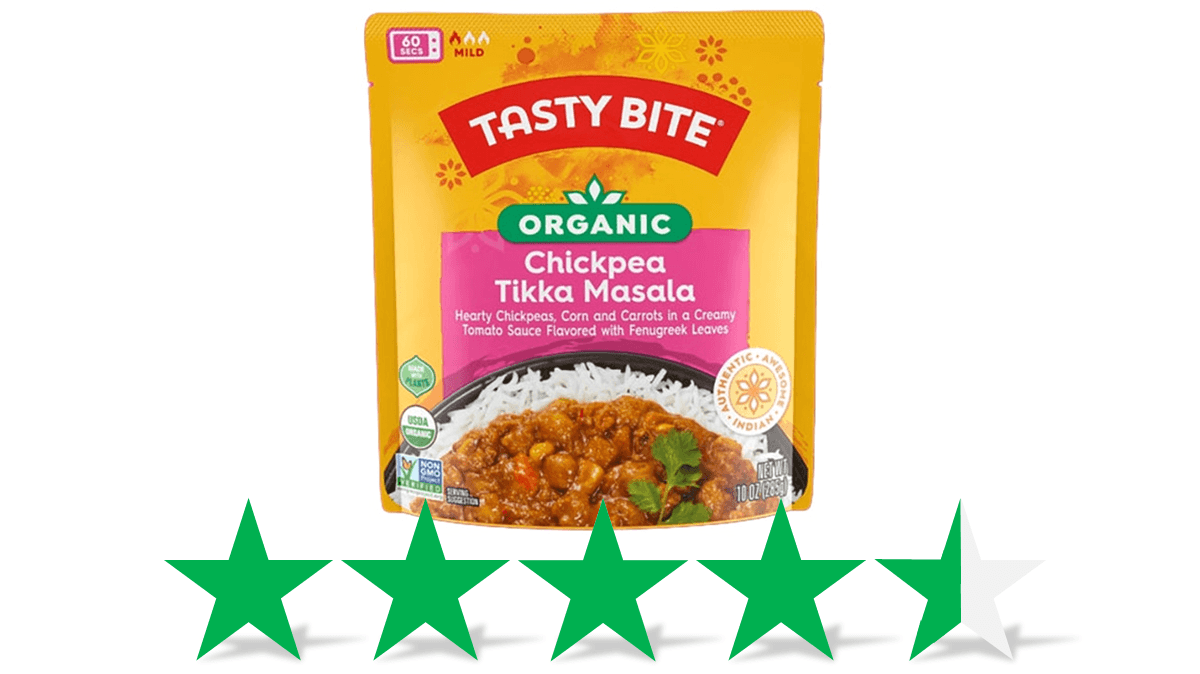
I picked up some shelf-stable Indian meals, including Tasty Bite, at the Grocery Outlet (around $2 each) to review here. These reviews are complementary to a GSP article that looks at shelf-stable Indian meals from various angles including packaging (aseptic pouches) and sustainability. A reason for the focus on these products is that they are mostly based on legumes such as split peas, which are 50-100 times better than beef across five major environmental metrics.
Tasty Bite was an overall favorite among the four brands of vegan Indian meal that I tried. Hocco made a bigger impression in terms of flavor but that love affair ended when I found issues with the ingredient list.
I believe I’ve tried Tasty Bite meals before and I heard that the company may also make Trader Joe’s Indian Fare meals, which were quite good too. The product I’ll focus on here is Tasty Bite’s organic Chickpea Tikka Masala.

Review: Tasty Bite Chickpea Tikka Masala
I picked up a pouch of Tasty Bite’s Chickpea Tikka Masala at the Grocery Outlet ($1.99) and, long story short, I liked it enough to buy a box of 6 on the next trip. It’s a little on the mild side for my taste but that’s quite easily fixed: after cooking, I top it with some freshly chopped raw jalapeno. With this heat-level adjustment it’s enjoyable and also satisfying as a meal, served with naan or rice. It’s full of spice, pleasantly creamy, very savory, and a little tangy.
Don’t get me wrong – it’s not as good as a homemade Indian meal. There’s also a lot of pleasure to be gained from cooking a curry from scratch at home. But for a work lunch, camping trip, or quick dinner, ready-to-eat Indian meals are a good standby. In this case, I appreciate that the ingredient list is similar to what I’d use to cook at home. Also, it’s organic, nutritionally balanced, and certified vegan.
Tasty Bite: ingredients and nutrition facts
Ingredients: Water, Chickpeas*, Coconut Milk*, Carrot*, Tomato Paste*, Sweet Corn*, Dried Onion*, Sunflower Oil*, Chickpea Flour*, Coriander Powder*, Salt, Dried Garlic*, Jaggery* (Brown Cane Sugar), Spices*, Cumin*, Chilli Pepper*, Dried Ginger*, Cardamom Powder*, Dried Fenugreek Leaves*, Natural Coriander Flavor*, Dried Bell Pepper*, Turmeric Extract*. *Certified organic ingredient.
As you can see from the ingredients above and the nutrition facts below, it’s fairly nutritious food made from ingredients that you’d want to see in a chickpea tikka masala. There are two servings per pouch but we all know how that goes. I will say, though, that I tried sticking to the recommended serving (half a pouch), with lots of brown rice on the side, and it actually felt like enough.

A serving of half a pouch contains 6 g protein, 6 g fat (3 g saturated fat), and 4 g fiber while providing 15% of our recommended iron intake. Actually it provides 30% of my recommended iron intake as I don’t have a monthly period. Women need about twice as much iron as men – something to look out for when adopting plant-based diets. I let this slip and then realized I was iron-deficient. That’s why I’m getting back to a diet rich in real legumes rather than relying too much on meat substitutes made from isolated protein. It was all in the name of research!
Tasty Bite – brand ownership
Tasty Bite was founded in Mumbai with the goal of selling shelf-stable foods across India but it struggled to take off. Ashok Vasudevan, a native of Bangalore who had moved to Connecticut, bought the company in the mid-90’s and targeted the North American market. Tasty Bite was widely adopted across the US, featured in Time magazine in 2008, and then sold to Mars Inc., in 2017.
Vasudevan used his Mars payout to start a new organization, the Center for the Spread of Affordable Wellness (C-SAW), which looks pretty interesting. It includes an incubator and accelerator for start-ups in the sustainable food space, including Hu Chocolate and Jackson’s Honest chips.
Tasty Bite meals continue to be made at the same facility in India (in Bhandgaon, a village 200 km SE of Mumbai) which also contains a research center and an organic farm where some of Tasty Bite’s ingredients are grown. The research center focuses on sustainability and farmer training.
Not that you’ll find any of this information on the Tasty Bite or Mars Inc., websites. It seems to be the norm, these days, for multinational giants to erase almost all personality and concrete information from websites of brands they acquire. That’s a shame as many of us prefer the idea of supporting sustainable development and the local economy in the Global South over the idea of supporting another Global North mega-corp.
Too often, we have to deal with a brand we like being acquired by a multinational with a mediocre reputation. See, for example my recent review of Pacific Foods and profile of parent company, Campbell’s. In these situations, keep an eye on whether third-party certifications are maintained.
Ethical rating for Tasty Bite meals
Here’s a summary of how I feel about the social and environmental impact of Tasty Bite Indian meals, which I’m scoring 4.5 out of 5 Green Stars.
- It’s a vegan product, as are most Tasty Bite meals (except for a few with paneer).
- Most Tasty Bite meals center on legumes such as chickpeas, lentils, and split peas. As per Poore and Nemecek (2018), the environmental footprints of legumes are 50 to 100 times smaller than those of beef.
- Tasty Bite is the only brand of the four I tried that’s made with organic ingredients.
- Tasty Bite is owned by Mars, Inc. Not the worst of the food giants, but still mediocre.
- I’ll discuss the packaging in my overview of shelf-stable Indian meals on the GSP. The downside of its disposability is offset by the upsides of reducing food waste (extended shelf-life products have been shown to reduce food waste) and not requiring refrigeration (most refrigerants are potent greenhouse gases).
- A key facet of ethical consumption is supporting economies in the Global South. India has a lot of expertise in food and I’m happy to support industries born from that. It’s a shame that Tasty Bite is owned by Mars, Inc. but it does still support the local economy and sustainable agriculture in India.
- Shelf-stable Indian meals have filled a niche for low-budget, convenient food that’s also planet-friendly. In a way, they are the antithesis to fast food burgers – meals produced from plants in the Global South.

Summary scores (out of 5) for Tasty Bite Indian meals:
- 4 gold stars for quality and value
- 4.5 Green Stars for social and environmental impact (for the vegan products)
Join the Green Stars Project!
Join the movement to hold corporations accountable (and recognize those with more positive impacts) by including a Green Stars rating when you review a product or business. Also, check out my sister site, The Green Stars Project, for a wider discussion on ethical consumption and social/environmental issues.
Here are a few GSP articles relevant to this post:


Leave a Reply