
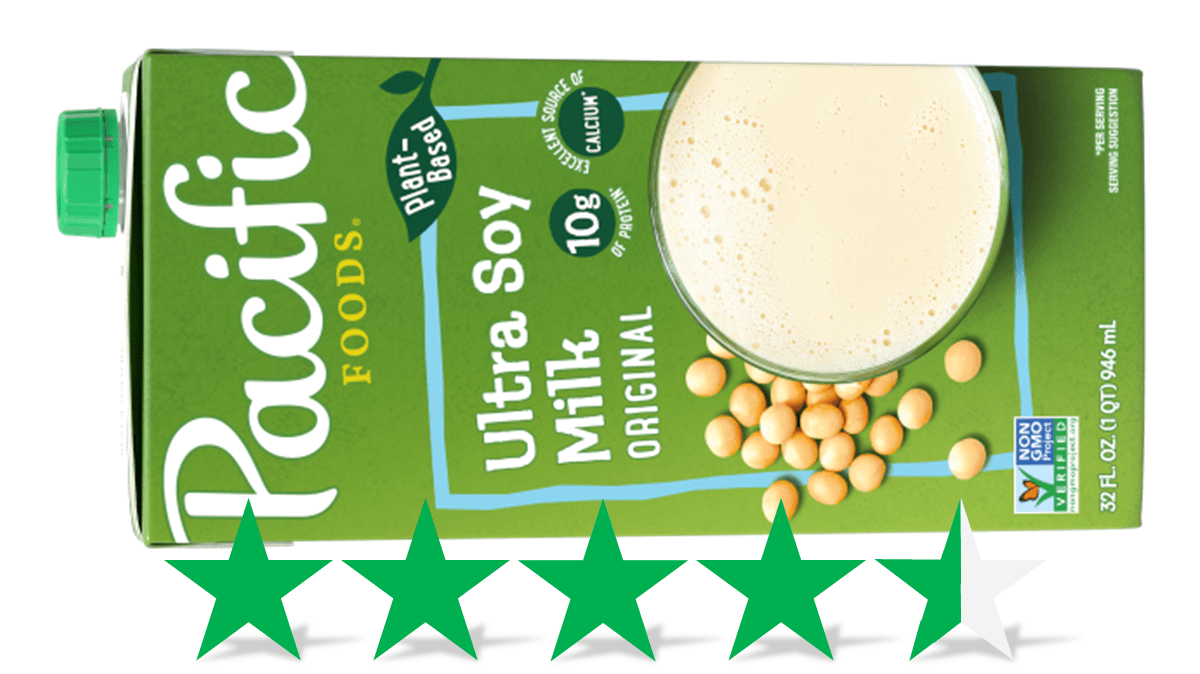
What’s your ideal kind of plant-based milk? I usually lean towards products made from legumes: soy milk, which has improved a lot over early awful products, and also milk made from bambara nuts or peas. I like oat milk too and had moderate success making it at home, but not so great that I stopped buying plant milks in stores. Maybe I’ll improve…
Pacific soy milk meets most of my ideals in a plant-based milk. It’s made from organic soybeans, is high in protein (10 g per serving), and is supplemented with vitamins (A, B2, B6, B12, D, and E). Supplementing milks (and cereals) with vitamins has played a fairly big role in helping people avoid nutritional deficiencies. Milks made from legumes such as soy are also natural sources of iron, an important nutrient that vegetarians and vegans can run low on. Regular dairy milk is also supplemented with vitamins (vitamin D and often vitamin A) but lacks iron.

Pacific soy milk is sweetened a little but it is actually lower in sugar than dairy milk and it doesn’t taste too sweet to me. I’ll discuss this more in the next section on nutrition. The milk works well in coffee and cereal – it’s creamy, has a fairly neutral taste, and doesn’t separate out when added to hot drinks. It doesn’t mess up the flavor of my coffee as did the older, lame versions of soy milk. The horror!
There are a couple of aspects to this product that I want to cover in more detail:
- The packaging – an aseptic Tetra Pak carton
- The parent company – Pacific Foods is owned by Campbell’s (the soup people)
However, each of these topics requires about a thousand words, so I’m going to cover them over the next two posts 😉
Pacific organic soy milk: ingredients and nutrition facts
You may notice that the product is not labeled organic but the main ingredient (soybeans) is organic, which is what matters the most. The second ingredient, cane sugar, is not organic and hence the final product can’t be labeled organic.
Pacific soy milk ingredients: Water, Organic Soybeans, Cane Sugar, Contains 1% Or Less Of: Gellan Gum, Locust Bean Gum, Natural Flavor, Riboflavin (B2), Sea Salt, Tricalcium Phosphate, Vitamin A Palmitate, Vitamin B6 (Pyridoxine Hydrochloride), Vitamin B12 (Cyanocobalamin), Vitamin D2, Vitamin E (D-Alpha Tocopheryl Acetate).
I was surprised to see sugar in the ingredient list as the product isn’t labeled as sweetened on the front of the carton. As you can see from the Nutrition Facts panel, below, it contains 7 grams of added sugar per 1 cup serving. Regular dairy milk contains 12 grams of sugar (lactose) per cup so 7 grams seems reasonable in that light. The sugar is balanced with a little fiber, along with the other nutrients (dairy milk, like all animal products, contains no fiber).
The added sugar doesn’t make a huge difference to me – I’m mainly using it in coffee, which I sweeten anyway. If you would prefer your soy milk unsweetened, I recommend Silk organic soy milk. According to Go Dairy Free, Pacific Soy used to make seven varieties of soy milk but had whittled them down to just two (Ultra Soy and Barista) by 2025.
For me, the 10 grams of protein, moderate fat, added B12, and the natural abundance of minerals (Ca, Fe, K, P, Mg) and beneficial phytochemicals in soy make this product worth buying.

FAQs on Soy Milk
I feel that soy is always plagued by concerns, and that this is not accidental. Because I’ve covered some of these before, I’ll just provide a very brief FAQ section with some references for further reading. I’m trying to avoid getting into a long rant here – misinformation is so infuriating 😉
Does soy milk cause Amazon deforestation?
I’ll answer that with a quote from my book-in-progress, Climactic – it’s about tofu but also applies to soy milk. You can also check out this GSP post on soybeans and tofu for more background.
“One of the genuine concerns about tofu is that soy farming can result in deforestation, for example in Brazil. Some articles reporting on this issue neglected to put the situation in perspective. First, cattle ranching has been responsible for most of the deforestation in the Amazon, with soy contributing only 1.5%.1 Second, 70-90% of the soy grown worldwide is used to feed animals raised for food, and only around 2.5% is used to make tofu.2 Third, the Soy Moratorium, introduced in 2006 following a Greenpeace report on the impact of soy commodity trading on the Amazon rainforest, has been very successful in curbing deforestation for soy.3 Fourth, compared to tracing the origin of animal feed used for meat production, it’s relatively easy to source tofu that’s deforestation-free.4 – Climactic.
- https://www.reuters.com/article/us-brazil-soy-amazon/brazil-curbs-soy-farming-deforestation-in-amazon-idUSKBN1EZ2BM. Accessed May 9, 2023.
- 10 Years Ago the Amazon Was Being Bulldozed for Soy — Then Everything Changed. Greenpeace. https://www.greenpeace.org/usa/victories/amazon-rainforest-deforestation-soy-moratorium-success/. Accessed May 9, 2023. For more detail on the breakdown soybean markets see Soy, Our World in Data, https://ourworldindata.org/soy. Accessed May 9, 2023.
- Brazil’s Amazon Soy Moratorium reduced deforestation (2020).
- See this post for more on the social and environmental impact of tofu: Daily Footprint, #34 – Tofu, The Green Stars Project, June 13, 2019. https://greenstarsproject.org/2019/06/13/sustainable-tofu-brands-soy-deforestation-ethics/. Accessed May 9, 2023. You may also find this guide to organic soy products helpful: Organic Soy Food Scorecard, The Cornucopia Institute, June 28, 2022. https://www.cornucopia.org/scorecard/soy/. Accessed May 9, 2023.
Bottom line: beef is the main driver of Amazon deforestation, by far.
Is soy milk linked to cancer?
Originally, concerns were raised that the isoflavones in soy could be problematic because they resemble estrogens. As it turns out, the isoflavones in soy are actually strongly protective against cancer. See this advice from the American Cancer Society or this 2024 meta-review, which I’ll quote here:
“High consumption of total soy products (Relative risk: 0.69), tofu (Relative risk: 0.78), and soymilk (Relative risk: 0.75) were associated with reduced total cancer risk.
“A 23 g per day increment of soymilk reduced cancer risk by 28%
“Isoflavones are structurally and functionally similar to estrogen, and depending on the concentration of estrogen at each site, isoflavones can bind to become estrogen receptor agonists or antagonists, preventing cancer through estrogen-dependent mechanisms in the estrogen signaling pathway
Is soy milk nutritious?
See the Nutrition Facts for Pacific soymilk, above. Besides being a good source of vitamins and minerals, soy milk provides some unique phytochemicals (such as isoflavones) that have nutritional benefits such as protection from cancer. For vegetarians and vegan, soy milk is a useful natural source of iron.
Ethical rating for Pacific organic soy milk
Here’s a summary of how I feel about the social and environmental impact of Pacific organic soy milk, which I’m scoring 4.5/5 Green Stars.
- It’s made from one of the most sustainable protein sources – a legume.
- It’s an organic product, supporting a form of agriculture that’s overall better for the planet and society.
- The packaging is an aseptic carton from Tetra Pak which I’ll cover in a separate post soon. I can see the benefits of shelf-stable containers – they don’t require refrigeration (refrigerants are strong GHGs) and with distant expiration dates they help reduce food waste. A definite downside is the plastic (25%) and aluminium (5%) content – it’s very complicated to recycle and therefore only done in a few places. Tetra Pak is working on renewable (paper-based) alternatives to these layers – that would address Tetra Pak’s biggest downside. Of course, it would be nice to see returnable glass bottles but that would only work for refrigerated products.
- I’m also going to cover Pacific’s parent company, Campbell’s, in a separate (drama-filled!) post soon. Campbell’s is mediocre, ethically, but my position is to support ethical brands owned by mediocre parents (for reasons explained in that post).
- Campbell’s is downsizing some operations and has sadly decided to close the Pacific Foods plant. Production of Pacific’s plant-based milk will be now be done by contract manufacturers. If you regularly buy this product then keep an eye out for any changes to product ingredients and ethics.
- I don’t see any reporting from Pacific Foods or Campbell’s on the country of origin of their soybeans.
- Pacific Foods uses Regenerative Organic Certified tomatoes and fair trade certified cashews in other products.

Summary scores (out of 5) for Pacific organic soy milk:
- 4 gold stars for quality and value (I’d prefer no added sugar)
- 4.5 green stars for social and environmental impact
Join the Green Stars Project!
Join the movement to hold corporations accountable (and recognize those with more positive impacts) by including a Green Stars rating when you review a product or business. Also, check out my sister site, The Green Stars Project, for a wider discussion on ethical consumption and social/environmental issues.
Here are a few GSP articles relevant to this post:
Leave a Reply