
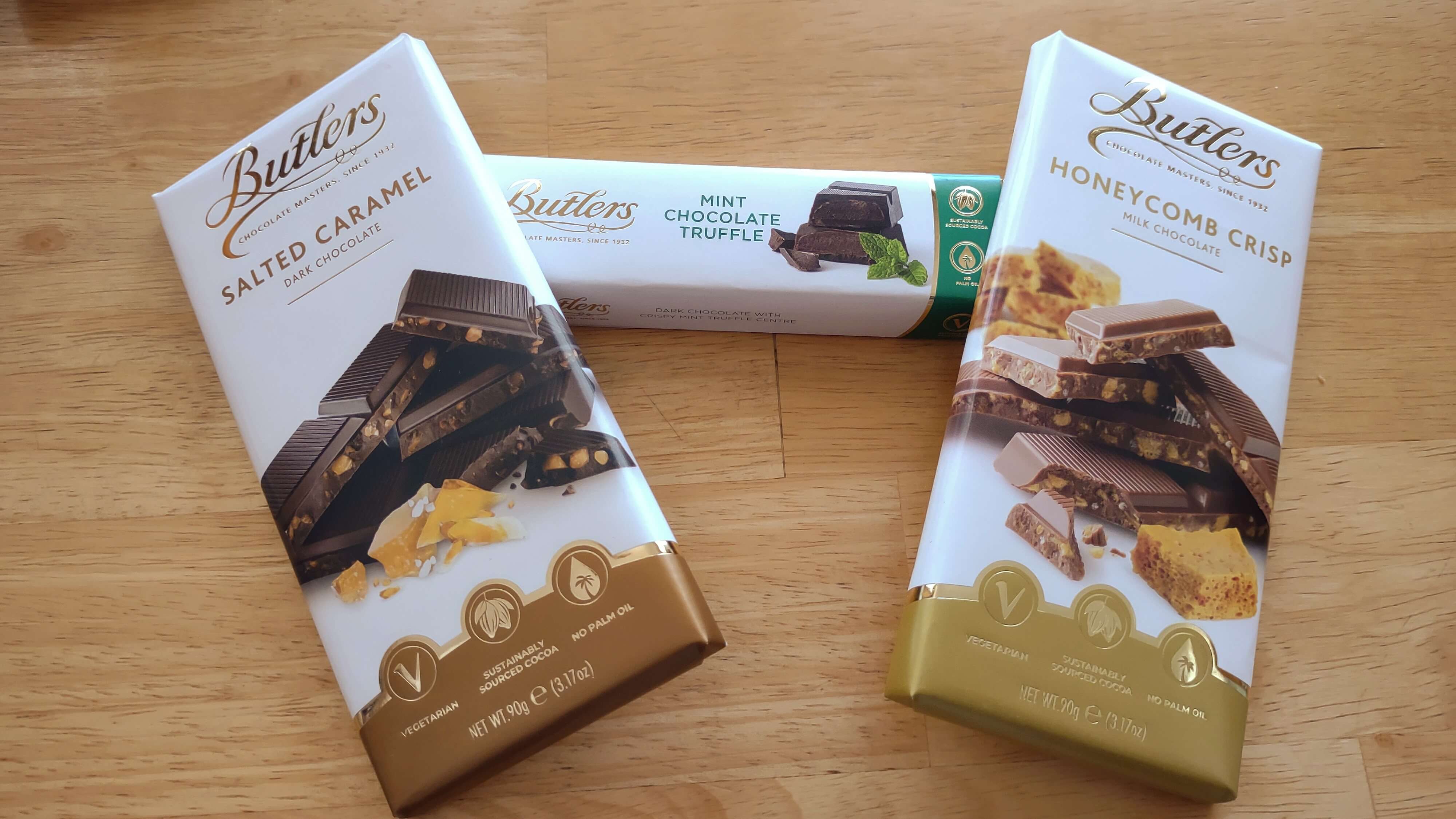
Hello dear readers! I have to say, I was quite excited this week to spot that the Grocery Outlet is stocking some chocolate bars from Butlers Irish Chocolate. So excited that I picked up three of the four varieties that were available at my local Grocery Outlet store and scurried home:
- Dark Salted Caramel ($1.99 for a 90 gram bar – or 3.2 oz. if you prefer!)
- Honeycomb Crisp ($1.99 for a 90 gram, 3.2 oz. bar)
- Dark Mint Truffle ($0.99 for a 75 gram, 2.6 oz. bar)
There was a fourth kind – white chocolate mixed berry – that I didn’t try, but it was also $1.99 for a 90 gram bar. The larger 90 gram bars normally retail for around $4.50 (or €4.50 in Europe) and the chunky Dark Mint Truffle bar sells for about $3.50 (or €3.50).

If you’re paying attention, you’ll see that the Dark Mint Truffle bar is the biggest bargain (why do I feel like a Price is Right host right now?). It also happens that this is my favorite of the three bars, to my surprise. I often feel this way about mint chocolate – I think I don’t want it but it’s actually delicious! And it had stiff competition – I love both honeycomb and salted caramel but yet the Dark Mint Truffle won out.
They all contain milk or butter (the salted caramel bar is 15% butterscotch, for example) and we all know how good Irish dairy is. But that also means that these chocolate bars are not vegan, although they are suitable for vegetarians. If you want to try their vegan chocolate, Butlers does sell a “library” of their three vegan bars.
Butlers Chocolate bars: ingredients and nutrition facts
I’ll quickly go through the ingredients before moving on to an ethical evaluation of Butlers Chocolates.
Dark Chocolate with Salted Caramel
Ingredients: Cocoa mass, sugar, butterscotch pieces (15%) (brown sugar, glucose syrup, butter (17%) (milk), natural flavouring), cocoa butter, Irish Atlantic Sea Salt (0.9%), emulsifier: soya lecithin, natural flavouring. (Dark chocolate contains: 58% cocoa solids minimum).
Honeycomb Crisp
Ingredients: Sugar, whole milk powder, cocoa butter, cocoa mass, honeycomb (10%) (sugar, glucose syrup, raising agent: sodium bicarbonate), crisp rice (1.7%) (rice flour), emulsifier: soya lecithin, natural flavouring. (Milk chocolate contains: 32% cocoa solids minimum, 20% milk solids minimum).
Dark Mint Truffle Bars
Ingredients: Cocoa mass, sugar, sweetened condensed milk (milk, sugar), invert sugar syrup, water, cocoa butter, emulsifier: soya lecithin, natural flavouring, peppermint oil (0.07%), preservative: sorbic acid. (Dark chocolate contains: 58% cocoa solids minimum).

Ethical rating for Butlers Chocolates
I’ve wanted to evaluate Butlers Irish Chocolate for some time actually so its arrival at the Grocery Outlet is a perfect excuse to feature it on this blog. I buy it for friends when returning from Ireland but always have the feeling that I should dig deeper to figure out if it’s an ethical purchase. So I’m going to spend some time on this topic and… hey presto, here’s my summary!
I’m rating Butlers Chocolates 3.5 Green Stars for social and environmental impact, based on the following:
- Butlers really is an Irish company – originally founded by Marion Butler in 1932 and later purchased by Seamus Sorensen, who launched the Butlers Irish Chocolates brand in 1984. The first retail outlet was opened in 1989 on Grafton Street in the center of Dublin and it soon became a model for the Butlers Chocolate Cafés that most visitors to Ireland will encounter.
- Chocolate bars are all vegetarian but only a few are vegan as many contain milk or butter.
- No palm oil is used in Butlers chocolate products.
- Most of the packaging is paper-based (recyclable / compostable) including the twist-wrapped truffles.
- Coffee served in the Butlers Chocolate Cafés is fair trade certified.
- Solar panels on the Butlers factory roof provide 25% of the facility’s electricity needs. That was the largest solar panel system on an industrial facility in Ireland up to that point. 50% of the company vehicles will be electric by next year, and 100% by 2030.
- The Butlers factory practices 0% waste to landfill. (I’m surprised there’s not a small amount of landfill waste.)
- Those last five points are what you’ll see most often when researching social responsibility at Butlers. But there’s less talk about the most important issue: cacao (cocoa) sourcing. The chocolate trade has a huge impact on the Global South – especially the people and rainforests of West Africa. So it’s worth digging deeper into cocoa sourcing at Butlers.
Cocoa sourcing at Butlers Chocolate
Butlers Chocolate packaging has the statement “made from 100% sustainably sourced cocoa,” which is concerning in that it sounds like a greenwashing statement you’d expect from the likes of Nestlé. I’ll explain what I believe Butlers means by 100% sustainably sourced.
Butlers sources cocoa from Swiss-based Barry Callebaut, perhaps the biggest business-to-business chocolate supplier on the planet. In order to deal with criticism on deforestation, child labor, and child slavery, Barry Callebaut launched a program known as Cocoa Horizons. Butlers joined the Cocoa Horizons program and gradually increased monetary contributions to the program over time until it covered Butlers Chocolate’s entire cocoa purchase. I believe that this is what Butlers means by 100% sustainably sourced cocoa.
So the more accurate statement would be: “Butlers Chocolate pays a premium to Cocoa Horizons, covering 100% of sourced cocoa.” The real question becomes: how effective is the Cocoa Horizons program at addressing ethical issues in the cocoa industry? In other words, should participants in the Cocoa Horizons program be allowed to claim “100% sustainably sourced cocoa” on packaging? I think most people would agree that they should not.
I’m not a fan of in-house “ethical sourcing” programs, such as Nespresso’s AAA Sustainable Quality program, Hershey’s Cocoa For Good, Nestlé’s Cocoa Plan, and Mondelez’s Cocoa Life. I don’t want to buy chocolate from Cadbury’s (Mondelez) if the only assurance I get is a “Cocoa Life” logo and a statement of “100% sustainably sourced cocoa.” In fact, I’ll specifically avoid these products because I don’t want to encourage greenwashing and the erosion of ethical standards.

Is Cocoa Horizons any better than in-house ethical sourcing programs such as Mondelez’s Cocoa Life or Nestlé’s Cocoa Plan? Reading through the Cocoa Horizons annual reports I get the impression that it might be slightly better than some of the others, but it’s hard to judge. There’s not a body of independent, peer-reviewed research on efficacy of Cocoa Horizons, as there is for fair trade and organic certifications. (I’ll provide a quote below from one recent paper that mentions the Cocoa Horizons project.) Given this uncertainty, coupled with the track record of the big cocoa suppliers, I’d rather put my trust in a product that’s third-party certified.
Though some companies issue annual reports documenting the implementation of their commitments, such as the Cocoa Compass from Olam, Cocoa Promise report from Cargill, and Cocoa Horizons report from Barry Callebaut, the statements contained are not third-party verified and often do not allow distinguishing the contribution of certification labels and voluntary commitments. Altogether, the incentive for sustainability value creation, the lack of minimum standards, transparency, accountability, and the risk of softened regulation create an enabling environment for potential corporate greenwashing. – Large gaps in voluntary sustainability commitments covering the global cocoa trade (2023)
Butlers Chocolate could have opted to source 100% fair trade certified and/or 100% organic cocoa and put that on the packaging. I’ve examined both of these third-party certifications in recent posts on the GSP and concluded that they are among the best certifications to look out for. Butlers could have supported even more rigorous programs such as Bird Friendly Cocoa or Regenerative Organic Certified. Instead it opted for a supplier-led program, Cocoa Horizons, that’s like a watered down, budget version of a third-party certification.
I appreciate that Butlers effort on using renewable energy, stocking fair trade coffee, and reducing (plastic) waste. I just wish it hadn’t framed its cocoa as “100% sustainably sourced,” as this comes across as greenwashing and glosses over the critical ethical issues of the chocolate industry.
Weighing this together with the positives, I think Butlers Chocolate deserves an overall score of 3.5 Green Stars for social and environmental impact. In other words it’s a little better than average and I’d choose it over Cadbury (Mondelez) or Nestlé, but Butlers Chocolates could do better on the most impactful aspect of its business – cocoa sourcing.

Summary scores (out of 5) for Butlers Irish Chocolate:
- 3 to 4 gold stars for quality and value (4 for the Mint Truffle)
- 3.5 Green Stars for social and environmental impact, depending on the flavor.
What do you think? Comment below with your rating if you like!
Join the Green Stars Project!
Join the movement to hold corporations accountable (and recognize those with more positive impacts) by including a Green Stars rating when you review a product or business. Also, check out my sister site, The Green Stars Project, for a wider discussion on ethical consumption and social/environmental issues.
Here are a few GSP articles relevant to this post:

Leave a Reply