
I’ve bought two brands of organic milk at the Grocery Outlet recently and liked them both a lot: Dream organic soy and Sown organic oat. It turns out that they are owned by the same company (SunOpta) so I’ll review them together. I’ll decide on a Green Stars rating for social and environmental impact, below, but let’s take a look at taste and nutrition first.
Dream organic soy milk
If you’ve read anything about the environmental footprints of food, you’ll know that soybeans (and legumes in general) are among the most sustainable protein sources. Years ago, I remember trying soy milk and just thinking that it wasn’t my cup of tea. Or, to be more exact, it wasn’t compatible with my cup of coffee. I’m fairly picky about what goes into my coffee (or tea) and I’d rather have it black than to add a milk that radically changes the flavor.
But then recently I found soy milks that I actually really like, including this Dream product and also Silk organic soy milk, which I rated highly on both metrics (gold stars and green stars). This Dream organic soy milk is at least as good as the Silk product – a little creamier, perhaps. But both of them are excellent in either coffee or cereal, so if you’re like me and think you don’t like soy milk I’d recommend trying one again. The same goes for tofu actually – there seem to be more flavorful tofu products on the market now, too (e.g., organic silken tofu).
Sown organic oat creamer
Because I had the idea that soy didn’t taste so good in coffee, I usually went for oat milk as a creamer. Now that I know better, I’m gravitating more towards soy than oat, because of the better nutritional content. But maybe oat milk has some nutritional benefits of its own (fiber?) even though it’s much lower in protein compared to soy. I’ll get back to that.
Many oat milks work pretty well in coffee, although the barista blends (e.g., Oatly) are usually better than regular oat milk, which can be a little thin. This Sown organic oat creamer (it’s specifically sold as a creamer) is quite creamy indeed – maybe a little more so than Oatly’s Barista blend. It adds similar organoleptic properties (such as mouthfeel*) to coffee as whole milk, while also maintaining a neutral flavor.
* Urgh, I don’t like that word! But then again, is organoleptic much better? 🙂
Testing Dream and Sown milks in cereal
Last night I skipped dinner and had three bowls of cereal in order to test out these milks (all in the name of science!). I combined the cereal (Cascadian Farms “climate-smart” Kernza-based cereal) either with Dream soy, Sown oat, or some hemp milk that I had on hand. The Dream organic soymilk was great and would be my first choice. The Sown organic oat creamer was really rich but actually delicious – it definitely elevated the high-fiber cereal, without being sickening. The hemp milk (made by a different company) was actually very thin in comparison to the other two milks. However, spiking the hemp milk/cereal with just a little of the Sown oat creamer saved it from mediocrity. So that’s how I would use the Sown product on cereal – to make milks that are nutritious but thin (such as hemp) creamier and more palatable.
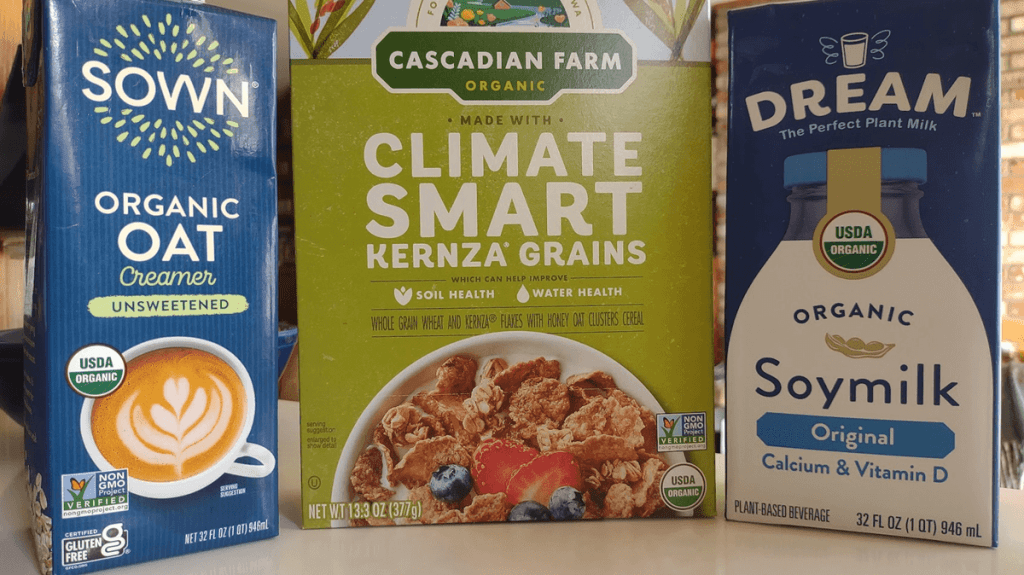
Dream soy milk and Sown oat creamer: Nutrition
Ingredients for these products are pretty straightforward:
Dream organic soy milk – Ingredients
Filtered Water, Organic Whole Soybeans, Rice Syrup, Tricalcium Phosphate, Sea Salt, Vitamin A Palmitate, Vitamin D2, Vitamin E, Vitamin B12.
Sown organic oat creamer – Ingredients
Organic oatmilk (filtered water, organic hydrolyzed oats), organic canola oil, contains 2% or less of: calcium carbonate, potassium citrate, gellan gum, baking soda.
So the soy milk is supplemented with a few vitamins while the oat creamer is not. Let’s compare them in terms of nutrition.
Soy milk versus Oat creamer – Nutrition Facts
First off, the serving size for the Sown oat milk is only one tablespoon (15 mL) so it really is designed to be a creamer rather than milk for cereal. A normal serving size for milk, such as the Dream soy, is 1 cup (240 mL) which is 16 tablespoons! Even still, if you had an entire cup of the oat creamer (as I did last night with my cereal-dinner) it wouldn’t be outrageous – 16 grams of fat, so about twice that of a cup of hemp milk. The (organic) canola oil that’s added to the oats to make the Sown creamer creamy has a favorable ratio of omega-3 to omega-6 fatty acids, compared to most oils.

I though the oat creamer would contain some fiber (Oatly milk does) but there’s none in this Sown product. The Dream soy milk has more going on, with dietary fiber, vitamins, minerals, and quite a lot of protein (10 g per serving). So, again, I’d choose the soy milk over oat, but if just adding a little to your coffee it’s not a huge deal, either way.
SunOpta, Inc. owns the Dream and Sown brands
SunOpta is a public listed company that owns three plant-based milk brands: Dream, Sown and West Life previously Westsoy. A little strange to use the same name as a famous Irish boy band! The band is one word – Westlife – but still, it can’t be great for search engine ranking to pick essentially the same name. Dream soymilk has also undergone an image revamp – it used to be called Soy Dream.

SunOpta has always had a pretty strong focus on environmental impact and has picked up several awards along the way for achievements such as water quality management. Most of their facilities have achieved their zero-waste goal of the diversion of 90% of waste from landfill. SunOpta also reduces food waste by converting the left over meal from oat processing to an oat protein product (OatGold, verified upcycled).

How bad are cartons? Should we make our own milk?
This is an ongoing project/debate for me. Whenever I try out a project in a carton, such as the aseptic TetraPak cartons used by SunOpta, I have questions. Are there viable packaging alternatives? It’s a little ironic for the image on the front of Dream soymilk carton is of soymilk in a glass bottle. Why not actually use glass bottles?
One of the upsides of a shelf-stable aseptic carton is that it doesn’t require refrigeration during transportation or in the store. Most refrigerants are actually potent greenhouse gases, so minimizing refrigeration, when possible, is important. (Having said that, green refrigerants have now come on the market, so seek them out if you need to buy a fridge/freezer or a/c unit). The cartons also tend to reduce food waste (another large contributor to climate change) as they keep the contents fresh for months. All of these factors have to be considered, if we want to reach a balanced opinion.
The alternative is to make our own plant-based milks at home. How reasonable is it to expect people to make their own milk on a regular basis? Every time I make oat milk at home (whether following an online recipe or inventing my own) the results have never been that great. I’m starting to think that making good quality oat milk at home might have to involve enzymes. Making soy milk at first seems like more work than oat milk – soaking, blending, boiling, filtering – but maybe it’s a more reliable process? I’ll return to that topic following some more experimentation in the kitchen. 🙂
If we choose to buy milk, what kind of packaging should we look for? The ubiquitous TetraPak cardboard containers are not recyclable in my area, but they might be in yours. Even if they are, the carton recycling process is not terribly efficient – it takes a lot of work to separate the layers of cardboard from the plastic and aluminium. The recycling of pure aluminium (beer cans, for example) is a very efficient and widely available process, saving energy and material. However, the aluminium used in shelf-stable cartons is rarely recovered.

TetraPak recently developed a paper-based alternative to the layer of aluminium that blocks air and water in shelf-stable cartons. Testing of this alternative began in Portugal in late 2023. That would be a big improvement since the use of aluminium (even though it’s just 5% of the package weight) is the largest contribution to the package’s environmental footprint.
Made of approximately 80% paperboard, the package increases the renewable content to 90%, reduces its carbon footprint by one third (33%) and has been certified as Carbon Neutral by the Carbon Trust.
The bottom line is that the kind of milk you buy is more important than the packaging – soy and oat milks each have significantly lower environmental footprints compared to dairy. So, for most people, the first step is to try out plant-based milks to find one that’s appealing. I’ll revisit the topic of homemade milks on the Green Stars Project after I’ve done some more experimentation.
Ethical rating for Dream soymilk and Sown oat creamer
I’m rating these SunOpta products – Dream organic soymilk and Sown organic oat creamer – 4.5/5 Green Stars for social and environmental impact, after considering the following:
- All Silk products are vegan. Adopting a plant-based diet is the top thing you can do to mitigate climate change, deforestation, animal cruelty, and food scarcity.
- Milks made from soybeans or oats have significantly lower carbon, land, and water footprints compared to milk sourced from a cow.
- The soybeans and oats and canola oil (for the creamer) are certified organic, thus avoiding the use of pesticides such as neonics that threaten bees and other insects.
- Oats and soy are mainly sourced from North America, avoiding deforestation risk.
- Cardboard used for Sown and Dream packages is responsibly-sourced, including certification by the Forest Stewardship Council (FSC).
- The cartons are technically recyclable but this requires quite a lot of effort at a (distant) specialized facility to separate all of the layers.
- SunOpta releases annual Environmental, Social & Governance (ESG) reports but they could be more comprehensive. For example, the 2023 report highlights one soybean supplier rather than giving an overview of all of them. They do contain useful information, however.

Summary scores (out of 5) for Sown and Dream organic plant-based milks:
4 and 4.5 gold stars for quality and value for Sown organic oat creamer and Dream organic soymilk, respectively.
4.5 Green Stars for social and environmental impact for both products, Sown and Dream.
This is a nonprofit project based on independent research that is not sponsored or commissioned in any way.
If you have a different opinion, please share your rating as a comment below.
Join the movement (and win a prize!) by including a Green Stars rating whenever you write a product or company review and let me know if you do.


 Grocery Outlet Ethical Bargains
Leave a reply to jkaybay Cancel reply