

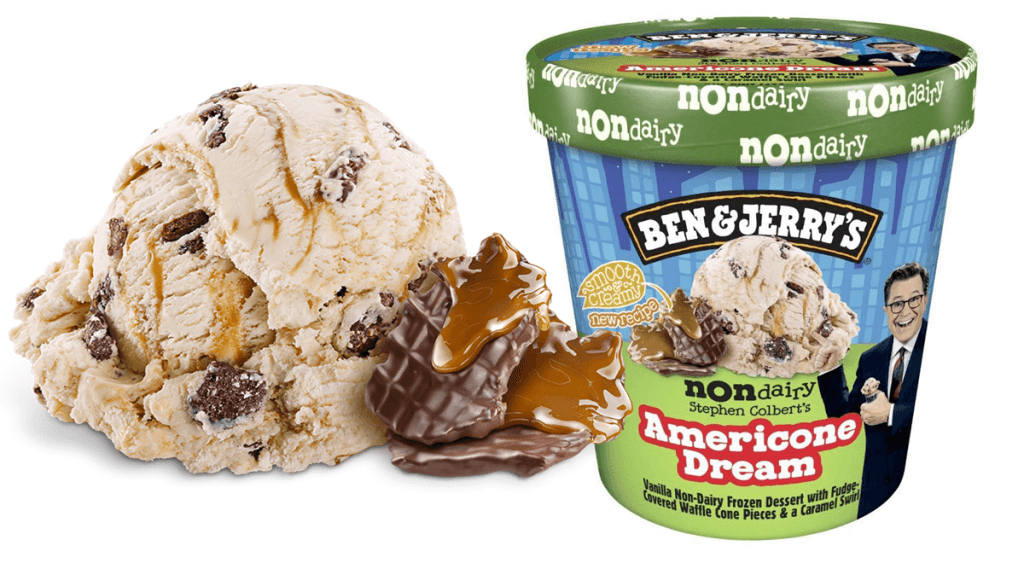
I’m not sure what’s going to happen to the American Dream over the next few years but, in the meantime, I found some Americone Dream at the Grocery Outlet to soothe my election woes. Americone Dream is a Ben & Jerry’s ice cream, made in collaboration with Steven Colbert, which amusingly rivals Jimmy Fallon’s B&J flavor, The Tonight Dough. There’s a regular dairy version of the Americone Dream ice cream but also a non-dairy version (which is certified vegan). To complicated matter more, there have been two plant-based versions: one made from almond milk and a newer version based on oat milk, which I bought at the Grocery Outlet.
On September 22, 2013, AmeriCone Dream appeared in the Breaking Bad episode, Granite State. On July 22, 2014, Daniel Radcliffe announced AmeriCone Dream as his favorite post-coital food. – Wikipedia.
Harry Potter! Wash your mouth out!
Whatever version you buy, Americone Dream ice cream contains fudge-covered waffle cones and swirls of caramel. I picked it up more out of curiosity to see if B&J’s could make a good vegan ice cream (plus, it was only $1.99 at the Grocery Outlet). It’s always nice to have an excuse to buy ice cream 😉
Another reason I thought it would be of interest to try this ice cream is that Ben & Jerry’s has been largely dead to me for a couple of decades. All the way back before the millennium (anyone remember that?) I used to eat B&J’s when struck with a case of the munchies. Then, in 2000, as the Y2K meltdown was narrowly averted and Bush “beat” Gore to the US presidency, Ben & Jerry’s was sold to Unilever, bringing two major consequences for the ice cream maker.
One, the flavor of the ice cream changed dramatically – Chunky Monkey (my favorite) was no longer a bold juxtaposition of banana and chocolate, but an overly sweet confection that no longer tasted of either. Two, Unilever had a poor reputation, ethically, raising concerns that B&J’s ingredient supply chain would be also become problematic.
But the ice cream that I spotted at the Grocery Outlet was plant-based and featured a prominent Fairtrade logo on the front, so I figured that it would be worth revisiting Ben & Jerry’s. It turns out that in 2005, Ben & Jerry’s became the first ice cream maker to use Fairtrade certified ingredients.
How does it taste? Very sweet but, considering that it contains caramel, the sweetness does not seem as out-of-place as it did with the Chunky Monkey. It has a nice texture and mouthfeel, whether or not you’re patient enough to let it melt a little before eating. I thought it was pretty tasty overall and would buy it again – with the obvious caveat that, like most ice cream, it has terrible nutritional value.
Non-dairy Americone Dream: ingredients and nutrition facts
Ingredients: Oat milk (water, oats), liquid sugar (sugar, water), corn syrup, coconut oil, sugar, water, wheat flour, cocoa, brown sugar, chickpea flour, pea protein, fava bean protein, natural flavor, soy lecithin, salt, vanilla extract, caramelized sugar, pectin, sea salt, guar gum, locust bean gum, soybean oil, invert sugar
These are the ingredients for the oat-milk version of Americone Dream that I bought. The version made with almond milk is almost identical except that the first ingredient is (can you guess?!) almond milk instead of oat milk 🙂
There’s also not much difference between the two non-dairy versions in terms of nutrition facts, shown below for the oat milk version. In either case, the ice cream contains around 23% sugar and 12 grams of saturated fat (60% of your recommended daily value). Bad as that sounds, most dairy-based ice creams (e.g., Häagen-Dazs) are actually worse as they contain trans fat and cholesterol on top of the sugar and saturated fat.

I could also try to convince myself that this plant-based ice cream is a little better on the basis that it contains some fiber (absent in the dairy versions). But of course I know that it’s not healthy and, in contrast to most other processed foods, I actually eat much less than the serving size in one sitting. Maybe Daniel Radcliffe feels differently after his orgies…
How does Ben & Jerry’s rate for ethics?
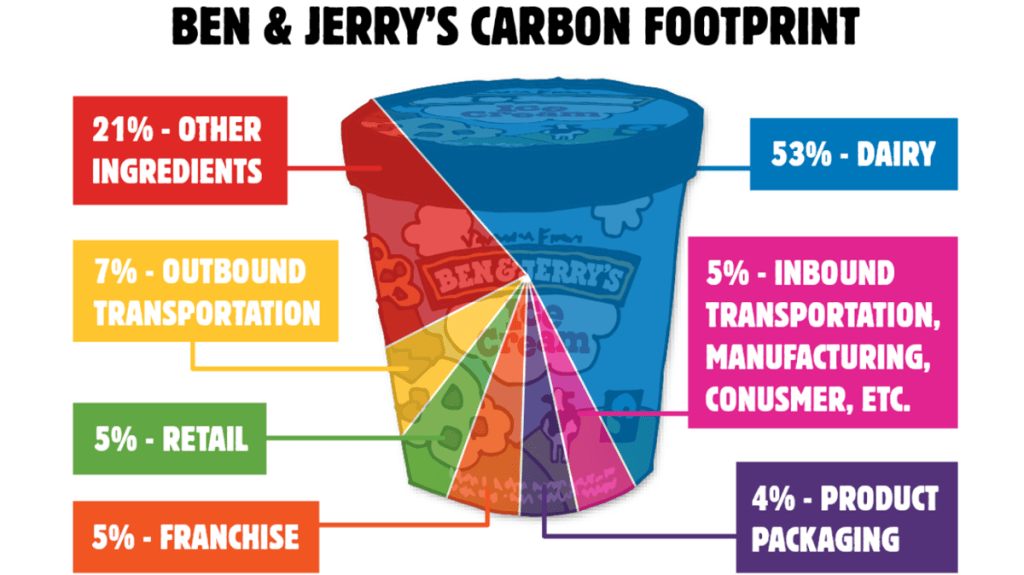
I’ll try to narrow down my thoughts to the essentials. B&J’s does publish a Social & Environmental Assessment Report each year. The most recent report (for 2022) also includes an Independent Accountant’s Report, verifying certain key facts from the report. This is helpful, although it is concerning that there is no 2023 report yet – have B&J’s stopped reporting? Anyway, I’ll go through some key parts of the 2022 report, focusing first on greenhouse gas (GHG) emissions.
How big is Ben & Jerry’s carbon footprint?
Here’s a quote from the latest report detailing progress towards their goal of a 40% reduction in GHG emissions per pint of product sold by 2025 (compared to a 2015 baseline):
As of the end of 2022, we have made some progress in our carbon intensity with a -5.6% reduction since 2015, but it is an increase in carbon intensity since 2021. This upward carbon intensity trend is connected to a decline in non-dairy pint sales as well as a decline in dough chunk sales, both of which have a lower carbon footprint than our dairy pints.
So, with only three years to go they are nowhere near the target reduction in GHGs. At least they are transparent about that in the report, but on the Climate Justice page of B&J’s website, only the goal is mentioned – 40% greenhouse gas intensity reduction by 2025, which gives the impression that they will reach the goal (next month!).
This tactic – emphasizing the goal rather than actual progress towards the goal – is commonly used by multinationals such as B&J’s parent, Unilever. Communicate a goal to keep consumers happy for now and then worry about the actual lack of progress when the target year is reached (usually by posting a new target for a new future date). I’d expect better communication of actual progress from a mission-driven company (which B&J’s has always claimed to be).
Decline in sales of Ben & Jerry’s plant-based products
The company is transparent about the lack of progress towards the GHG reduction goal being largely due to a decline in non-dairy ice cream sales. So is the consumer to blame? It has to be said that B&J’s does a terrible job at communicating on non-dairy products on the company website – the main webpage for non-dairy ice cream doesn’t show any products: you can “browse by base” (oat, almond, sunflower butter) but these links actually lead nowhere (update: this has just been fixed!). Also, if you go to the page for the regular dairy version of the Americone Dream there is no mention that a non-dairy option exists. This is all very confusing and I wonder if B&J’s are really that serious about their plant-based ice creams.
Refrigeration and GHG emissions
Getting back to Ben & Jerry’s 2022 impact report, there’s a section on energy efficiency in their scoop shops:
Our Scoop Shops rely on robust refrigeration, lighting, and cooling systems to ensure a fantastic fan experience. While this is a relatively small portion of our carbon footprint…
The report goes on to talk about using software to evaluate energy use in a flagship store in 2022. Besides the fact that you would think this would have been tackled much earlier than 2022, there’s an elephant in the room that they never talk about – refrigerants.
Project Drawdown, one of the best guides to reducing GHG emissions, lists two refrigeration-related actions that actually rank among the top 10 solutions. The most commonly used refrigerants – hydrofluorocarbons (HFCs) – are potent GHGs, and Drawdown estimates that roughly 1.5 billion tonnes of GHGs (2.5% of all global GHGs) could be avoided with a switch to green refrigerants (which do exist).
Ben & Jerry’s, an ice cream company, should be aware of the impact of refrigeration on climate change. There should be a statement on whether: a) new freezers will contain green refrigerants and b) that existing freezers are regularly monitored for HFC leaks. (Avoiding HFC leaks is the second refrigeration-related action recommended by Drawdown; monitoring for leaks was done regularly in the US National Lab that I worked in).
Instead of waffling on about “robust refrigeration for a fantastic fan experience” Ben & Jerry’s should be addressing the very real climate risks that a freezer-dependent ice cream company poses.
B&J’s Fairtrade ingredient sourcing
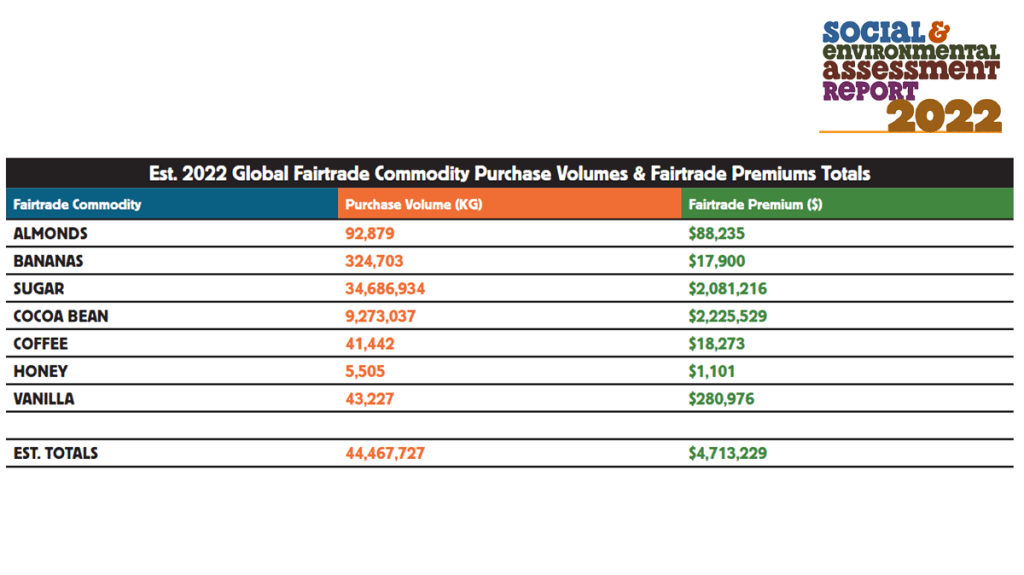
Ben & Jerry’s pays a Fairtrade premium for all relevant ingredients – sugar, cocoa, bananas, etc. Many other companies would only focus on one (e.g., cocoa) and ignore the others, such as sugar. Fairtrade premiums paid back to farmers were reported in the 2022 impact report – this amounted to a very respectable $4.7 million, around 1% of annual revenue.
Back in 2020, Ben and Jerry’s Chief of Social Mission Dave Rapaport explained that:
Our Fair Trade cocoa purchasing is mass-balanced, so we don’t have traceability to the farm with our cocoa. We do have financial transparency through the Fairtrade Foundation, which could assure that the financial benefits are traced back to farmers.” – Forbes
The mass balance system is explained in this video from Fairtrade International:
In 2021, B&J’s transitioned to working with a specific supplier for some of its cocoa, and increased the premium paid to living income pricing, a step above standard Fairtrade pricing.
In 2022, B&J’s collaborated with Tony’s Chocolonely (reviewed previously, here on EB), reporting that this prompted B&J’s to work towards fully traceable cocoa beans (rather than relying on the mass balance system).
Ben & Jerry’s packaging
Ben & Jerry’s messaging on packaging is quite confusing. On the webpages for some ice creams, such as Americone Dream, you’ll find a trio of messages about packaging:
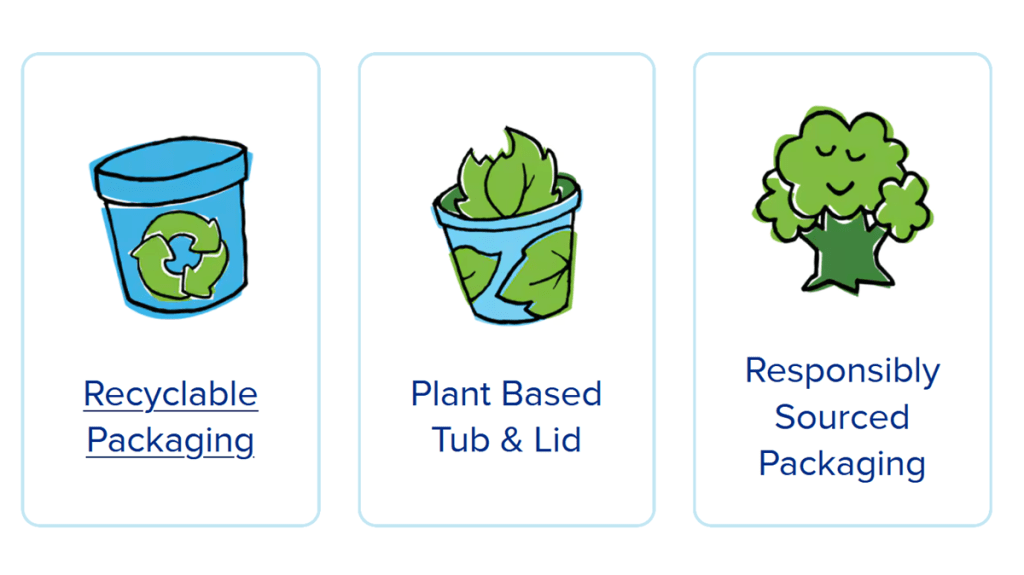
Those first two images lead to the same page, which deals with paper sourcing but makes no statements about the packaging being recyclable or plant-based.
Here’s a key statement from the page on Responsibly Sourced Packaging page, from the third image:
As with most food product packaging, much of ours is not reused, composted, or recycled, but rather disposed of as waste. We’re on a journey to change that. Our goal is to have 100% of our packaging be free of petroleum-based plastic. And we want it all to be reusable, compostable, or recyclable by 2025!
Well guess what, Ben and Jerry – it’ll be 2025 in a few weeks!
Some advice for Ben & Jerry’s on impact
Some of the issues discussed above would be resolved with better management of the website and better communication on sustainability. It’s unfortunate that a company that is apparently so focused on social and environmental impact ends up being so confusing and unreliable when communicating on it.
Here are some suggestions for how the company could improve:
Be realistic and avoid misleading customers
Claims such as these should be removed from the website, pronto:
- 40% greenhouse gas intensity reduction by 2025
- All packaging to be reusable, compostable, or recyclable by 2025!
Making compostable ice cream packaging has been done already (e.g., Sacred Serve, which sadly closed in spring 2024). It’s not trivial – the cost and practicality needs to be worked out – but just decide on whether you want to make it happen or not. Stop with the rhetoric of: we’re working soooo hard on this and will have it solved by 2025 – pwomise!
Address refrigerants
Not many companies address this topic in their corporate sustainability reporting but what better company to set an example than an ice cream maker? Ben & Jerry’s: commit to using green refrigerants for all future freezer/chiller purchases. Address whether the company checks for refrigerant leaks and follows the best disposal guidelines.
Do better with plant-based products
Doing better with the plant-based (dairy-free) products would be the biggest step Ben & Jerry’s could take towards improving the environmental impact of the company. As B&J’s has stated, the company failed to meet climate goals largely because plant-based products have not sold so well.
The issues with conventional dairy are also reflected by widespread criticism of the company’s impact on animal welfare. Maybe it’s best summed up in a statement from Ben & Jerry’s in a response to a NY Times article that reported on child labor in the US, including B&J’s dairy supply chain:
It is an established fact that the dairy industry comes with profound social and environmental challenges.
Indeed it is, Ben & Jerry, so the most critical way for you to improve is on formulating and marketing your plant-based products. The website is a disorganized mess, so it’s reasonable to assume that improvement is needed in other areas of marketing too, particularly for the dairy-free products. A large ad campaign for the dairy-free ice creams would help, to start with.
The product itself also needs investment if it’s going to succeed, and it seems that this has just occurred with new recipes launched for B&J’s vegan ice creams (including this creamier, oat-based Americone Dream). I’ve reviewed several vegan ice creams on this site – So Delicious, Ripple, Oatly, and Brave Robot – and found them all to be surprisingly good (with the exception, for my taste, of some Brave Robot flavors). I think that the Ben & Jerry’s plant-based Americone Dream could be improved further but the new oat milk version is actually pretty good already. It’s better, in fact, than many of the dairy-based B&J’s ice creams that I’ve tried since Unilever took over.
Ethical rating for Ben & Jerry’s dairy-free Americone Dream
As argued above (actually by Ben & Jerry’s itself) there is a huge difference in impact between the regular dairy ice creams and the plant-based products. The regular dairy ice creams deserve only 1.5 Green Stars, in my opinion, while the dairy-free versions deserve 4/5 Green Stars for social and environmental impact.
So, I’m rating Ben & Jerry’s dairy-free Americone Dream 4/5 Green Stars for social and environmental impact for these reasons:
- These dairy-free ice creams are vegan. Adopting a plant-based diet is the top thing you can do to mitigate climate change, deforestation, animal cruelty, and food scarcity.
- There is a huge difference (ethically) between the dairy and non-dairy versions of Ben & Jerry’s. For example, the company is nowhere near meeting climate goals because of a decline in non-dairy sales. Choosing the non-dairy ice creams (which have been recently improved) over the dairy versions helps shift the company ethos radically.
- Ben & Jerry’s pay a premium to Fairtrade International for all applicable ingredients – sugar, cocoa, and vanilla in this case. This is largely though the mass balance system. I have no faith in Unilever (B&J’s parent) engaging in responsible ingredient sourcing but Ben & Jerry’s Fairtrade premiums do certainly count for something. $4.7 million, or around 1% of annual revenue, was paid to the Fairtrade International program in 2022. B&J’s has also made some moves towards more direct Fairtrade relationships rather than relying on the mass balance system.
- Ben & Jerry’s is B-Corp certified, with a score of 96, as of 2022 – this is down from a score of 110 in 2017.
- Packaging for ice cream pints has been made from Forest Stewardship Council (FSC) certified paperboard since 2009. Various strategies are in progress to further improve on this, such as the reduction of the amount of plastic coating on the packaging and the use of plant-based plastic in Europe.
- Ben & Jerry’s engages in global activism, focused on racial equity, voting rights, climate change, and human rights for LGBTQ+, immigrants, and refugees.
- The Ben & Jerry’s Foundation was created in 1985, with an initial gift and a commitment to donate 7.5% of the company’s annual pretax profits to philanthropy. This has continued following the Unilever acquisition, with B&J’s donating $5.2 million to the foundation in 2022. The Foundation supports small social and environmental nonprofits through grant programs.
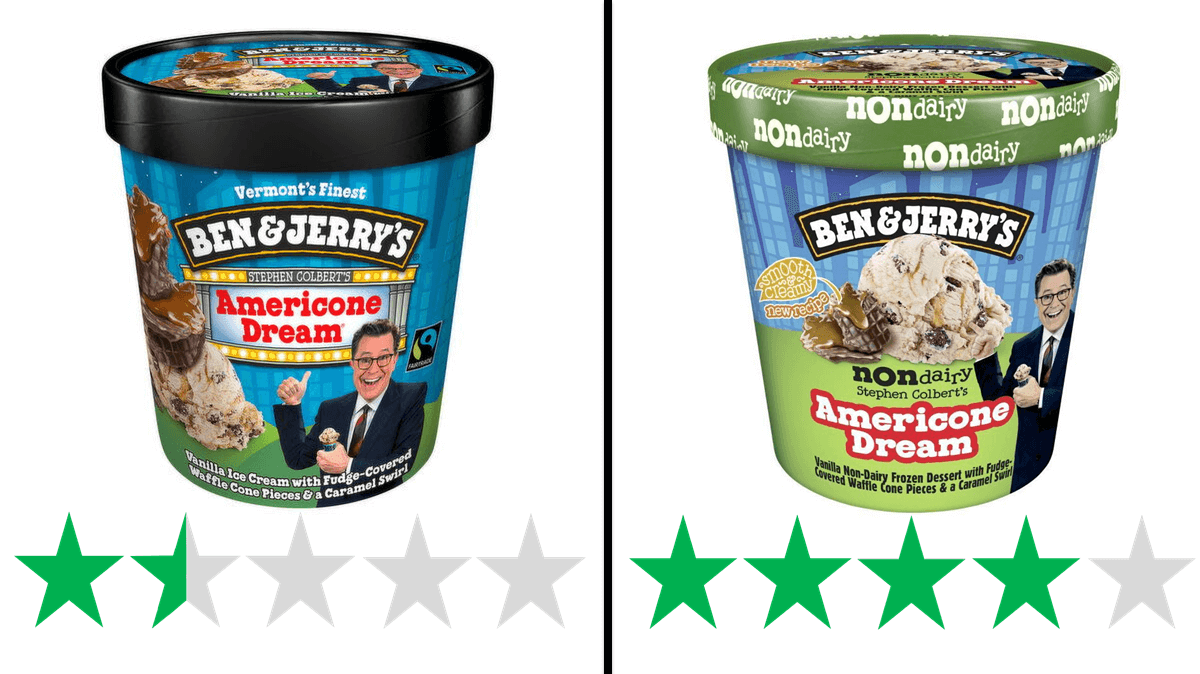
Summary scores (out of 5) for Ben & Jerry’s dairy-free Americone Dream:
- 4 gold stars for quality and value.
- 4 Green Stars for social and environmental impact.
(The regular dairy-based Americone Dream gets 1.5 Green Stars.)
If you have a different opinion, please share your rating as a comment below.
Join the movement (and win a prize!) by including a Green Stars rating whenever you write a product or company review and let me know if you do.


 Grocery Outlet Ethical Bargains
Leave a comment