
In a previous post here on Ethical Bargains I asked the question: How ethical is Taylor Swift merch? The conclusion was that Tay’s merchandise is slightly better than average in terms of social and environmental impact, but with lots of room for improvement. I mentioned that her cardigan (to go along with Folklore’s first single) was made from acrylic, a textile that I put at the bottom of my list in a Green Stars Project post on sustainable textiles. However, the cardigan was the low point and there were some highlights to balance that – such as her collab with Stella McCartney on Lover merch.
As all Swifties are well aware (and most non-Swifties too!), Taylor’s 11th album – The Tortured Poets Department – was released last Friday. So it’s a good opportunity for an update on Taylor Swift merchandise in terms of social and environmental impact. But first…
Favorite song from TTPD
Before getting into the merch, I want to include a quick note about the music. I previously posted on my favorite song from each Taylor Swift album so here’s my update on that with my favorite TTPD track. When I listened to Midnights, I chose my favorite track – You’re on your own, kid – after only one listen to the album. That actually hasn’t changed over the intervening 1.5 years – it’s still my clear favorite from the album. I’m not sure if the same will apply here but for now my favorite song on TTPD is also track 5 – So long, London.
You sacrificed us to the gods of your bluest days
And I’m just getting color back into my face
In a very close second place is loml, a beautiful song with a perfect piano accompaniment by Aaron Dessner. Most of the other best-song candidates are on the second album – I’m definitely more partial to the songs made in collaboration with Dessner over those produced by Jack Antonoff. But that’s one of the nice things about Swift’s music: her fans differ wildly on their favorite songs.
The Tortured Poets Department merch – ethical rating
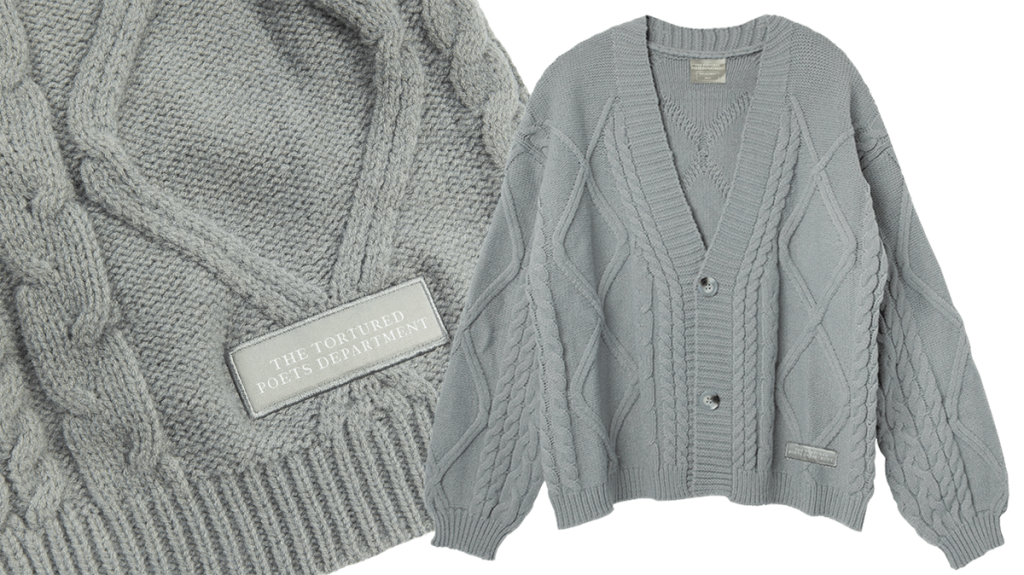
The first thing I noticed that there is a new cardigan in town – a TTPD cardigan to wear while writing poems by the fire (or addressing letters to it). For more on why the original cardigan, made from acrylic, is not ideal, check out my previous post investigating if TS merch is ethical. Actually, here’s a quick recap:
- Like polyester, acrylic is made from petrochemicals and is therefore non-renewable (unlike plant-fibers).
- Synthetics like acrylic and polyester are major sources of microplastic pollution (microplastics are a real issue – they are now turning up in our blood). It’s estimated that one third of microplastics originate from synthetic fabrics (especially fluffy items like fleeces) during laundry.
- The building block for making acrylic (acrylonitrile) is quite toxic. The odds of contracting breast cancer were calculated to be almost 8 times higher for women who spent 10 years working with acrylic fibers.
While the Folklore cardigan was 100% acrylic, the TTPD cardigan is a mix of three textiles: 52% acrylic, 26% nylon, and 22% PBT. Here it is in all its glory:
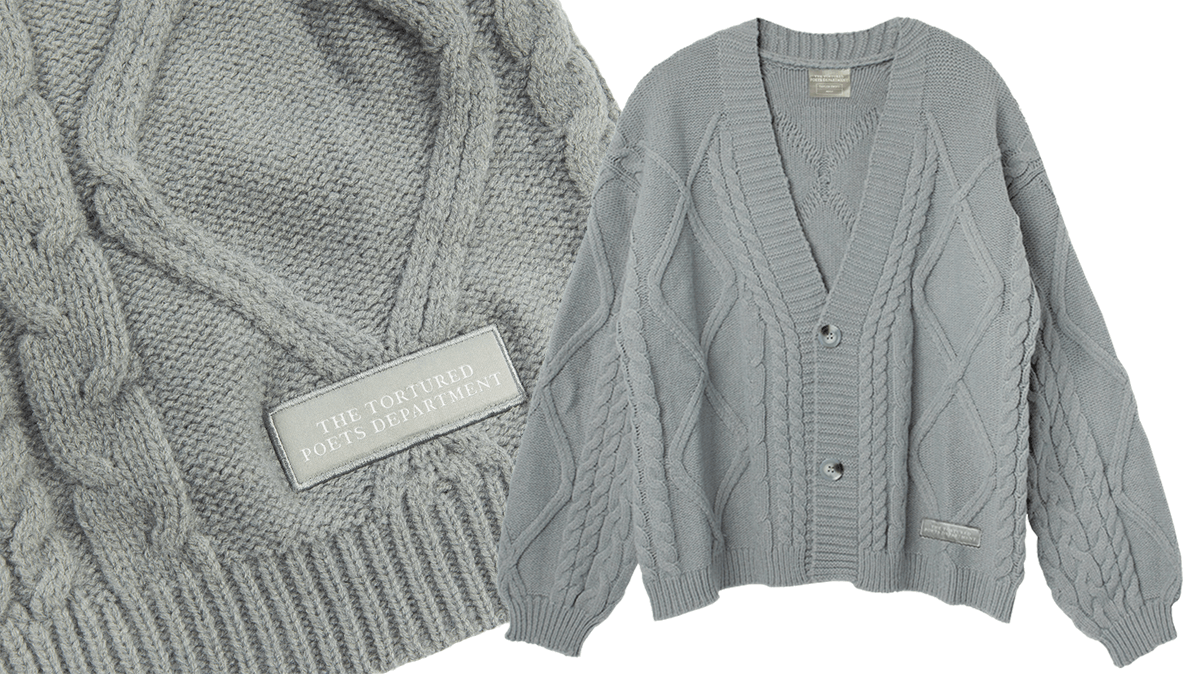
It can be yours for only $70 and, like most other TS merch, its value will probably appreciate over time. But it it an improvement, ethically, on the previous cardigan? Acrylic is one of the worst textiles in terms of environmental impact (perhaps only PVC is worse). In some ways, reducing the acrylic content is a good thing, although we should be moving away from textile blends (more on that later). But the most important question is, how do the new fibers, nylon and PBT, fare in terms of environmental impact?
What is the textile PBT?
In fact, PBT (polybutylene terephthalate) is new to me so I had to do a little research on it. It’s similar to PET (polyethylene terephthalate) which is one of the most common plastics, known as #1 in the recycling scheme and as polyester in the textile world. There’s not a lot of information available on PBT, but I’ll share what I found.
A 2022 paper, Promoting eco-informed design attitudes in plastic selection and use, compared different plastics in terms of fossil fuel use and GHG emissions. Here’s a key figure from that paper showing the amount of fossil fuels needed to make each type of plastic and the amount of GHGs emissions resulting from each one. Yes, it’s quite a transition from the previous image – Lessons in Chemistry for Swifties 😉
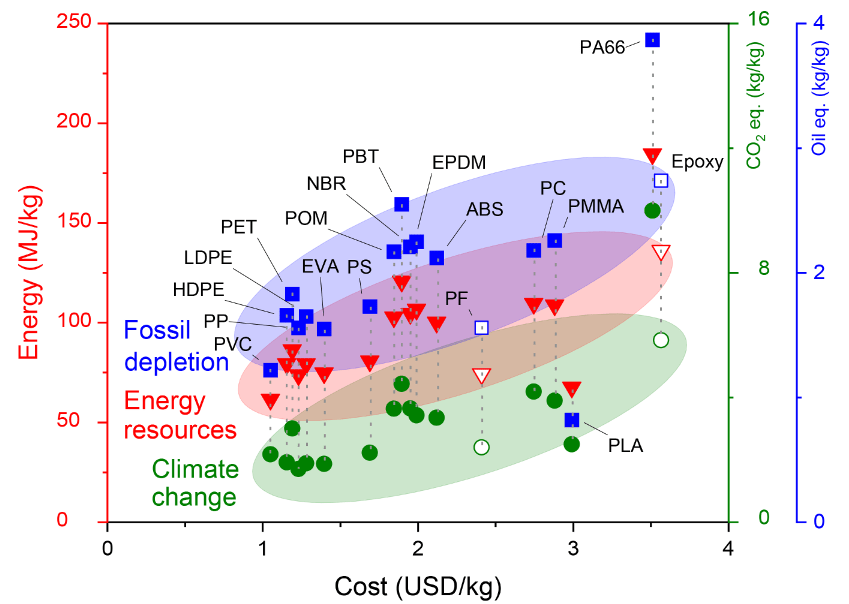
If you look at the blue squares in the chart, which represents the amount of oil needed to make one kg of each plastic you can see that the two highest values are PA66 (aka nylon) and PBT. So the two new synthetic textiles that go into the TTPD cardigan require a lot of oil to make and have large carbon footprints, compared to other synthetics such as polyester (PET, in the chart above).
However, acrylic isn’t on that chart and, according to this source, it has a higher carbon footprint than any of the above, even nylon. The oil footprint and carbon footprint are not the only considerations, of course. PVC, which I mentioned as one of the worst plastics, doesn’t look too bad in the chart above, but its problems are more related to chemical toxicity. Acrylic is bad in terms of both toxicity (see the statistic on breast cancer, above) and carbon footprint.
So where does this leave us? Well, basically the cardigan has changed since Folklore – there is less acrylic (that’s a good thing) but the textiles used (nylon and PBT) have larger carbon footprints than most other synthetics. Zooming out a bit, all synthetics are bad choices (made from petroleum, shedding microplastics) so although this TPPD cardigan may be slightly better than one made from 100% acrylic, it could have been a whole lot better.
What I would have really hoped for is to turn away from synthetic textiles and make the cardigan from sustainable textiles such as hemp, linen, Tencel, or organic cotton.
Almost all TTPD merch is 100% cotton
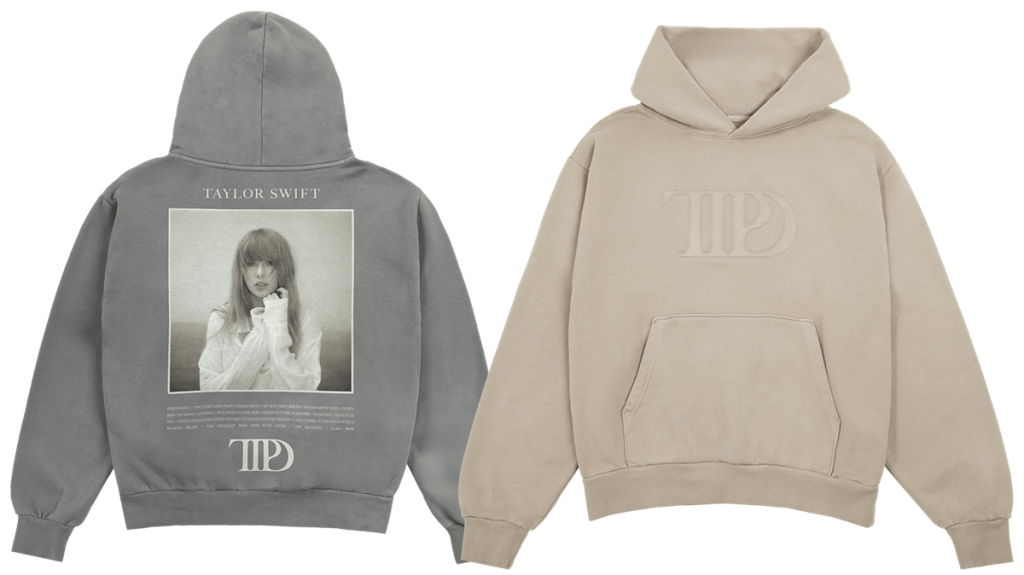
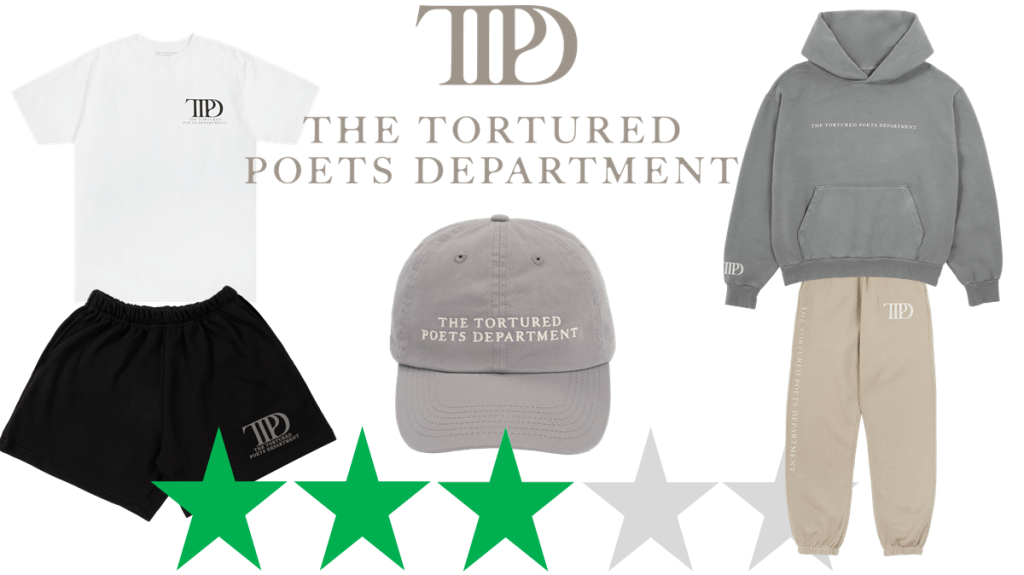
Aside from the cardigan and one other item, all of the other TTPD clothing items are made from 100% cotton. This is an improvement on the previous round of merch (Eras tour) where some items such as hoodies were made from a cotton/polyester blend. Now, the TTPD hoodies are 100% cotton, as are the T-shirts, sweatpants, shorts and baseball hat. Why is it an improvement to make something from 100% cotton rather than 80% cotton/ 20% polyester blend?
Why is 100% cotton better than a cotton/polyester blend?
When we think about sustainability of materials such as clothing, there are two main options. These options are the two cycles of the circular economy: a biological cycle and a technical cycle. The biological cycle often begins with carbon capture via photosynthesis and ends with the return of nutrients to the soil and air (and then we watch it begin again). Examples include natural textiles such as cotton, linen, hemp, Tencel, viscose from bamboo, etc. The technical cycle begins with a finite resource, such as a fossil fuel or a mined metal, and depends on a high degree of recyclability to be sustainable. Examples include the synthetic textiles that are made from oil – polyester, nylon, acrylic, PBT, etc.
Unfortunately, virtually no synthetic textiles are currently recycled – the technology is starting to come online but it will be a while before it’s widely available, if ever. So, when it comes to synthetic textiles, the technical cycle is not really a cycle at all yet. (This is why we should minimize our use of synthetic textiles, just as we should avoid any plastics.) It’s also true that natural textiles such as cotton usually don’t complete a full biological cycle. Items like cotton T-shirts are not allowed in green bins, but this seems like a much easier problem to crack than the recycling of synthetics (you can try it out in your backyard if you have something suitable to compost). And even if sent to landfill, at least the natural textiles are a form of carbon capture – originating as a plant and ending underground. This is better than taking 2.5 kg of oil, turning it into 1 kg polyester, and then sending it to landfill.
But, back to the main point – why should we specifically avoid blends that include synthetics, such as cotton/polyester? Clothing made from synthetic blends has almost no chance to become part of either cycle. You can’t compost a t-shirt if it’s made from a cotton/poly blend, nor would it be very feasible to recycle polyester (even with cutting-edge chemical recycling) if it’s blended with cotton or other textiles.
Overall rating for Swift’s TTPD merch
So, since February when I evaluated the social and environmental impact of TS merch, there are two major updates:
- One step backwards: the return of a synthetic cardigan – less acrylic but still a poor mix of high-carbon footprint synthetics that will shed microplastics during laundering.
- One step forwards: Most items are now made from 100% cotton rather than cotton/poly blends.
So the rating stays the same at 3/5 Green Stars for social and environmental impact.
See the previous post on TS merch for a list of recommendations for how Taylor Swift and her team can improve this rating. The best actions would be to use more sustainable textiles and fair trade labor.
Please comment below on anything from your thoughts on TS merch to your favorite song on TTPD!


 Grocery Outlet Ethical Bargains
Leave a reply to jkaybay Cancel reply