

As all Swifties know, there isn’t much that Taylor Swift and her fans can’t achieve. She has taken on many issues over her career, from artist royalties on Spotify to Ticketmaster’s general incompetence and monopolization. On a personal level, Swift made a decision, mid-career, to start voicing her opinion on political and social issues, as shown in the 2020 documentary Miss Americana. This was against her father’s advice to stay neutral as she is likely lose half of her fan base or, worse, be attacked by right-wing nutters. The clip from the film is worth watching.
There is no doubt that Swift is one of the most influential and powerful people on the planet. It is her power that gives her the opportunity to make stances that smaller artists often can’t risk. And yet she aspires to balance her power with reason and empathy, following the advice from her late grandmother, Marjorie Finlay. Swift wrote these lyrics to Marjorie in 2020, the year she decided to speak out against Trump and others who aimed to erode our rights:
Never be so polite, you forget your power
Never wield such power, you forget to be polite
Unlike other people with power (Elon and Jeff: It’s you, hi!) she is much loved for being true to herself and for caring about people (and animals too). So, getting back to the subject of this post, I can see a huge opportunity for Taylor to again wield her power to change our world: via her merchandise.
Taylor Swift X Stella McCartney
First off, Taylor did launch a special ethical line of clothing in collaboration with Stella McCartney in 2020 (a lot happened in 2020!). This was in connection with her seventh album, Lover, on which she compared herself to Stella:
Like a Tennessee Stella McCartney on the Heath
They have at least one thing in common: McCartney had fought to regain ownership of her brand in 2018 so that she could continue to make sustainable apparel on her own terms. Like her parents, Stella McCartney is an environmentalist who supports animal rights, and her fashion reflects this. She is cutting edge in the use of sustainable, plant-based materials such as Savian, Mylo, and Bananatex.
Following Lover, Taylor released Folklore and Evermore in 2020 and, deciding to take more control over her own styling, wore Stella-designed outfits for the album covers.
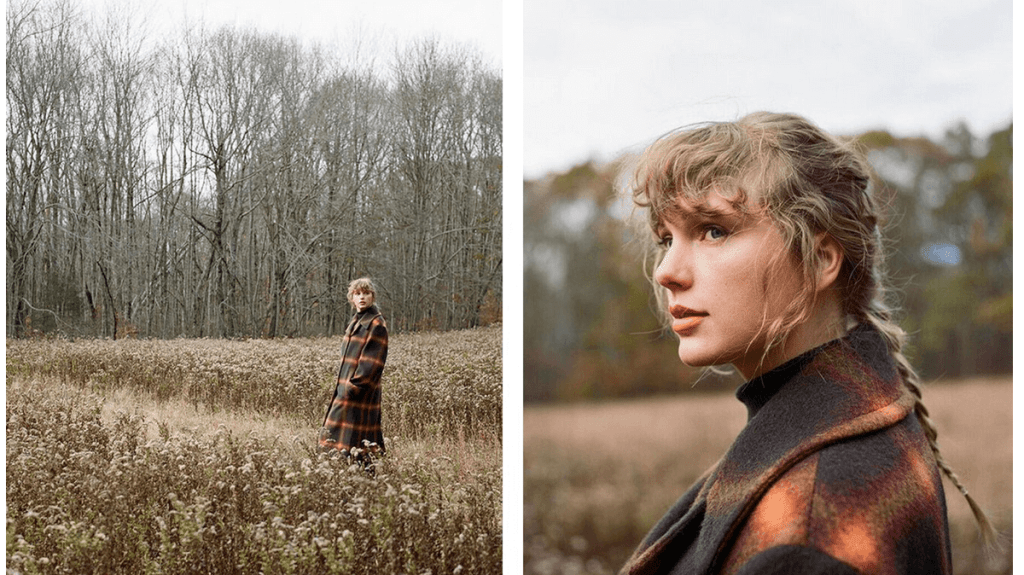
The Stella X Taylor Swift clothing is no longer available (it was also pretty pricey, as you’d expect) so let’s take a look at the Taylor Swift merch available since then.
Is Taylor Swift merchandise sustainable?
After the surprise release of Folklore in the summer of 2020, winning over many new fans, Taylor’s store sold a very large number of cardigans to go along with the first single from the album. (Who didn’t need a comforting cardigan in the bleak autumn of 2020?!) Unfortunately, the cardigans were made from one of the least sustainable textiles: acrylic. I ranked acrylic at the bottom of my list in an early Green Stars Project post on sustainable textiles. I’ll tell you why:
- Like polyester, acrylic is made from petrochemicals and is therefore non-renewable (unlike plant-fibers).
- Synthetics like acrylic and polyester are major sources of microplastic pollution (microplastics are a real issue – they are now turning up in our blood). It’s estimated that one third of microplastics originate from synthetic fabrics (especially fluffy items like fleeces) during laundry.
- The building block for making acrylic (acrylonitrile) is quite toxic. The odds of contracting breast cancer were calculated to be almost 8 times higher for women who spent 10 years working with acrylic fibers.
Sorry Taylor – I would like to put your name at the top of my list but in this case I cannot.

It’s unfortunate that the first item I came across while starting this investigation was a pretty poor one. Yes, I started thinking about this over three years ago – sometimes it takes a while before my blog post ideas reach maturity! Since 2020, through many album releases (Evermore, Midnights and four Taylor’s version re-recordings!) there has been a lot of merch sold on the TS Store. (I’m mostly just looking at the clothing for this post.)
The good news is that all of the merch since the cardigan has been better – no more acrylic, as far as I could see. Many of the T-shirts are 100% cotton while heavier items (hoodies, sweaters) are usually a cotton/polyester mix.

My rating for Taylor Swift merch (2020-2024) is 3/5 Green Stars – slightly better than average. The rating would be higher for the special Taylor Swift X Stella McCartney items, of course, and Taylor deserves credit for that. One interesting thing about her merch is that, because it never goes out of style, it likely has a much lower environmental cost per wear than fast fashion items. Even second-hand items sell like hotcakes – take a look at Goodwill’s auction site and search for Taylor Swift. On the other hand, there are reports of Eras tour merch fading after a few washes.
Rather than focusing on reasons for the current score, I’ll focus on suggested areas for improvement (which pretty much amounts to the same thing).
Sustainable Merch (Taylor’s Version)
Here are some ways in which Taylor Swift can improve sustainability and ethics of her merchandise. I’ll put these points roughly in an order of easiest to most ambitious.
- On the store website, provide some information on sustainability/ethics, such as information on the textiles, dyes, garment manufacturing, etc., and perhaps a policy statement or future directions.
- Avoid acrylic – one of the worst textiles. This seems good now – no sign of acrylic items since 2020.
- Ideally avoid synthetic blends (e.g., cotton/polyester) as it makes clothing much more difficult to recycle or even compost (cotton composting is possible although not very common yet).
- When forced to use synthetics such as polyester for some items, use recycled material. A few items do already contain some recycled polyester content.
- Most of the Taylor Swift T-shirts are made from 100% cotton. It’s good that this is a pure fiber rather than a cotton/poly blend but it would be nice to see some items made from organic cotton, ideally certified by the Global Organic Textile Standard (GOTS). I’ll put the reasons organic is better in a footnote.*
- Here’s the first of the big things: make some items from textiles that are at the top of the list in terms of sustainability, whether natural fibers such as hemp or linen** or modern fibers such as Tencel.
- The second big thing: sell some items with a fair trade certification. This could cover farming (e.g., fair trade GOTS cotton) and/or garment manufacturing. Taylor, support a living wage for workers in the textile industry!
- Icing on the cake: use green dyes for some items and explain all of this in a blog post on the site. Based on reports on the Eras tour merch, the dyes that are currently used are problematic anyway (they fade fast). Time for a change.
* The carbon footprint of organic cotton is only about half the size of conventional cotton’s footprint, on average (see here also). By definition, organic cotton also avoids one of the biggest issues with this textile – synthetic pesticide use. Cotton crops are responsible for 16% of global insecticide use, even though they occupy only around 2% of farmland.The main reasons for choosing organic cotton are similar to those for choosing organic food, boiling down to the argument that industrial farming takes a toll on the environment that cannot be sustained.
** Linen, made from fibers found in flax plant stems, is one of the world’s oldest textiles and makes great clothing for warm weather. You could consider it a good option for both mitigating climate change and dressing for the heatwaves that have become all too common. In a recent European Environment Agency (EEA) report on sustainable textiles, various materials were ranked for five environmental factors: climate change, water use, land use, eutrophication (water pollution), and toxicity. Linen (flax) scored better than cotton on all fronts and is widely considered to be one of the most sustainable textiles.
One thing we can say with some confidence about Taylor Swift is that she works hard and enjoys her successes. Ok, I guess that’s two things. If I can add a third, it’s that she genuinely appreciates and cares about her fans. And maybe a fourth – she wants equality for women. I think she wants to be better than average when it comes to sustainability / ethics of her merch.
Our choice of textiles addresses all of our biggest planetary issues: climate change, biodiversity, pollution, and extreme poverty. This is a great opportunity for Swift to set an example and help change the fashion industry.
PS: I’ve written an update on this, based on her merch to go along with her 11th album: The Tortured Poets Department.


 Grocery Outlet Ethical Bargains
Leave a reply to jkaybay Cancel reply