
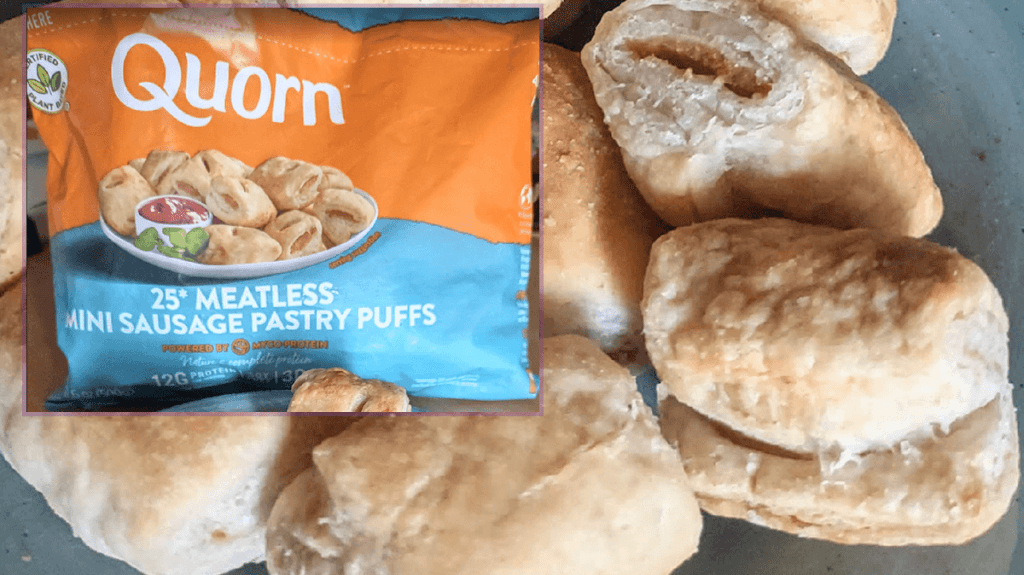
I was quite excited to find Quorn vegan sausage rolls at the Grocery Outlet. Technically the product is called Quorn Meatless Mini Sausage Pastry Puffs – I guess QMMSPP for short?! But I’m just going to stick to calling them (vegan) sausage rolls here. I consider myself an aficionado of sausage rolls (or at least an enthusiast) and think that these are pretty darn good.
One small complaint: I’d like them to be a bit meatier, with more filling to provide more bite. The filling is mainly Quorn’s “Mycoprotein” – a fungus that’s grown in a fermenter (like brewing beer but without the alcohol) that has a nice meaty texture. Overall, they are very well made with perfectly flaky pastry and a nicely spiced vegan sausage filling.
Quorn sausage rolls – ingredients and nutrition facts
Quorn Meatless Mini Sausage Pastry Puffs, Ingredients: Water, Wheat Flour (Wheat Flour, Calcium Carbonate, Iron, Niacin, Thiamine), Palm Oil, Mycoprotein, Onion, Wheat Gluten, Contains 2% or less of: Canola Oil, Yeast Extract, Pea Protein, Salt, Natural Flavors, Maltodextrin, Methylcellulose, Potato Protein, Dextrose, Calcium Chloride, Pea Fiber, Potassium Chloride, Spices, Wheat Starch, Red Beet (Color), Calcium Acetate, Carrageenan, Sodium Alginate, Spice Extracts (Paprika, Capsicum, Black Pepper, Nutmeg, Ginger), Caramelized Sugar Syrup, Citric Acid, Sodium Metabisulphite (Preservative), Onion Powder, Sugar, Sunflower Oil.
The product is mainly composed of water, flour, palm oil, Quorn Mycoprotein, onion, and wheat gluten, with most of the other ingredients added for flavor. As you can see from the nutrition facts, below, they provide 12 g of protein per serving, which isn’t bad. They also provide 3 grams of dietary fiber (11% of our recommended intake) and are low in added sugar. But I’d prefer more protein and definitely less fat.
It’s not just that there’s a bit too much saturated fat from a health perspective, but they also taste a bit too fatty. More importantly, palm oil should be used sparingly, considering the industry’s impact on rainforest habitats.
Quorn’s policy on palm oil sourcing
So the elephant in the room is Quorn’s use of palm oil for this product. I understand why they use it – it’s a useful fat for making vegan pastry, especially puff pastry. Here’s Quorn comment on their use of palm oil in some products:
We use palm oil in Quorn products where it’s needed to help create great taste and texture. We use sustainably produced palm oil certified to the segregated model as a minimum by the Roundtable on Sustainable Palm Oil (RSPO). Do you know that palm oil is a very versatile vegetable oil with higher yield and efficiency compared to other vegetable oils, which take between 4 and 10 times less land to produce? Also, palm oil production creates millions of jobs in Asia, Africa and Latin America, contributing to economic growth in the areas, improving farmers’ livelihoods and reducing poverty. – Quorn FAQs.
Palm oil does have a good yield per hectare as well as a few other environmental benefits. I’m all for using palm oil if it’s ethically sourced, but that’s rare. In the last post on Spectrum organic oils, I was happy to see that their one palm oil product addressed the downsides of palm oil industry:
Spectrum only has one palm oil product (shortening) – it’s sourced from Colombia and is certified both fair trade and organic, avoiding most of the human and environmental downsides of palm oil. – Spectrum ethical rating
Quorn, on the other hand, mentions that “palm oil production creates millions of jobs” without addressing the human rights issues in the industry (for example, by sourcing fair trade palm oil). I always look to support companies that help create positive change in problematic industries, but is Quorn doing enough here?
In 2019, we achieved 100% fully segregated Roundtable for Sustainable Palm Oil (RSPO) palm oil. This means any palm oil we use is physically separated from non-sustainable oil, all the way from the mill to the manufacturing site of the final product. We continue to work with the RSPO, our suppliers, NGOs and other businesses to promote the use and benefits of sustainable palm oil. – Quorn FAQs.
So Quorn’s palm oil is all certified by RSPO at the second-highest level, Segregated (the highest level is Identity Preserved). I wish I could say that the RSPO model worked but all the papers I’ve read indicate that RSPO certification doesn’t significantly help to conserve biodiversity. (Please send me a link if you know of any peer-reviewed paper that suggests that it does).
It counts for something that Quorn’s palm oil is certified at the higher segregated level, but that’s not sufficient to turn this into a positive.
Ethical rating for Quorn sausage rolls
I’ve rated Quorn before so I’ll refer you to those posts for more background on the company and its social and environmental impact: 2019 on the GSP and 2024 here on EB.
I think that Quorn deserves a perfect score of 5/5 Green Stars for many of its vegan products. Quorn’s Mycoprotein is a unique solution to our meat-driven social and environmental problems. Researchers from the Potsdam Institute for Climate Impact Research projected large benefits from even a partial switch from beef to microbial protein (like Quorn’s Mycoprotein):
Replacing 20% of the world’s beef consumption with microbial protein, such as Quorn, could halve the destruction of the planet’s forests over the next three decades, according to the latest analysis. – The Guardian.
This particular product, Quorn’s vegan mini sausage pastry puffs, contains more palm oil than Mycoprotein, so that needs to be factored in. Quorn’s sourcing of palm oil, RSPO Segregated, is perhaps better than the average food company but is still a negative. This is the biggest (almost the only) issue with this product and, as a result, I think an appropriate rating is 3.5 Green Stars for social and environmental impact. What do you think?
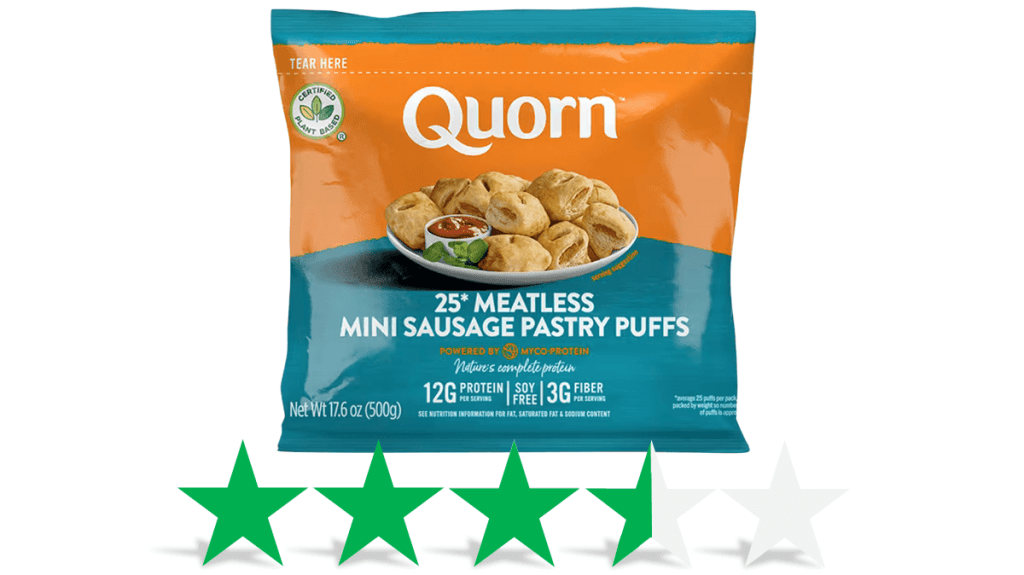
Summary scores (out of 5) for Quorn’s vegan mini sausage rolls:
- 4.5 gold stars for quality and value.
- 3.5 Green Stars for social and environmental impact for the organic products (4 stars on average)
This product would be better on several levels if it contained more Mycoprotein and less fat. Even better if that fat was more demonstrably ethical palm oil (e.g., fair trade, organic, shade-grown, Palm Done Right, polycultured, grown in less sensitive countries, etc.) and/or alternative fats such as ethically sourced shea, rapeseed (canola) or coconut.
This would maintain Quorn’s status (in my opinion) as top 10% ethically (i.e., 5/5 Green Stars).
What do you think? Comment below with your rating if you like!
[PS: I just found that you can use healthier canola (rapeseed) oil instead of saturated fats like palm oil to make vegan pastry! Why isn’t this becoming an industry standard?]
Join the Green Stars Project!
Take part by including a Green Stars rating when you review a product or business.
Check out sister site The Green Stars Project for a wider discussion on ethical consumption and social/environmental issues. Here are few articles relevant to Quorn and palm oil:
 Grocery Outlet Ethical Bargains
Leave a comment