
I’m evaluating Earthbound Farm in part because I just finished a post on organic certification on the GSP and the company came up a couple of times. In The Omnivore’s Dilemma, Michael Pollan associated Earthbound Farm with the concept of “Big Organic.” I’ll address some of Pollan’s concerns below but first, let’s review the product!
Review of Earthbound Farm greens
I bought a box of Earthbound Farm organic baby spinach at the Grocery Outlet – $4.99 for a large 1 lb. box, instead of the regular price of around $5.99. I normally buy my spinach and mixed greens from a local fruit and veg store where they are sold loose, by weight. I also like to buy Napa cabbage as it lasts for over a month in the fridge, gradually getting smaller as I peel leaves off to use on burgers or in hot pot dishes. Napa cabbage – that’s my top tip for avoiding food waste from wilted greens 🙂
So I don’t normally buy Earthbound Farm greens, but I know several friends who do – especially the Costco shoppers – and I don’t judge! Yes, it comes packaged in a big plastic box but if it works for them and encourages them to eat more spinach and less beef, then it’s worth it. A review on A Billion mentions that “a container lasts for over a week in the fridge with minimal wilting.” Indeed, my baby spinach has not deteriorated noticeably in the week since buying them – they are still squeaky-fresh enough to be the star of their own salad.
And these resealable boxes of prewashed leaves do make it a bit more convenient to eat your greens. Since buying my box of baby spinach, I found that I’m more likely to use a little every day – maybe because all that’s required is grabbing a handful of leaves or perhaps cos the box takes up so much space in the fridge that it’s hard to ignore! I put some into a grilled cheese (w/ Parmela vegan cheddar) one day and the next day sautéed some with garlic to have as a side-dish.
Packaging for Earthbound Farm greens
Yes, the salad greens come in a big plastic box – not great compared to buying in bulk in a reusable or compostable bag. But there have been some developments in making Earthbound Farm packaging more sustainable over the years.
First, the boxes are made from 100% post-consumer recycled (PCR) plastic and the corrugated shipping cartons are made from PCR cardboard. The plastic (PET) is also recyclable – with the caveat that plastic recycling markets are not healthy in the US. The best way to create a better market for recycled plastic better is for companies to use PCR fibers when possible, so it’s good that Earthbound Farm made this choice.
Even better would be to reduce plastic content, of course, and Earthbound Farm has been working on that too. The amount of plastic has been reduced by over a third by switching from hard lids to peel-and-reseal film. There’s also no printing or labels on the carton, increasing its likelihood of being actually recycled.
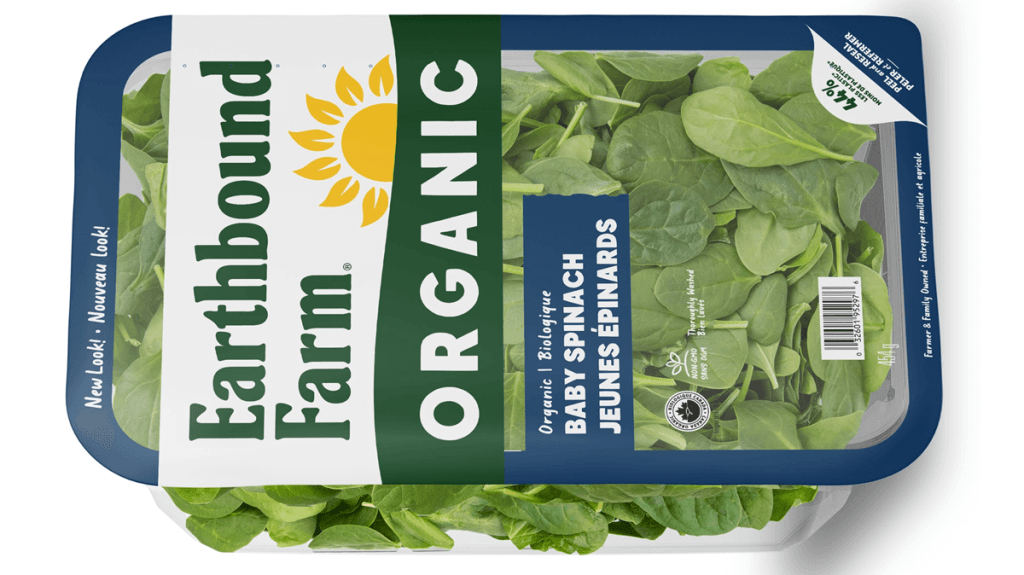
However (!) it turns out that these clamshell-type cartons are not so likely to be recycled as PET bottles because they are made by thermoforming instead of the blow-molding process used to make bottles. It’s lower-grade plastic and much harder to find a market for.
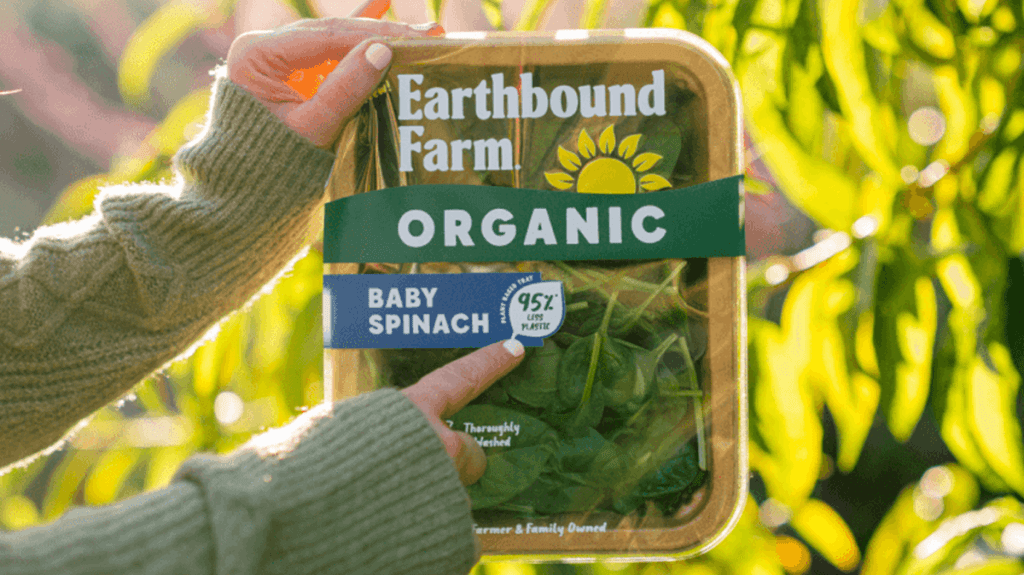
But the best development so far has been the replacement of Earthbound Farm’s plastic carton with a “first-of-its-kind plant-based tray made from recycled plant-based fibers.” These new trays, which I guess are still being tested in select markets, are recyclable and also in the process of being certified as biodegradable. My box from the Grocery Outlet wasn’t made from the plant-based fibers, alas, but had the peel-and-reseal film and messaging that it requires 34% less plastic.
I’ll continue to buy my baby spinach in the bulk section of the local fruit & veg market but these improvements on the packaging footprint make me more likely to consider Earthbound Farm greens in a pinch. Let’s take a look at some other aspects of the company.
Earthbound Farm and Big Organic: two perspectives
In a parallel post on the GSP, after weighing the pros and cons of organic versus industrial agriculture, I recommended that we support organic agriculture when possible. In The Omnivore’s Dilemma (2006) Michael Pollan discussed the onset of “Big Organic” – questioning whether organic agriculture has become watered down as it has grown in popularity and scale. I want to briefly discuss this in the context of Earthbound Farm, which is the largest producer of organic salad greens in the US.
In his book, Pollan examines the social and environmental impact of an organic dinner made from supplies bought at Whole Foods, which included a box of Earthbound Farm greens. He refers to Earthbound Farm as “a company that arguably represents industrial organic farming at its best,” but also expresses concerns about how organic practices have changed. He points out some compromises made back when the US Dept. of Agriculture and various farmer groups argued over the rules of organic certification. Then he discusses the large-scale producers that the bigger supermarket chains prefer to deal with, wondering whether more compromises have been made.
Having researched Earthbound Farm, I think there are pros and cons that come with the scale of the company. I like being able to buy loose organic baby spinach in my local store, but not everyone has that option. Earthbound Farm has clearly brought organic greens to a wider audience.
Earthbound Farm was founded in the Carmel Valley, California, in 1984, acquired in 2014 by WhiteWave Foods, in 2017 by Danone and in 2019 by Taylor Farms – returning to “local roots and family ownership.” It is the largest producer of organic salad greens in the United States.
On one hand you could imagine that Earthbound Farm’s large-scale farming and heavy use of technology, loses some of the ideals that we associate with organic agriculture – small fields surrounded by hedgerows that provide habitats for local wildlife.
On the other hand, Earthbound Farm’s use of technology (sensors and software) to economize on the use of agricultural inputs (water, nitrogen, etc.) is hardly a bad thing.
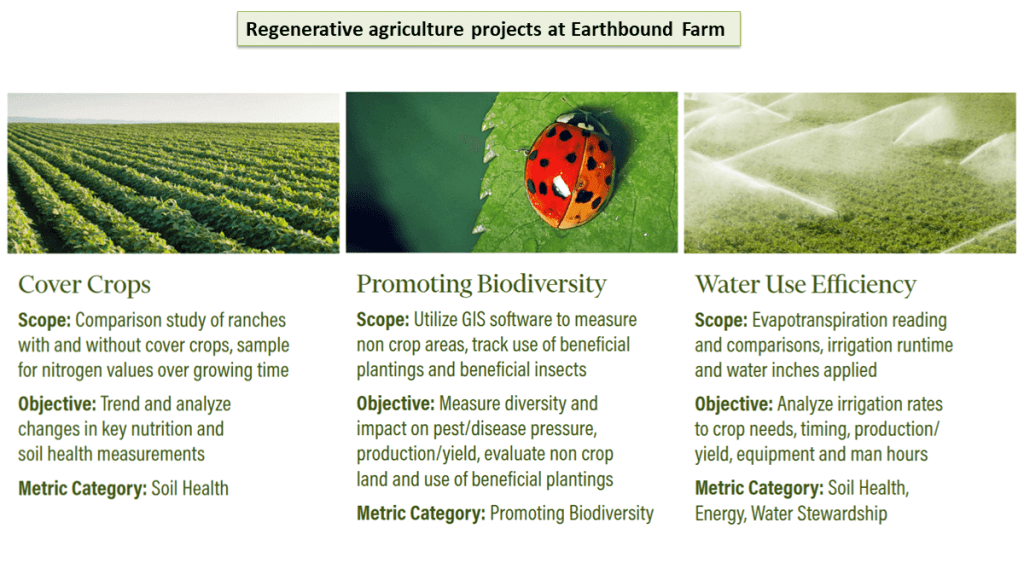
The company also runs trials to determine which conditions work best in terms of yields, water footprint, etc. – potentially making valuable advances in organic farming.
As explained in the GSP posts on organic farming and how to feed the growing population without further deforestation, the downside of organic farming is that it generally offers lower crop yields compared to conventional, industrial farming. Some argue that it would be good to have a hybrid system that combines the best of organic and industrial farming, in order to conserve land. Well, when we look at the environmental footprints of various foods, the answer to our problems is to reduce red meat consumption. But yes, making organic a little more efficient is part of the solution too.
I don’t think that Earthbound Farm compromises on the most important tenets of organic farming – it qualifies as certified organic under the USDA rules, by avoiding synthetic pesticides, etc. I would argue that the company is at the very least a useful experiment in the future of agriculture.
Long-distance greens
Another issue raised by Pollan is that the Earthbound Farm greens are shipped long distances. He’s a little unfair in looking at this from the most extreme perspective – amount of energy required to transport the greens on a per-calorie basis! Everyone knows that we don’t eat greens for their caloric content – if the carbon footprint had been expressed per unit of antioxidants the picture would look quite different.
But, in any case, Earthbound Farm has changed since Pollan published The Omnivore’s Dilemma as there are now supplier farms located all over the US (plus Canada and Mexico).
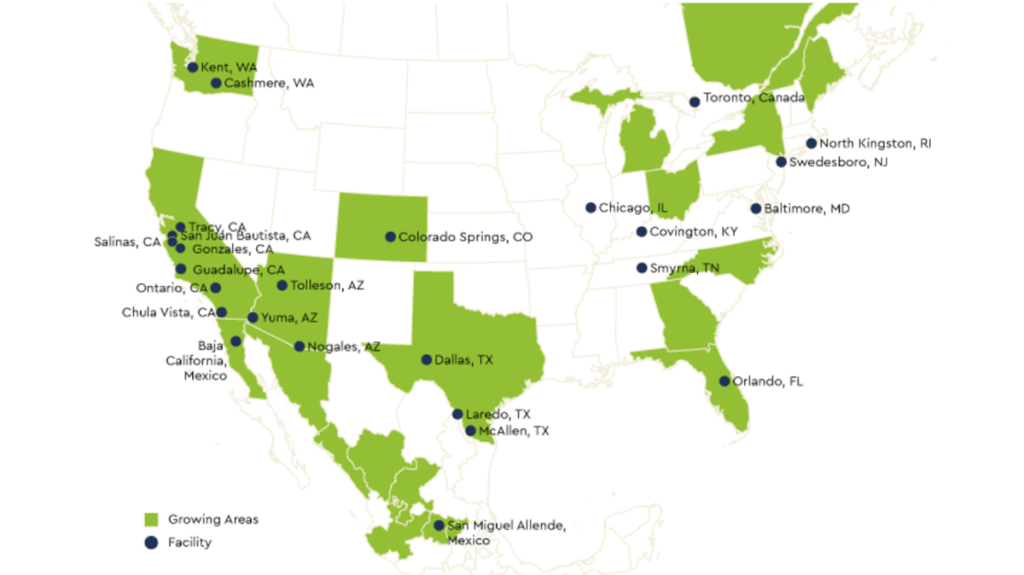
Pollan tries to set up a big idea with his Big Organic chapter (and various articles on the same theme) but actually the arguments don’t really hold up very well. For example, he discusses all the fuel used in trucking compost into large organic farms, but then begrudgingly mentions that organic produce has an overall lower carbon footprint than industrially farmed produce.
I do take his point, that there are downsides to large-scale centralized supply chains, but my take on all of these issues is to simply incorporate them into an overall assessment of how a product rates on an ethical scale. So, to that point, here’s my overall rating for my box of organic spinach Earthbound Farm.
Ethical rating for Earthbound Farm
I’m rating Earthbound Farm in general 4/5 Green Stars for social and environmental impact. But the products packaged in the new plant-based trays get a higher rating of 4.5 out of 5 Green Stars. My ratings are based on the following:
- Leafy greens such as spinach tends to have small environmental footprints, especially when organically grown, while also being highly nutritious. This is true for most fruit and veg – see this paper for more detail. Adopting a plant-based diet is the top thing you can do to mitigate climate change, deforestation, animal cruelty, and food scarcity.
- Earthbound Farm greens are organic, avoiding synthetic pesticides, etc. I’ll refer you to the GSP post on whether you should support organic farming for a general discussion on organic agriculture. More specifically, on an annual basis, Earthbound Farm’s organic farming methods “avoid the use of 18.4 million pounds of conventional agricultural chemicals; Conserve 3 million gallons of petroleum by avoiding the use of petroleum-based pesticides and fertilizers; Sequester as much CO2 as taking 12,600 cars off the road; Provide a safer environment for farm workers as well as neighboring homes, schools and businesses by avoiding the use of harmful agricultural chemicals.”
- Packaging has been improved over the years as described above. Trays are made from post-consumer recycled (PCR) plastic but Earthbound Farm recently launched a new version made from plant fibers. Shipping cartons are made from PCR cardboard.
- The greens are a little bulky (the way they are packaged) and because they generally require refrigeration during storage, transportation, and display cases in supermarkets, that’s a lot of refrigeration. Would be good to see Earthbound Farm discuss the use of green refrigerants – replacing hydrofluorocarbons, which are potent greenhouse gases, with safer alternatives.
- Earthbound Farm (and parent company Taylor Farms) is actively engaged in trials that explore various strategies in organic farming. This work should yield valuable information on improving soil quality and reducing agricultural inputs. To me, these contributions to the advancement of sustainable agriculture offset the downsides of “Big Organic.”
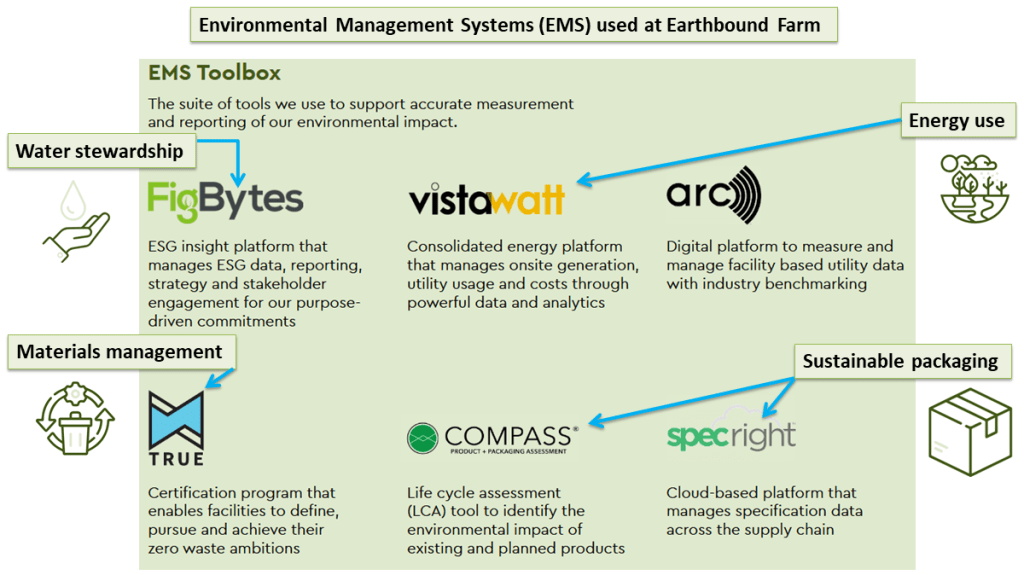
- The company also utilizes various environmental management system tools to economize on resources such as energy, waste, and packaging.
- Taylor Farms did release an impact report in 2022 but has not released another since then. The Taylor Farms blog does, however, include several updates on sustainability and social impact.
- In 2024, Earthbound Farm was named in Inc.’s Best in Business list, in the sustainability category. It’s a pretty short list of winners actually and seems quite thoughtful. (Some organizations give out sustainability awards to very dubious recipients like Nestlé and Coca-Cola, losing all credibility, in my opinion.) “To earn this award, Earthbound Farm developed more sustainable packaging formats [and] invested in innovative farming practices such as regenerative organic and greenhouse farming
- Dedication to reducing waste: “Taylor Farms is the first fresh food company to achieve TRUE (Total Resource Use Efficiency) Platinum Certification for Zero Waste.” “Three of our California facilities are now TRUE PlatinumZero Waste Certified, and more than 90% energy independent. Since 2018, we have reduced our greenhouse gas emissions by over 175,000 metric tons (that’s over 37,000 cars off the road annually).” – Taylor Farms
Summary scores (out of 5) for Earthbound Farm organic greens:
- 4 gold stars for quality and value.
- 4.5 Green Stars for social and environmental impact for products packaged in the plant-based trays. 3.5 Green Stars for the older products, packaged in plastic trays.

What do you think – is this fair? Comment below with your rating if you like!
Join the Green Stars Project!
Join the Green Stars Project (GSP) movement by including a Green Stars rating whenever you write a review. This is one of the most effective ways to hold corporations accountable while sharing our knowledge on ethical issues.

 Grocery Outlet Ethical Bargains
Leave a comment