
I’ve never reviewed a nut company before, although the topic of nuts in general has come up on GSP posts on the environmental footprints of various foods and how to reduce our water footprint. I’ll give you a really quick summary of the information from those posts (which examine the best science on the topic):
- Yes, tree nuts like almonds, pistachios, and cashews have large water footprints. When water scarcity is factored in then nuts grown in dry regions like California can have a big impact on local water availability.
- However, the other four major environmental footprints (greenhouse gas emissions, land use, eutrophication, and acidification) for tree nuts are pretty small, especially compared to animal proteins.
- Groundnuts, which include peanuts (and bambara nuts) are actually legumes and they generally have smaller environmental footprints (especially water, but not carbon) than tree nuts.
So, considering all that, it’s good to remember that Planters is predominantly in the business of selling legumes – peanuts. Look no further than the company mascot, Mr. Peanut.
Review of planters products
There’s usually a range of Planters products on sale at the Grocery Outlet, so I’ve been trying them out for the purposes of this post. The sacrifices I make! But this assessment of Planters is useful for me too. Like many people, I’ve felt ambivalent about nuts since learning about their water footprint and certain social impacts.
But, after looking into the broader environmental impacts, I feel that a moderate intake of various nuts does make sense for a planet-friendly diet. Accepting that, then the main objective when buying nuts becomes finding responsible producers. We’ll get to the Planters ethical rating later but first, here’s a brief reviews of the products that I’ve tried.
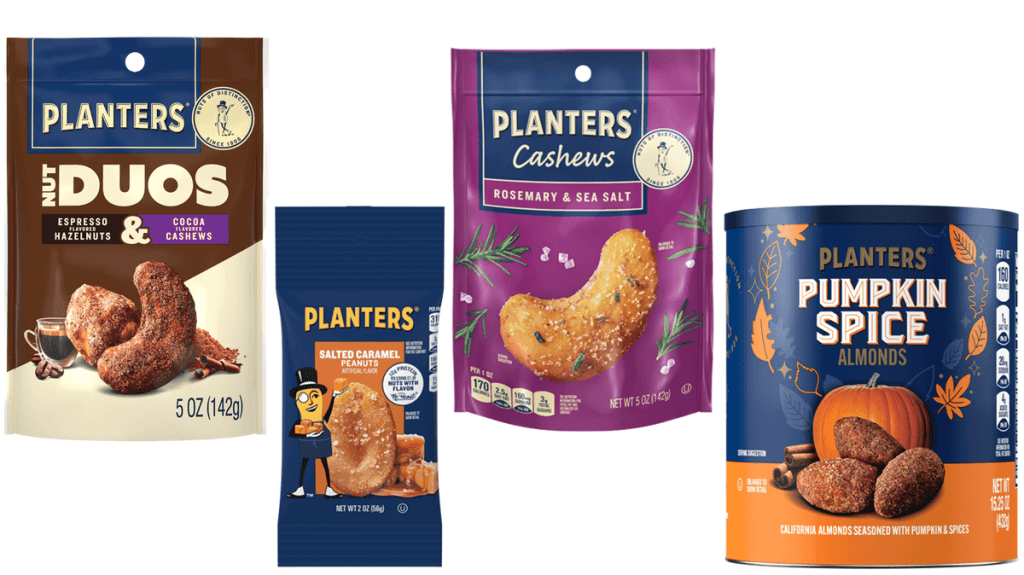
Planters Duos – espresso flavored hazelnuts combined with cocoa flavored cashews. These were on sale at the Grocery Outlet at only $1 for a 5 oz. bag, compared to a normal price of around $4-7. I thought these were quite successful, although I’d prefer if they were more salty than sweet, and friends who tried them also liked them. I’m a fan of anyone who can make hazelnuts (or walnuts) into tasty snacks as they are among the most sustainable tree nuts.
Planters salted caramel peanuts. These were on sale at the GO for $0.33 (or $0.25 in some stores) for 2 oz. bags that normally retail for around $1.50 each. If you want to bring a high-density snack with you for the day then these little packs work quite well, providing 12 grams of protein, 24 g fat (3 g saturated fat), 11 g sugars, 4 g fiber and 310 calories per 56 gram (2 oz.) serving. I thought they might be too sweet but the salt just about saves them from this. Having said that, they taste more like sweets than nuts but as long as you think of them that way they’re not bad! High-protein sweets 🙂
Planters rosemary and sea salt cashews. $1.99 for a 5 oz. bag at the GO, compared with the normal retail price of $4-5. I knew that these would probably be my favorite among these Planters products since I prefer my nuts to be savory and I love rosemary. And indeed they were my faves!
Planters pumpkin spice almonds. These are $3.99 for a 15.25 oz. tin at the Grocery Outlet, compared to a normal price of around $11. I didn’t think these were going to be that great, to be honest, but they surprised me by being quite subtly flavored. Not bad for a hiking snack and a crazy-low price for almonds. Per 28 g serving they contain 5 g protein, 12 g fat (1 g saturated fat), 5 g sugars, and 3 g fiber – in the same ballpark as the salted caramel peanuts.
There are a few other Planters products at the Grocery Outlet – Planters Salt and Vinegar Cashews (only $1 for a 5 oz. bag) and dry-roasted peanuts.
Just for fun (although maybe you won’t find it fun at all!) I’m going to do the ethical evaluation of Planters in a kind of debate. I think this will be useful exercise as it’s very natural to react strongly to social and environmental issues – in some cases we overreact and needs to take a breath and put it in perspective. Let’s start with a hot button topic on Planters – at least in the Reddit universe.
Some Planters nuts are not vegan! (Not even vegetarian!)
It turns out that some Planters products – dry roasted peanuts in particular – contain gelatin as an ingredient. This means that they are not suitable for vegans or even for vegetarians, since gelatin is made from animal skin and bones.
There are plenty of strong reactions to this on Reddit. Here are a couple of them:
Was eating Planters Dry Roasted Peanuts. Randomly decided to look at the ingredients list, and… are you f#@king kidding me?
I’m too grossed out to wonder why gelatin should be anywhere near peanuts…
But, to their credit, most vegans and vegetarians on Reddit are not unreasonable or angry – they are just disappointed 😉
One of the cooler heads on Reddit points out that:
They spend millions of dollars on research and development. If a product contains a specific ingredient, it is not “for no reason” or as a “conspiracy against vegans”. The presence of any ingredient is designed to contribute to the flavor, texture, or some other attribute of the product, while maintaining the pre-established parameters (cost, production time/ease) of said product.
So you could say that it’s the company’s prerogative to weigh all factors and make a business decision to include gelatin. It seems to me like a bad business decision, considering how many vegetarians and vegans rely on nuts in their diet. Even on the Planters website there are many 1-star reviews of their dry-roasted peanuts, with the main criticism being the presence of gelatin. But it’s their business.
However, I have to say (Ooh, gossip!) that I noticed that some of the Planters product webpages for dry roasted peanuts just happen to obscure the fact that gelatin is an ingredient. As shown in the screenshots below, the photo of the 6 oz. bag is too blurry to read the ingredient list. For the 7 oz. jar, there’s a much sharper image but wait, the product is oddly rotated so that a few of the ingredients are hidden from view – including gelatin!
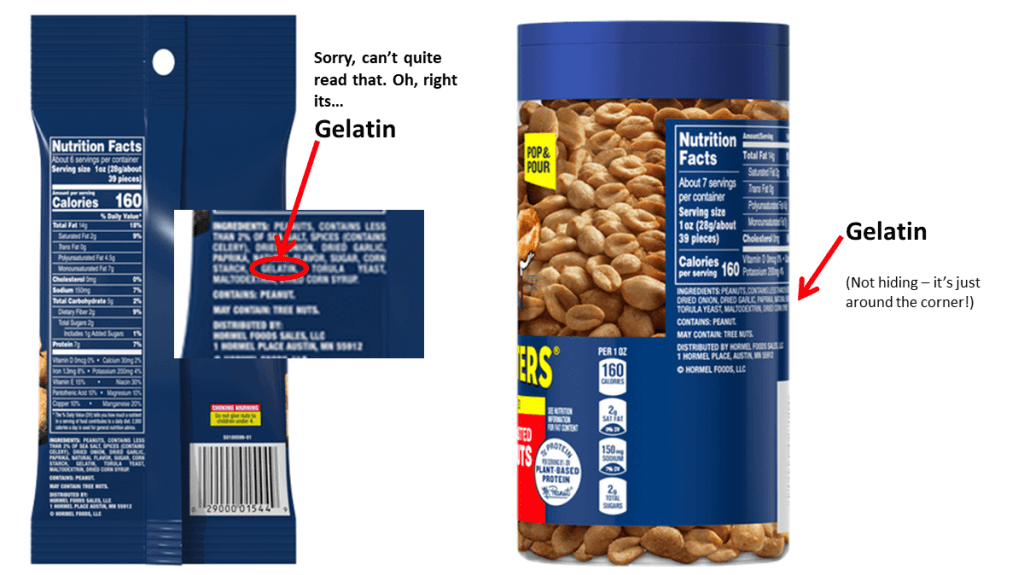
So that is annoying and seems disingenuous, in my book. My take on this issue is that it’s one thing to make add gelatin to an otherwise vegan product but another thing to not make this clear to customers. It seems that Mr. Peanut wants to have his cake and eat it… So Mr. Peanut has dropped the ball there… Darn, I can’t decide on a metaphor!
The funny thing is, most dry-roasted peanuts sold in the US suck! I always pick some up when in Europe because the spicing/roasting is far superior. They’re crunchier, tastier and are also vegan. It’s not freaking rocket science, Mr. Peanut!
Planters is owned by a meat company
To be more exact, Hormel Foods Corporation, which acquired Planters in 2021, is mainly a meat company (most famous for SPAM!) but also owns other brands now. Many of the non-meat brands are in the nutty space – there’s Skippy (peanut butter) and Justin’s, which makes organic nut butters and peanut butter cups.
So, I think there are two main perspectives on this. On the one hand, you could say that you don’t want to support a company that’s mainly in the meat business. A quick browse through the Wikipedia page on Hormel Foods reveals some pretty disturbing cases of animal abuse at Hormel suppliers, for example.
On the other hand, a pragmatist might point out that many food conglomerates own meat brands and that supporting the plant-based side of the business helps moves the needle in that direction. They could argue that animal abuse is not uncommon in the meat industry, so a company the size of Hormel Foods is bound to encounter some bad actors in the supply chain. Hormel gets a low rating for animal welfare by the Business Benchmark on Farm Animal Welfare (BBFAW) but this is true for most large food corporations – very few companies (Marks and Spencer is one of them) received a “good” rating from the BBFAW.
I’ve discussed this topic before – in a GSP post on whether to support vegan brands that are owned by mediocre parent corporations and also in specific case studies here on Ethical Bargains. For example, I’ve argued for supporting Lightlife – a vegan brand owned by one of Canada’s biggest meat companies – because we want these companies to pivot towards more sustainable plant-based foods, after all.
My main lookout here is whether a brand like Planters has maintained its integrity (or even improved) under the current owners. The inclusion of gelatin in Planters dry roasted peanuts started well before the acquisition by Hormel Foods. So let’s look at some other social and environmental factors.
Planters nuts: Social and environmental impact
Regarding the social and environmental impact of nuts, I concluded above that nuts can have a place in our diet, but that we should seek out responsible producers.
Not to slut-shame Mr. Peanut, but before Planters was with Hormel Foods it was part of Kraft-Heinz (and part of Standard Brands and Nabisco, before that). During the Kraft era, the Planters website touted the company’s partnership with the African Cashew Alliance, which is also supported by the Bill & Melinda Gates Foundation. You can find out more about the company’s relationship with suppliers in this 2010 interview and this 2011 video. However, now that it’s part of Hormel Foods, the current Planters website has no information on sustainability.
I read through the Hormel Foods 2023 Global Impact Report and, although it’s 112 pages long, there’s very little information about nut supply chains or Planters in particular. Here’s the only reference to social or environmental impact of Planters:
Specifically, in 2023, we used more than 100,000 pounds of PCR [post-consumer recycled] content in the pouches of the Planters® 5-ounce flavored cashews to reduce the environmental impact of this product’s packaging.
The report also provides details on expenditures on giving “diverse companies, such as small, women-owned, minority-owned, LGBTQ+-owned and veteran-owned businesses, the opportunity to supply quality products that meet our company’s growing business needs.”
There was also a 2022 press release, which is one of the few communications from Planters on sustainability, since the brand was acquired by Hormel Foods. It was all about the “new peanut-shaped sustainable packaging, which uses 8% less plastic than its dry-roasted nuts’ standard 16-ounce bottles.”
The 8% reduction in plastic use is fine, but if that’s their biggest news on the sustainability front, it’s quite lame. Incorporating post-consumer recycled plastic into Planters cashew packaging sounds good, but it’s unclear whether this will be continued.
The bottom line is that Planters has communicated very little on its social and environmental impact since the acquisition by Hormel Foods in 2021. The website contains no information on topics such as cashew souring that were covered in older versions of the website. However, checking on the always-helpful Internet Archive, I see that all of this content was removed from the website around 2015, when parent company Kraft foods merged with Heinz to form Kraft-Heinz. That doesn’t necessarily mean that the company stopped all efforts on the social and environmental fronts – it just stopped communicating them on the product website. For example, the website never reported that a Planters nut roasting facility was given a zero-waste award in 2015 by the state of Arkansas.
Summary: Ethical rating for Planters
Dear Mr. Peanut,
I’d be more of a cheerleader if Planters stepped up on improving the company’s social and environmental impact and also being more transparent about it. On the social front, it would be huge if Planters committed to sourcing some Fairtrade-certified nuts. Would also be great to see the company demonstrating its continued support of African cashew farmers, for example, or responsible sourcing of hazelnuts. On the packaging front, it would be good to know more about how it’s going with the incorporation of PCR plastic. Another positive step would be to make their nut cans recyclable – perhaps follow in footsteps of Pringles, which recently introduced a new tube in the UK that’s suitable for cardboard recycling by replacing the metal base with cardboard.
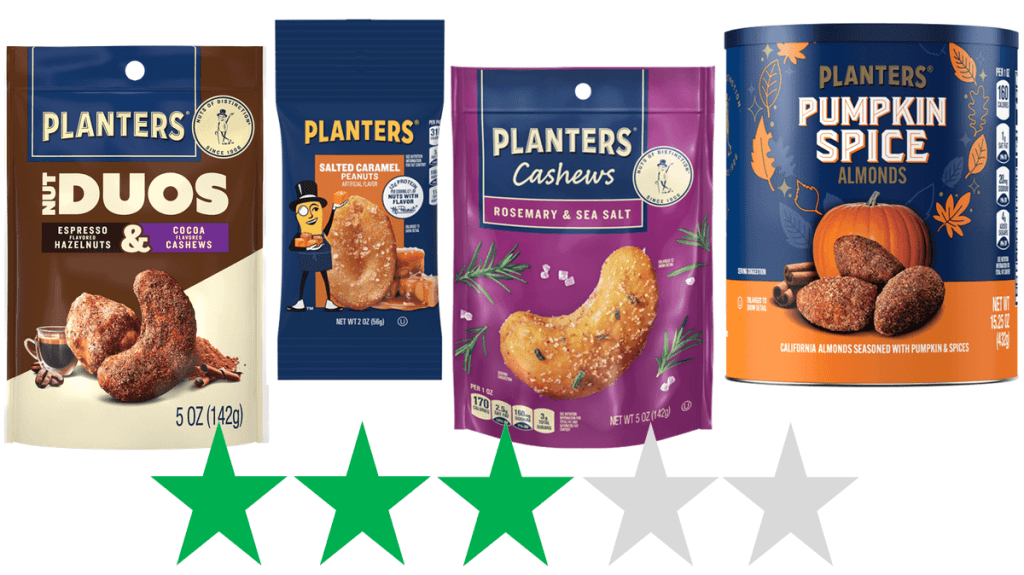
The bottom line is Planters needs to do better on both transparency and effort on the social/environmental fronts. At the same time, peanuts and tree nuts are among the most sustainable sources of protein available to us. All things considered, I think the Planters products covered above (which excludes the gelatin-containing dry-roasted peanuts) deserve a score of 3 out of 5 Green Stars for social and environmental impact.
What do you think – is this a fair rating?

 Grocery Outlet Ethical Bargains
Leave a comment