
The Grocery Outlet is having a surprise wine sale, starting tomorrow! It runs from June 11-18 and wines will be discounted an extra 20% on top of the already discounted prices. But, as an additional twist, on the first day of the sale only (Wed, June 11), customers who use the Grocery Outlet app will receive a 25% discount on wine instead of 20%.
I realized that I’m not on the GO mailing list (I’ve fixed that now) but apparently there was an email sent out yesterday announcing all of this. The app is worth downloading (and it’s free, of course) as you’ll occasionally get coupons for $5 off, and that kind of thing. I don’t work with the Grocery Outlet by the way – this site is basically a collection of case studies (as part of The Green Stars Project) that evaluate brands in terms of social and environmental impact.
Picks for the Grocery Outlet summer wine sale
I’m used to the Grocery Outlet having wine sales in spring and autumn, so I’m usually more prepared in terms of potential buys. However, I do have one pick that I’m going to hopefully recommend. I say hopefully because I haven’t tried it yet – but I will be having it with dinner later so I’ll let you know! The reason why it’s a pick is that it’s a Châteauneuf-du-Pape – one of my favorite wines – and even before the sale it was already very cheap.
Calvet Châteauneuf-du-Pape
My pick is the Châteauneuf-du-Pape from the very old French winemaker, Calvet. I picked up a bottle last week at my local Grocery Outlet – 2021 vintage – for only $10. That’s the lowest price I’ve ever seen for a Châteauneuf-du-Pape, which normally retail for $30-40 upwards. So I was fully expecting this wine to have a mediocre rating online, considering the price tag. But no! It has a score of 4.1 on Vivino, based on over 4,000 ratings.
For ratings on Vivino, I start to pay attention if it’s above 3.8 and is based on several hundred, preferably several thousand votes. So, with a rating of 4.1 that’s based on more than 4000 votes, this CdP looks like a clear buy at $10.
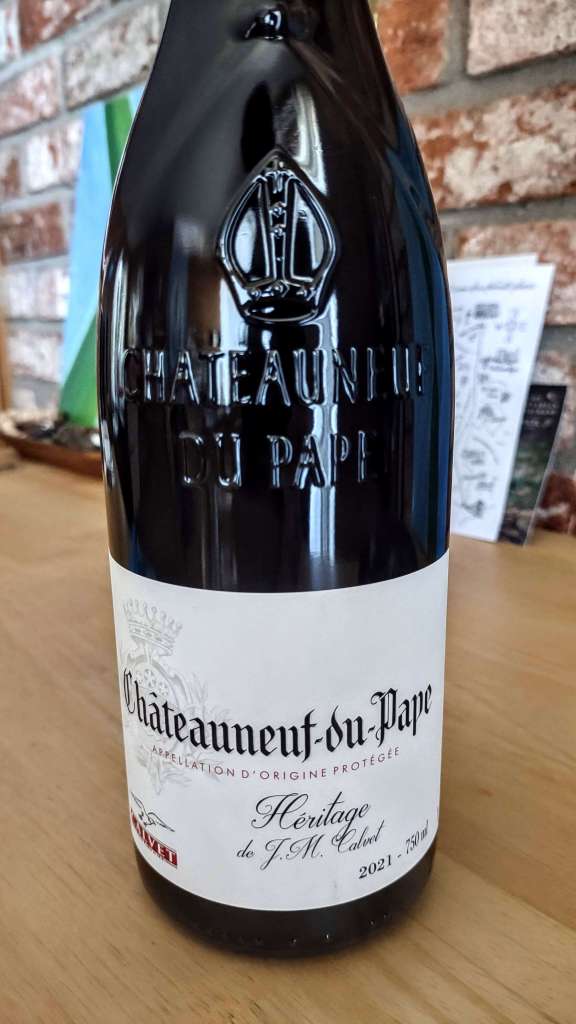
However, the 2021 vintage of Châteauneuf-du-Pape, in general, is not rated as high as any of the other years of the last decade – perhaps that’s the reason for the wine turning up at the Grocery Outlet. However, as both Robert Parker and this in-depth guide from The Wine Cellar Insider point out, 2021 Châteauneuf-du-Pape is generally ready to drink now, so that’s kind of an upside! Just don’t plan on hanging on to it much beyond 2030 – but considering how 2025 is going, I don’t think that’ll be an issue.
Maybe, 2021 Chateauneuf du Pape represents a modern, classic style. But, 2021 Chateauneuf is not a vintage to lay down for years. Being precocious, 8-12 years for the majority of wines is about right. – The Wine Cellar Insider
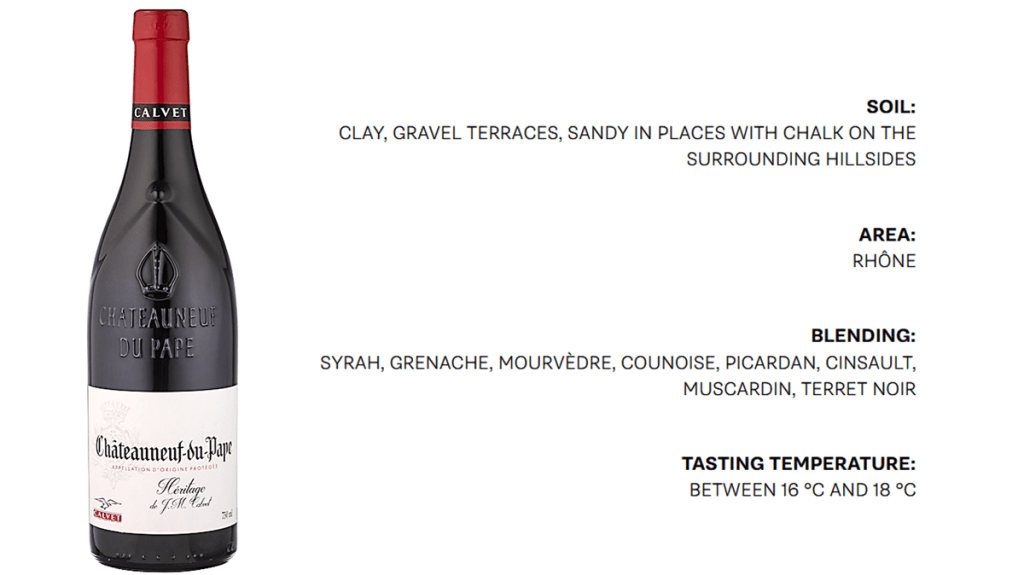
To be honest, there are several grapes in this wine that I’ve never heard of – Counoise and Picardan, for example.
Picardan or Picardan blanc is a white wine grape which is one of 13 permitted blending grapes within the Châteauneuf-du-Pape AOC in Rhône wine region in France, although very little planted. – Wikipedia.
Picardan did make me think of Captain Jean-Luc Picard, the iconic Star Trek character, played by Patrick Stewart. Picard comes from a French winemaking family and is filmed at “Château Picard” in several scenes from Star Trek: The Next Generation and Star Trek: Picard. Well, according to Wikipedia, Star Trek creator Gene Rodenberry was inspired by Swiss scientists named Piccard – twin brothers who were both hot air balloon explorers, believe it or not. Auguste Piccard became the first person to enter the Earth’s stratosphere, in a hydrogen-filled balloon in 1931.

So… back to the actual wine. I’ll report on how the Calvet Châteauneuf-du-Pape goes tonight after I try it with a Beyond Burger tonight! I do like the combination of beyond burgers and red wine – and it’s nice to be able to enjoy those experiences while living ethically on a budget. Speaking of which, here’s a little bit about the environmental footprints of wine.
The environmental footprints of wine
Back in January, on the Green Stars Project, I wrote about the environmental footprints of various foods, based on a seminal paper on the topic (Poore and Nemecek, 2018). I didn’t discuss the footprints of wine in that post, which focused more on protein-rich foods. Below is a condensed version of the main figure from that paper, which shows five major environmental footprints for various foods and drinks: greenhouse gas (GHG) emissions, land use, acidification, eutrophication, and water footprint (blue water, scarcity-weighted).
In order to appreciate this figure you have to notice that the numbers on the scales for beer and wine are much smaller to those for proteins, at the top. So, for example, GHGs for 100 g of protein from beef are 50 kg CO2 equivalents, on average, compared to only 0.14 kg CO2 equivalents for a glass of wine. In other words, the carbon footprint of a glass of wine is over 300 times lower than that of a serving of beef. The difference in land use is even bigger – the land footprint of wine is over 1000 times lower than that of beef. And the story is similar with the other three metrics.
So, some choices are much more important than others – replacing a beef burger with a plant-based version is a much bigger contribution to dealing with planetary boundaries such as climate change than drinking water instead of wine.
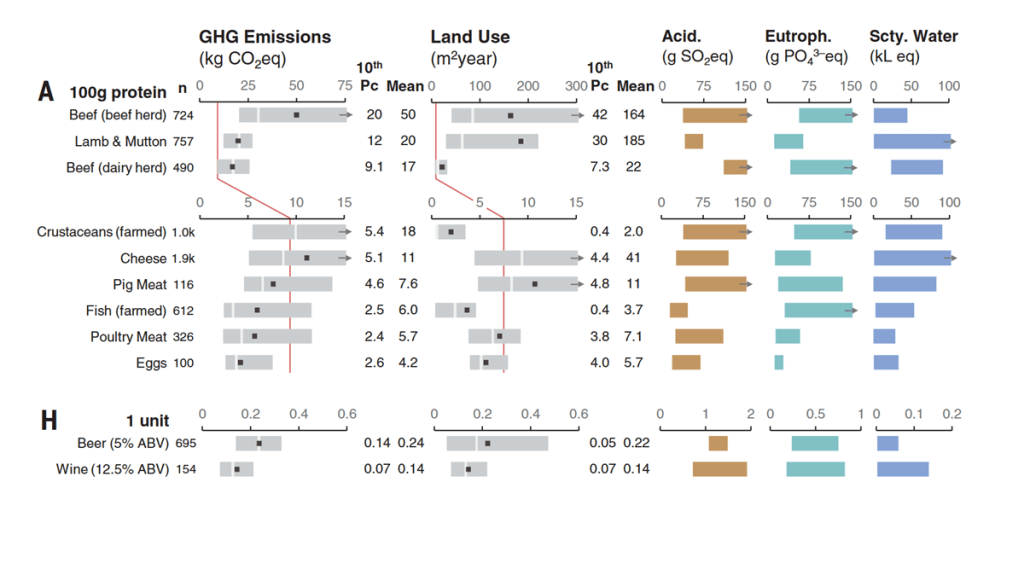
In order to appreciate this figure you have to notice that the numbers on the scales for beer and wine are much smaller to those for proteins, at the top. So, for example, GHGs for 100 g of protein from beef are 50 kg CO2 equivalents, on average, compared to only 0.14 kg CO2 equivalents for a glass of wine. In other words, the carbon footprint of a glass of wine is over 300 times lower than that of a serving of beef. The difference in land use is even bigger – the land footprint of wine is over 1000 times lower than that of beef. And the story is similar with the other three metrics.
So, some choices are much more important than others – replacing a beef burger with a plant-based version is a much bigger contribution to dealing with planetary boundaries such as climate change than drinking water instead of wine.
Three Rhone wine picks for the Grocery Outlet sale
The Calvet Châteauneuf-du-Pape is currently $10 at the Grocery Outlet but will be discounted 20% (to $8) during the sale. Plus, if you happen to go on the first day and use the GO App, you’ll receive 25% off, so it’ll be $7.50.
In case you don’t see this wine, here are two other picks from the Rhone region that are more widely available at the Grocery Outlet and also well worth seeking out:
- Vieux Clocher Côtes du Rhône, France ($8, or $6.40 during the 20% off sale)
- Domaine de Beaumefort Côtes du Rhône Villages, France ($9, or $7.20 during the sale)
Good luck with finding some wine that you love in the sale!
—
Join the Green Stars Project!
Join the Green Stars Project (GSP) movement by including a Green Stars rating whenever you write a review. This is one of the most effective ways to hold corporations accountable while sharing our knowledge on ethical issues.
For more information, see these articles on the GSP:
Why we need crowdsourced ethical ratings
How to decide on an ethical rating, taking the example of a café
 Grocery Outlet Ethical Bargains
Leave a comment