

Boursin has a vegan soft cheese – with garlic & herbs – that mimics the original Boursin cheese pretty darn well. I picked it up at the Grocery Outlet for a mere $0.99 (way cheaper than the normal price) and decided that I should try it in the name of research. I’ve tried out a few different vegan soft cheeses lately, as case studies for The Green Stars Project and also to spread the word on products that can help people transition to more sustainable diets. Of those that I’ve tried recently, I liked Nuts for Cheese and Treeline’s French-style soft cheese.
I can recommend this Boursin cheese for those looking for a tasty plant-based soft cheese. If you like the original dairy-based Boursin then I think you’ll like the flavor of this one too. The texture is a little different – a little more whipped and airy than the denser dairy-based Boursin, which makes it easier to spread on crackers. I thought that both the texture and flavor were on point but, perhaps more importantly, my sophisticated French friend really liked it (and her adopted-French husband too). The virtually empty tub at the end of a recent picnic served as evidence.
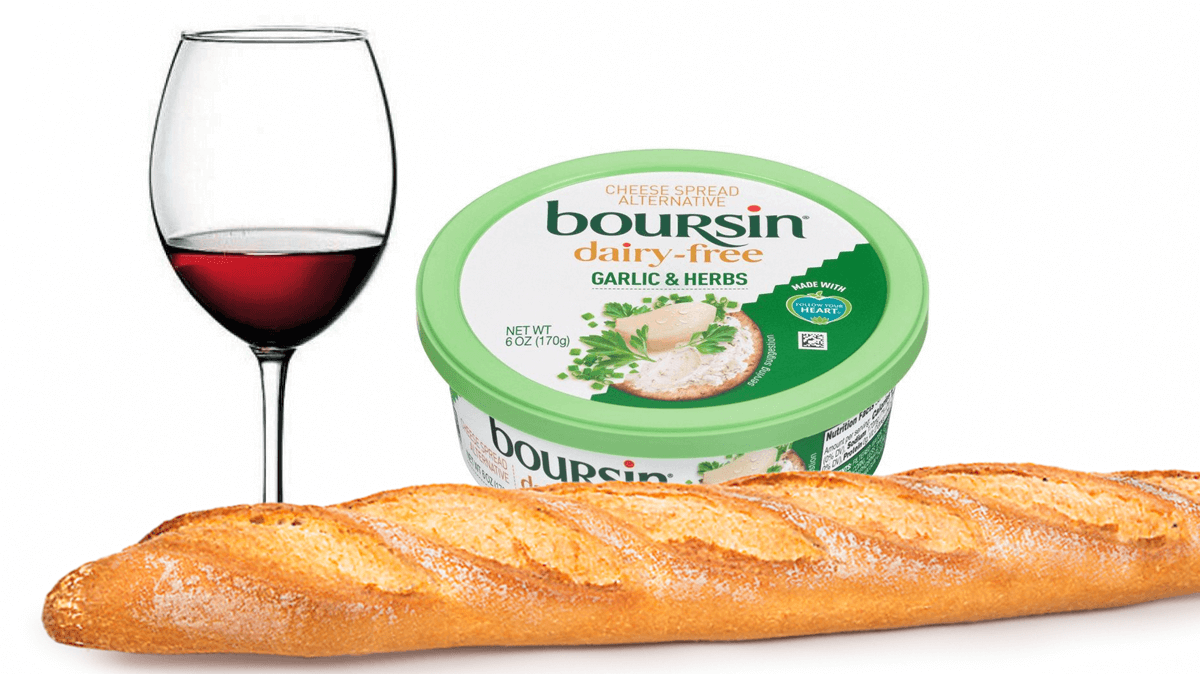
I generally steer clear of deli items that come in polypropylene tubs (#5 plastic) especially since you can easily make better versions for many of them at home (e.g., guacamole, hummus). But I would say that if the product helps you to replace dairy in your diet then you could think of the plastic as acceptable collateral damage. Having said that, Boursin could and should do better as polypropylene is not widely recycled in the US (much less than even PET and HDPE).
Greenpeace estimated the total domestic US capacity for recycling PET and HDPE in 2022 as only 21% and 10% of waste generated, respectively. The recycling capacity for all other plastics in the US is less than 5% and therefore Greenpeace has asserted that only PET and HDPE meet the U.S. Federal Trade Commission definition of recyclable. – my upcoming book 🙂
I came across reviews of this non-dairy Boursin cheese from two vegan bloggers who were both very excited in advance but then a little underwhelmed by the cheese, and each went on to say that they preferred their own homemade version. Now I’m curious to try one of these recipes for a cashew-based garlic & herb soft cheese and figure out if it’s something I’d do on a regular basis. One version from Vegan Food & Living entails soaking the cashews overnight while a recipe from My Quiet Kitchen that involves simmering the cashews in white wine. I’ll get back to you on that project!
Boursin dairy-free cheese: ingredients and nutrition facts
Cashews form the basis of the other soft cheeses (Nuts for Cheese and Treeline) that I’ve recently tried, as well as many recipes for homemade cheese. Boursin, however, is made from the classic vegan cheese ingredients – coconut oil and potato starch. The sight of these ingredients has often foreshadowed a dull product that doesn’t resemble dairy cheese very much. But the Boursin people have managed to make a product with a good texture and flavor, so kudos to them.
Ingredients: Filtered Water, Coconut Oil, Organic Expeller-Pressed Canola Oil, Modified Starch (Potato and Corn), Less Than 2% of Each: Organic Vegan Cane Sugar, Natural Flavors, Sea Salt, Garlic Powder, Calcium Phosphate, Citric Acid, Sugarcane Fiber, Sodium Citrate, Spices, Sunflower Lecithin, Lactic Acid, Parsley, Xanthan Gum, Chive, Beta Carotene (Color).
It’s probably also worth mentioning that the ingredients have changed a little, so presumably this is an improved recipe.
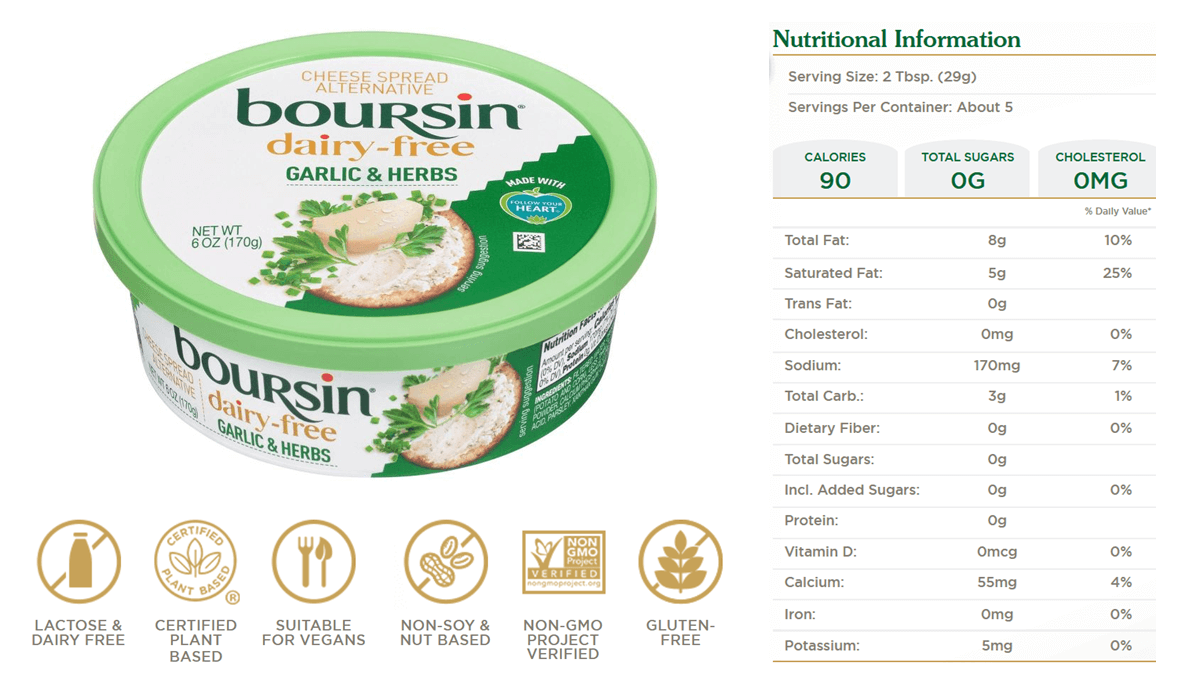
A 29 g serving contains 8 g total fat (10% of daily recommended intake) and 3 g saturated fat (25% of daily recommended intake) and not much else – no dietary fiber or protein. But if it’s something you just occasionally spread on crackers or toast, I don’t consider this to be a massive issue. Coconut oil and canola (which is organic) are two oils that I would rank as better than average, nutritionally.
Ethical rating for Boursin dairy-free cheese
Boursin is owned by French cheesemaker Bel Group (of Babybel fame) and I’m just now remembering that I reviewed another Bel product last year: Nurishh vegan Camembert. The vegan products from Nurishh and Boursin show how people with enough experience in an industry can make good plant-based products if they put their minds to it. These non-dairy products are critical to Bel Group meeting climate change goals:
In 2021, a lifecycle analysis carried out with the consultancy firm Quantis showed that some of the plant-based products in the Nurishh brand have a carbon impact four times lower than their dairy equivalent. – Bel Group.
The situation here is similar to that of Ben & Jerry’s non-dairy ice cream, which I recently reviewed: there is a world of difference between the dairy and non-dairy versions in terms of impact.
Overall, I’m scoring Boursin dairy-free cheese 4/5 Green Stars for social and environmental impact for these reasons:
- Dairy-free Boursin is a vegan product. Adopting a plant-based diet is the top thing you can do to mitigate climate change, deforestation, animal cruelty, and food scarcity.
- The main ingredients are coconut oil, expeller-pressed canola oil, and corn/potato starch. I’ve discussed coconut oil in the post on Nurishh Camembert so I’ll refer you to that for more info. Briefly, because coconut can coexist quite well with native plants and also tends to be grown in small pockets, it fares better than palm oil in terms of impact on biodiversity and climate. The plant starches are low-impact ingredients and the canola oil is organic.
- Does not require cashews, which come with some social and environmental challenges, as discussed in the post on Treeline vegan cheese. (Cashews can, however, be a sustainable crop if managed well as they grow on long-lived trees.)
- Packaging is not ideal. Polypropylene is rarely recycled in the US. Greenpeace estimated the US capacity for polypropylene recycling in 2022 is only 2-5% of the amount generated each year. Even worse, the US EPA estimated that only 0.6% of polypropylene was actually recycled in the US in 2018. An improvement would be to use smaller, lighter tubs made from PET, as Treeline does, or to source post-consumer recycled plastic.
- As per Ben & Jerry’s, there is a huge difference (ethically) between the dairy and non-dairy versions of Boursin. Choosing the non-dairy version helps shift the company ethos radically.
- In other words, Bel Group is mediocre on the ethics scale, mainly because the business is dependent on intensive, indoor dairy operations. However, none of the factors that make the company rate poorly for social and environmental impact (animal welfare and the carbon, water, and land footprints) apply to the non-dairy products.
- The ethical score of 4/5 Green Stars applies very specifically to the non-dairy Boursin – the dairy version would score around 1.5 Green Stars for social and environmental impact.
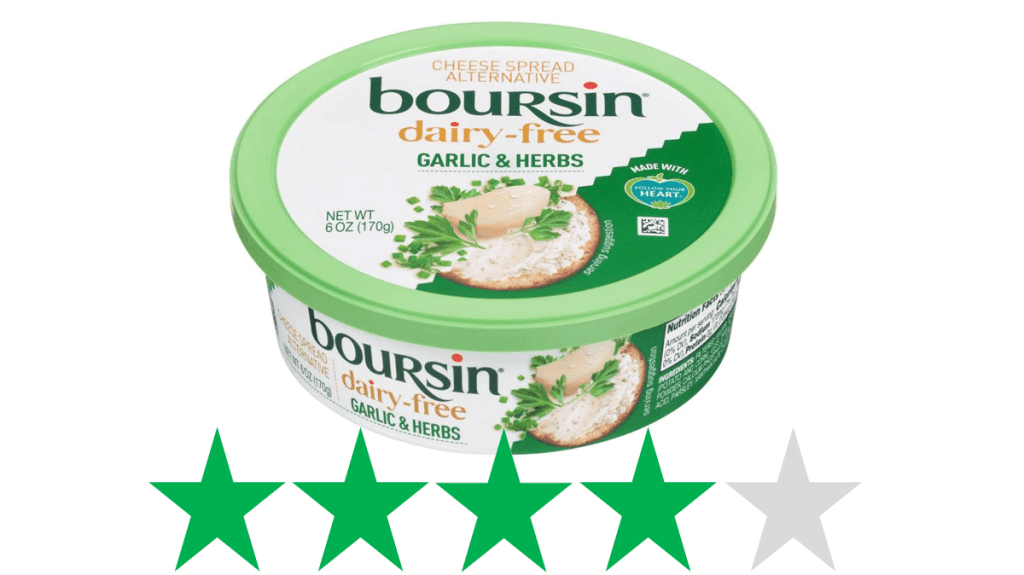
Summary scores (out of 5) for Boursin dairy-free cheese:
4.5 gold stars for quality and value (especially for $0.99 at the Grocery Outlet!)
4 Green Stars for social and environmental impact.
This is a nonprofit project based on independent research that is not sponsored or commissioned in any way.
If you have a different opinion, please share your rating as a comment below.
Join the movement (and win a prize!) by including a Green Stars rating whenever you write a product or company review and let me know if you do.

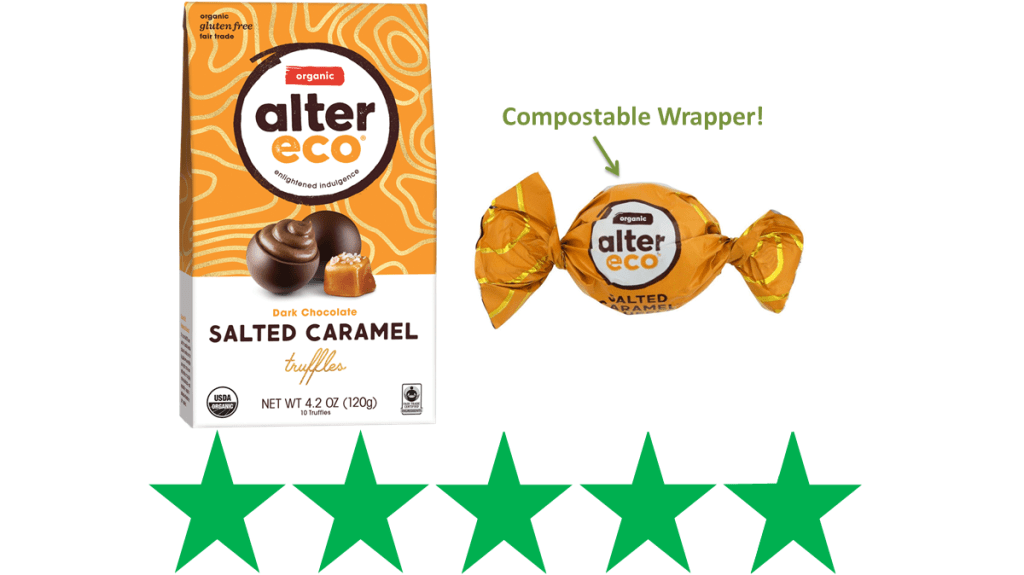
 Grocery Outlet Ethical Bargains
Leave a comment