

New York based vegan cheesemaker Treeline makes some great cashew-based cheeses that are worth checking out. Especially so, if you can find any of them at the Grocery Outlet (as I did) as they’ll be considerably cheaper than buying them at Whole Foods.
I’ve become reluctant to buy (vegan) cream cheese or soft cheese for a few reasons – they are frequently disappointing in terms of taste and texture and are often nutritionally poor to boot. Considering that they are usually packaged in a plastic tub, and I feel that the contents of a tub have to be pretty good to justify this use of plastic, vegan cream cheeses are often a pass for me.
There are exceptions, however, so I keep trying promising-looking products, hoping to find a good one. Recently I wrote about Nuts for Cheese (packaged in light plastic film and a cardboard box), which has a nice creamy texture and some interesting flavors. I can say the same for the Treeline product that I tried – the Creamy Scallion flavor of its French-Style Cashew Cheese (Treeline also makes cream cheeses, which I haven’t tried yet). This Treeline cheese does better than average on all of the fronts mentioned above – it tastes good (even compared to dairy-based soft cheeses), is nutritionally better than regular cream cheese, and is pretty light on plastic.
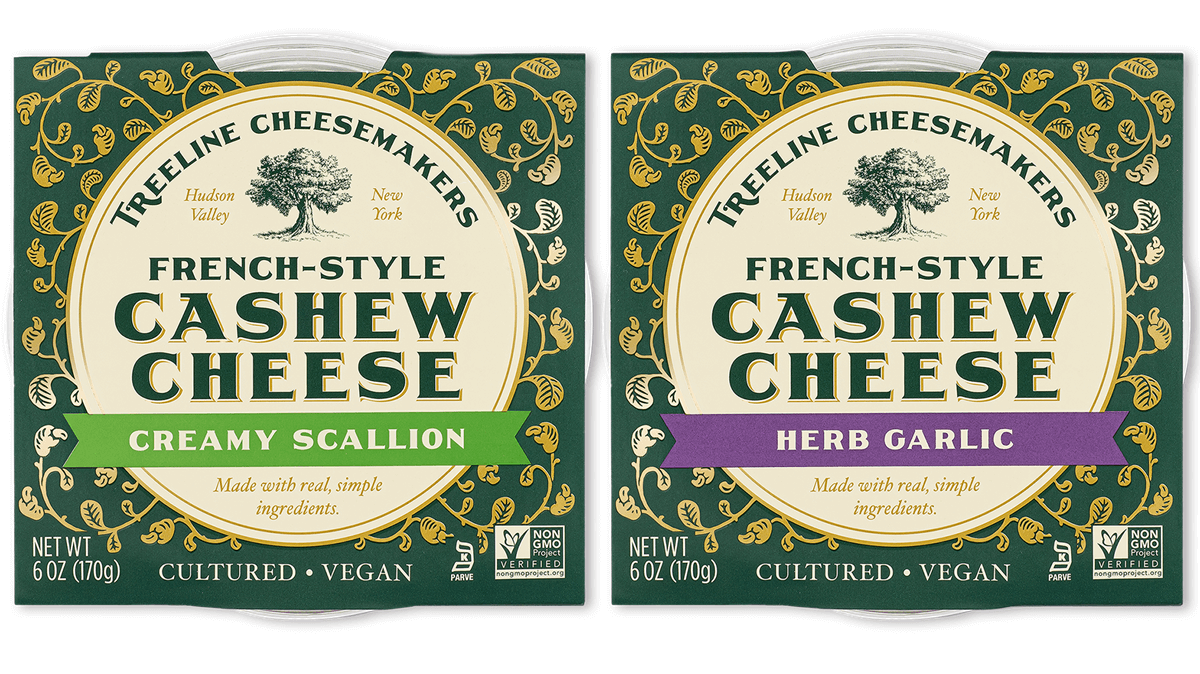
Having tried so many vegan cheeses, just looking at the ingredient list usually gives me a sense of whether a product is likely to be good. In this case, my optimism was based on the fact that Treeline’s cheese contains cultured (fermented) ingredients, some protein, and promising flavors (creamy scallion was the variety I found). Too often, vegan cheeses contain fat, carbs and not much else.
Anyway, I have been spreading this cheese on English muffins and toast and find it to be actually better than dairy-based cream cheeses. It spreads well, straight from the fridge, melts a little on top of something hot, has a nice creamy texture, and the scallion flavor is just right. It’s good on its own but also combines well with tomatoes and veggie sausages (the Grocery Outlet has Beyond Meat breakfast sausages on sale at the moment).
I’m not the only one that likes this cheese – it gets a high rating in many food and lifestyle magazines/sites.
Treeline cream cheese: ingredients and nutrition facts
As mentioned above, the ingredients and nutritional content are two of the reasons I decided to take a chance on Treeline, having been burned (not literally!) by so many cream cheeses in the past. The Treeline product is made from mainly cashews and includes some form of fermentation – cultured brown rice suggests maybe koji (Aspergillus oryzae) but actually in the video at the end of this post, Treeline CEO Michael Schwarz mentions the use of lactic acid bacteria. This makes sense as the cheese has a slightly tart taste that reminds me a little of Miyoko’s butter, which also contains cultured cashew.
As far as nutrition goes, it’s actually very low in fat, for a cream cheese (which is normally mostly fat) and contains some fiber, a little iron, and quite a lot of protein compared to most vegan cheeses – it’s around 10% protein, providing 3 grams per serving. It’s definitely better, nutritionally-speaking, than dairy-based cream cheese and also better than most other vegan versions too.
Ingredients: Cashews, Filtered Water, Sea Salt, Cultured Brown Rice, Onion, Scallions, Lemon Juice, Cultures.

Cashew Sourcing for Treeline cheese
There’s quite a lot of text on the Treeline website, which includes some quite specific information on sourcing of the major ingredient – cashews.
Our cashews come from renewable sources as close to the United States as possible, where cashews are processed by local inhabitants and shipped directly to East Coast ports, rather than being shipped halfway around the world to other countries for cheap processing before being shipped to us. This means our cashews are exclusively sourced from Brazil and Côte d’Ivoire.

Treeline mentions that processing cashews in the country of origin reduces the carbon footprint, which is true, of course. But, by processing cashews by machine (instead of by hand) and avoiding shipping to Vietnam for cheap processing, Treeline also addresses two big social issues in the cashew industry.

These two social impacts of cashew processing are described in an article by Equal Exchange:
As much as 60-70% of the cashews sent to Vietnam for processing are then exported back to Europe and the United States for consumption.
In Vietnam, Human Rights Watch documented forced labour among vulnerable members of society, including inmates in prison on drug charges—for whom the grueling work, for little or no pay, is called ‘rehabilitation.’ If they refuse to work or do not meet their daily quota, they are punished with torture or solitary confinement.”
Cashews are shelled by hand, a process that can cause serious damage to workers’ hands and fingers. During the deshelling process, the nuts produce a caustic liquid (cardol and anacardic acid) that burns the skin. Although bandages or rubber gloves help protect the hands and alkaline pot ash can counteract the acid, in most instances, these supplies are not available or workers have to pay for them and cannot afford it. Workers’ skin turns black and burnt. – Impact International.
So this is why Treeline emphasizes that the cashews are processed by machine rather than by hand, and that sourcing avoids cheap processing in Vietnam. However, there is another aspect of cashew industry that Treeline has not discussed, in any material that I’ve read – the impact of cashew cultivation on forests.
The impact of cashew farming on forests
On the one hand, cashews are a perennial crop (in that they grow on trees) which can be good for soil health and food security. However, cashews can also be problematic in that they contribute to deforestation in several countries, including Brazil and the Ivory Coast.
“Savannas and dry forests in vast parts of Côte d’Ivoire are being transformed into orchards of cashew trees, just as large areas of its rainforest have fallen for cocoa. – Mongabay
Cashew crops are on the rise in tropical regions and, like coffee and cocoa, the impact on biodiversity depends on how intensively the crop is grown. Some maintenance of native plant life can help not only with maintaining biodiversity but can also help increase cashew yields by attracting insect pollinators.
Other vegan dairy companies, including Miyoko’s and Nuts for Cheese, source organic cashews, which reduces the environmental impact on local ecosystems. I can totally understand concerns that Treeline products might become too expensive if they switched to organic cashews – the French-style cheese already costs $8, bought directly form Treeline.
Either way, it would be good to see Treeline take steps to address this concern over deforestation as a result of cashew farming in Brazil and Côte d’Ivoire.
Côte d’Ivoire has lost as much as 90% of its forests over the past 30 years, with agriculture as the primary driver. Dry forests in key cashew-growing regions are rapidly disappearing; some cashew-growing regions have seen as much as a 25% loss of primary forest cover between 2019 and 2023. – Mighty Earth.
Ethical rating for Treeline cashew cheese
I’m rating Treeline cream cheese 4.5/5 Green Stars for social and environmental impact for these reasons:
- Treeline cheeses are vegan. Adopting a plant-based diet is the top thing you can do to mitigate climate change, deforestation, animal cruelty, and food scarcity.
- The main ingredient, the cashew nut, grows on trees that can be productive for decades – perennial crops can be good for maintaining soil integrity and carbon and have been emphasized as a climate solution by Project Drawdown.
- Of course, forestry products can also cause deforestation and habitat degradation, so how they are farmed is important. See this recent post over on the GSP for more on the importance of agroforestry. Treeline’s cashews are not organic, and there is no information or certification provided regarding their possible impact on forests.
- Treeline does, however, provide some assurance that some of the social problems of cashew processing are avoided – damage to workers’ hands and human rights violations. Treeline’s cashews are machine-processed directly in their source countries of Brazil and Côte d’Ivoire.
- The entire cashew is used to make the cheese, rather than just cashew milk, thus avoiding food waste.
- The French-style cashew cheese is packaged in a very lightweight clear plastic tub, thanks to the cardboard sleeve surrounding it.
- Also the plastic tub is made from PET (#1 on the recycling scheme) – a much more widely recycled plastic than the polypropylene (#5) that most cheese tubs are made from.
- Here’s some more on Treeline’s social impact from its website: “We support a variety of charities that help human and non-human animals in meaningful ways. They range from animal advocacy and rescue to running soup kitchens (serving vegan food) for the poorest of the poor.”

Here’s an interview with Treeline founder and CEO, Michael Schwarz, from Switch4Good, which is all about switching to plant-based dairy alternatives.
Summary scores (out of 5) for Treeline cream cheese:
4.5 gold stars for quality and value.
4.5 Green Stars for social and environmental impact
If you have a different opinion, please share your rating as a comment below.
Join the movement (and win a prize!) by including a Green Stars rating whenever you write a product or company review and let me know if you do.
 Grocery Outlet Ethical Bargains
Leave a comment