

Tindle is not the love child of Tinder and Kindle but a Singaporean vegan food brand, most known for its plant-based chicken products. Apparently it’s a big deal, raising $130 million in funding (including a little help from Paul McCartney) but is not yet that widely available in the US. I was not aware of either of these things when I found some Tindle chicken tenders in the freezer of my local Grocery Outlet for $3.99. I should have been jumping for joy with my find, but I actually almost passed on them. But I decided to pick up a bag in the name of science – and I’m glad I did!
Even though the company HQ is in Singapore, Tindle Foods also has several European connections. My Tindle vegan tenders were made in The Netherlands, and that’s also where the company’s R&D department is based. The company was co-founded (originally as Next Gen Foods) by Timo Recker, a German whose father ran a schnitzel factory; Timo currently serves as Tindle’s CEO and chairman. Earlier this year, Tindle launched a bratwurst line in Germany. The final European connection is that Tindle’s branding was done by swanky Danish agency, Everland.
I cooked them in my toaster oven as prescribed and served them with a dipping sauce cobbled from two other Grocery Outlet products that I may get around to reviewing – Kite Hill vegan ricotta and Fody ketchup. The Tindle tenders (!) were actually very good and I say that as someone who’s tried many kinds of vegan chicken nuggets and tenders. In fact I have a post over on the GSP site covering some of my favorite chicken nuggets from both taste and ethics perspectives. Tindle’s tenders were almost like a hybrid between two of my favorites, from Beyond Meat and Quorn, and deserve to be in the top-three in terms of taste and texture. Not quite as juicy as the Beyond chicken tenders, which are almost too juicy, and a little meatier in texture compared to Quorn.
Tindle Chicken tenders – Ingredients and Nutritional Info
The ingredients on my Tindle chicken tenders were different to those on the Tindle website. It’s not unusual for product ingredients to evolve over time, but it’s a little annoying that the website has not been updated to match the packaging. A company valued at over $100 million should have accurate information on the website. The Tindle website also lacks the Nutrition Facts table that’s required on product packaging. Here’s the correct ingredients list for Tindle chicken tenders:
Ingredients: Water, Wheat Flour, Soy Protein, Sunflower Oil, Wheat Starch, Wheat Gluten, Lipi™ (Sunflower Oil, Natural Flavoring), Breadcrumb (wheat flour, yeast, salt), Corn Flour, Coconut Oil, Natural Flavoring, Methylcellulose, Oat Fiber, Wheat Kernels, Spices, Salt, Food Starch-Modified Dextrose, Stabilizer (Sodium Acid Pyrophosphate), Raising Agent (Sodium Carbonates).
The ingredient list looks fairly normal looking for this kind of product. The Lipi™ is the only mysterious ingredient and since it’s a proprietary ingredient, I don’t know what’s in it, other than sunflower oil emulsified with “natural flavorings.”
TiNDLE Chicken’s unique similarities to chicken from birds come from Lipi™, our proprietary emulsion of plant-based ingredients that mirror the aroma, cookability and savory qualities that typically are found in chicken fat.
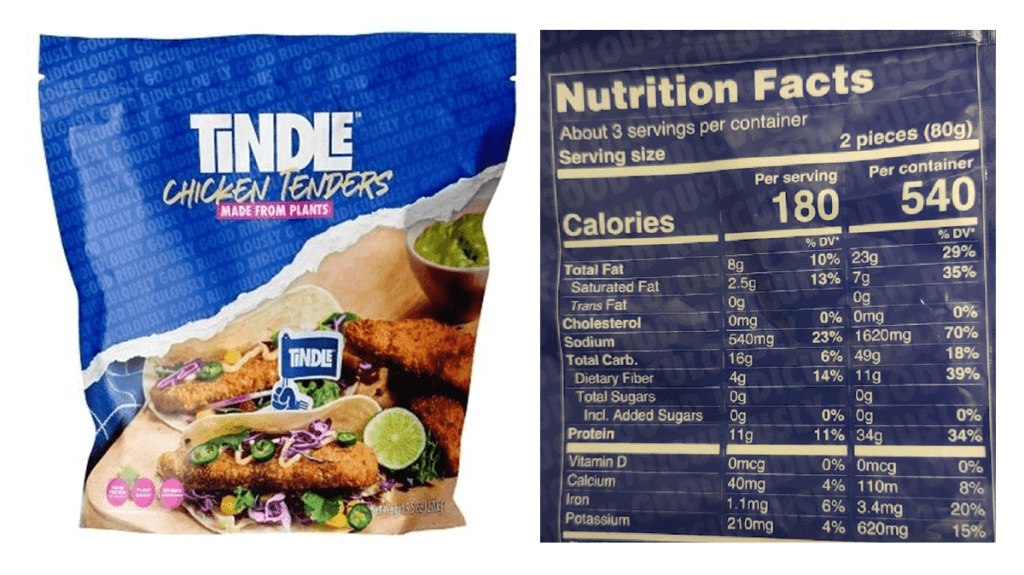
As far as nutritional content goes, Tindle chicken tenders are a little high in sodium but, on the other hand, provide a lot of dietary fiber and 11 g protein per serving.
Tindle Foods – environmental impact
Thanks to the always useful Web Archive I can see that in 2021 Tindle had this statement on its About page:
Want to eat ridiculously delicious chicken and help the planet? You’re looking for TiNDLE. On average, chicken made from plants uses less land, less water, and produces less CO₂ than chicken from birds. The figures speak for themselves. 74% less land, 88% lower greenhouse gas emissions, 82% less water than chicken requires.”
The numbers come from a 2020 report by Blue Horizion on sustainability of plant-based foods, rather than specific numbers for Tindle’s own product. This doesn’t bother me too much as Tindle Foods (Next Gen Foods) was an early-stage company in 2021. But now, in 2024, that statement is gone and the Tindle website has almost no information on sustainability. This is all a result of the brand image work that has been done – the website has been stripped of meaningful content and replaced with a bunch of social media imagery.
That’s not a good way to build trust with consumers – especially for a company that’s funded in part on the basis of sustainability. Even the company’s name, Tindle Foods, was chosen to signal its mission to mitigate climate change.
Where did Tindle get its name?
Tindle is actually named after the Irish physicist, John Tyndall, who demonstrated the existence of the greenhouse effect around 1859. Tyndall’s experiments, and other work around the same time, established that 99% of the air in our atmosphere (nitrogen and oxygen) is “transparent” to heat transfer but that a few gasses, mainly carbon dioxide and methane, could trap heat from escaping the earth’s atmosphere (as can water vapor). Since plant-based meat alternatives play a major role in our efforts to mitigate climate change, by reducing carbon dioxide and methane emissions, it’s a nice idea to name the company after Tyndall.
Ethical rating for Tindle vegan chicken tenders
Tindle’s vegan chicken actually serves as a pretty good case study for rating a product when there’s not a lot of information available about it. Sometimes it doesn’t require a lot of nuance to figure out whether a product is basically better than average or not. A product that replaces meat with plant-based ingredients is, almost by definition, better than average. It might be possible to intentionally design a plant-based product that’s worse than meat in terms of environmental impact, but even that would be a challenge.
The Tindle tenders essentially boil down to three major ingredients (other than water) that account for almost all of their mass: wheat, soy and sunflower oil. These crops, especially soy, have much smaller footprints – carbon, land, water, agrochemical use, and aquatic pollution – compared to meat. It would be nice if the ingredients were organic, for a couple of reasons. Organic wheat, for example, causes less nitrogen pollution compared to conventional. But the difference between organic and conventional plants is much smaller than the difference between plants and meat. And plant-based meat substitutes are not cheap to make, so I understand that it’s often not feasible for companies to use organic ingredients. Tindle products are certified non-GMO, and that actually does count for something – more on that in a moment.
As I pointed out in a recent post on the war over meat vs legumes, arguments that sometimes soy can be worse for the environment than meat (e.g., if grown on deforested Amazon land) simply don’t hold. The vast majority of Amazon deforestation takes place to make room for animal grazing and almost all of soy grown in sensitive habitats is used for animal feed. No matter how you look at it, animal agriculture is the main driver of global deforestation.
My point here is that even when there’s not much information available about a plant-based meat substitute, that you can still be pretty confident that it’s better for the planet than the meat that it replaces.
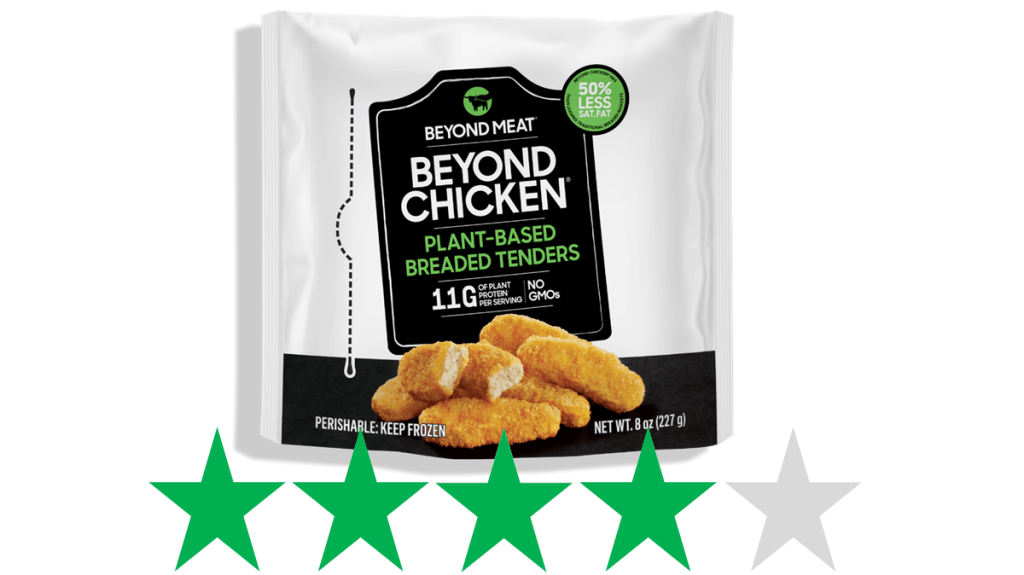
I’m rating Tindle vegan chicken tenders 4/5 Green Stars for social and environmental impact for these reasons:
- It’s a vegan product. Adopting a plant-based diet is the top thing you can do to mitigate climate change, deforestation, animal cruelty, and food scarcity.
- Tindle does a poor job at communicating on sustainability and social impact.
- Having said that, the product doesn’t contain ingredients that are particularly problematic, such as palm oil.
- Therefore it’s probably fine to apply the numbers from Blue Horizon report to this product and assume that environmental footprints (land, water, and GHG emissions) of the Tindle product are 75-90% lower than those of chicken.
- The product is certified non-GMO. Genetically-modified microbes are beneficial in some cases (e.g., making insulin or rennet without having to kill animals) but when it comes to agriculture, virtually all GMO crops are combined with detrimental agrochemicals and agricultural practices.
- One example of the detrimental agrochemicals used on soy and sunflower are the bestselling pesticides known as neonics, which are toxic to bees. Neonics are used on well over 90% of GMO varieties of soy and sunflower crops. Non-GMO doesn’t guarantee that neonics are not used, but they are much less likely to be used.
- Would be nice if Tindle put more tenders into each package, to justify the use of plastic.
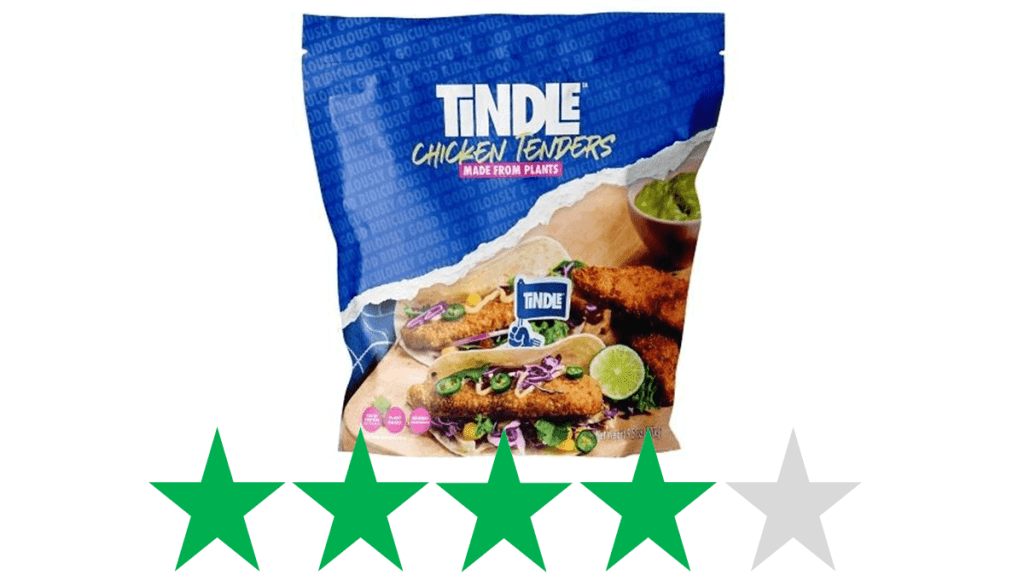
Summary scores (out of 5) for Tindle vegan chicken tenders:
4 gold stars for quality and value.
4 Green Stars for social and environmental impact
If you have a different opinion, please share your rating as a comment below.
Join the movement (and win a prize!) by including a Green Stars rating whenever you write a product or company review and let me know if you do.
 Grocery Outlet Ethical Bargains
Leave a comment