
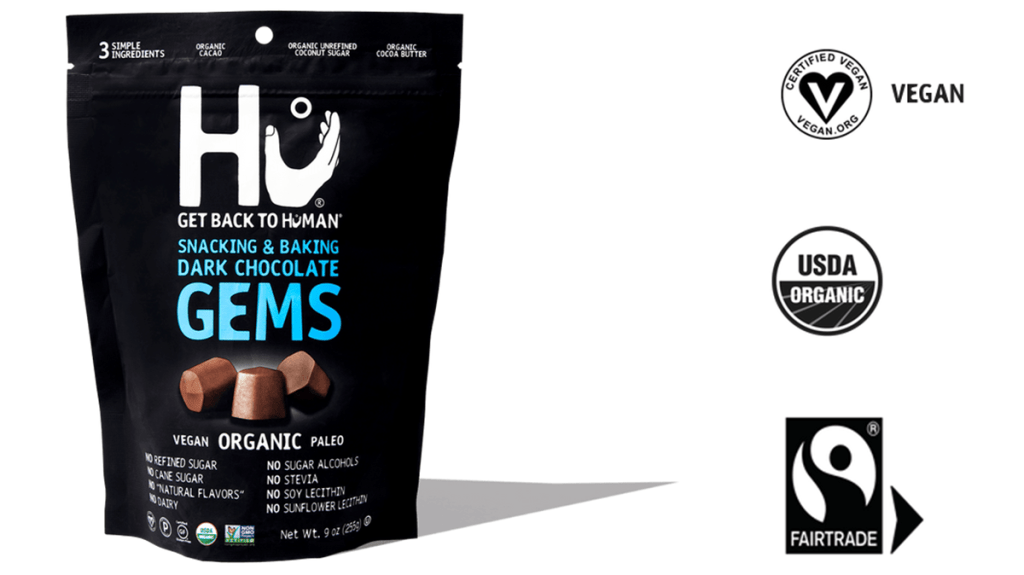
I picked up some Hu Dark Chocolate Gems at the Grocery Outlet and they sat on my shelf for a surprisingly long time (for a chocolate product). When I first tried them I picked up on a licorice flavor from them (perhaps the black bag reinforced this idea) and I don’t love licorice. Anyway, it wasn’t until months later that I tried them again and was shocked to discover that they are actually really good! They have a really good chocolate flavor (not that much aniseed or licorice actually!) and a nice texture and balanced sweetness. I think the real difference was that the temperature was warmer (summer had arrived!) and chocolate is best experienced when it’s ready to melt fast.
I’d highly recommend these Gems for anyone looking for a convenient way to eat chocolate in small quantities. Chocolate is actually a pretty high-impact food (e.g., see this post on chocolate and deforestation) so it should be consumed in moderation. Also, I find that chocolate is best experienced in small morsels, like these Hu Gems or the Cadbury Buttons of my youth, because it melts faster in the mouth and releases its flavor before its swallowed.* Speaking of which, both Cadbury and Hu Kitchen now have a common owner – multinational food & beverage company, Mondelez. I’ll get back to this later, but first, a quick look at the product itself.
*What’s the point of eating chocolate so fast that you can’t taste it? Well, for high-volume, low-quality confectionary makers, the point is higher sales and lower consumer awareness that the chocolate doesn’t actually taste of much.
Hu Chocolate Gems – Ingredients and Nutritional Info
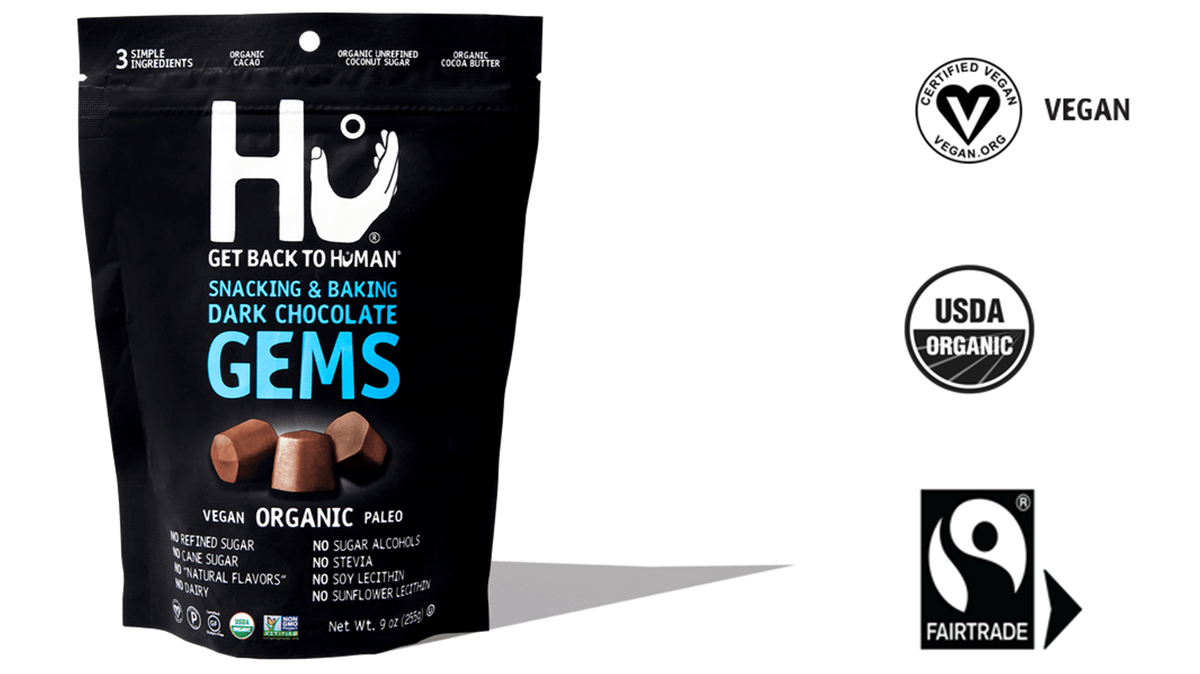
Well the ingredients are pretty simple – cacao, coconut sugar, and cocoa butter. Hu Gems are made with fair trade certified cocoa and cocoa butter, plus all three ingredients are certified organic.
Hu Dark Chocolate Gems – Ingredients: Organic Fairtrade cacao, unrefined organic coconut sugar, organic Fairtrade cocoa butter.
Coconut sugar has roughly the same glycemic index as regular white sugar, but because unrefined coconut sugar also contains inulin – a soluble fiber that encourages beneficial microbes in our digestive systems – it may offer some nutritional benefit.
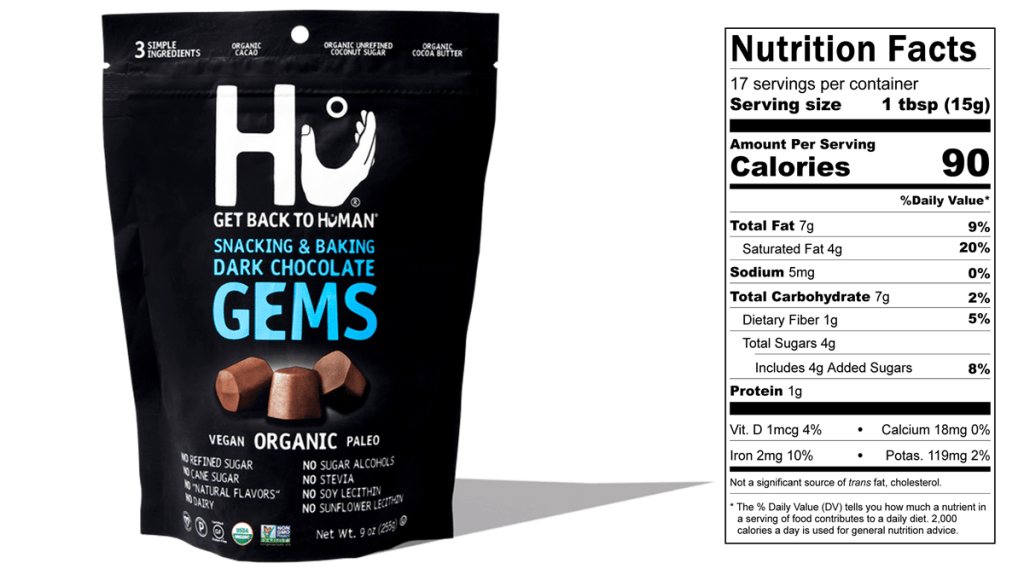
The overall nutritional composition of Hu Dark Chocolate Gems is fairly typical for dark chocolate – around 50% total fat (25% saturated fat) and 25% sugar. Perhaps an advantage is that, because of their diminutive size, we’re less likely to eat more than we should.
Hu’s ownership by Mondelez
In 2021, Hu Kitchen was acquired by Mondelez – also known as Mondelēz International, an exotic name for a Chicago-based food and beverage multinational that originated from Kraft Foods. Mondelez has a sweet tooth, acquiring Cadbury in 2010 (despite widespread protest and opposition), Tate’s Bake Shop in 2018, Hu Kitchen in 2021 and (to my surprise) Clif Bar in 2022. It’s now the world’s second largest confectionery manufacturer, after Mars.
It’s often tricky trying to figure out if a small brand is still ethical after being acquired by a larger company. If I was deciding on an ethical rating for Hu Kitchen purely based on these Dark Chocolate Gems, I would say that, while it’s not in the top 10 ethical chocolate brands (which you can vote for in that post) it’s probably in the top 10% (certainly 20%) of all chocolate makers. This is largely based on the chocolate’s certifications – fair trade and organic. These are the most important common certifications for mitigating extreme poverty and habitat destruction.*
But how do we take into account the fact that Hu Kitchen is now owned by Mondelez? We can start by considering these two questions:
How bad is the parent company? Rather than getting into a full evaluation of Mondelez, I’ll refer to ratings from Ethical Consumer (“a brand to avoid”) and Shop Ethical (grade F). Bottom line: Mondelez rates quite poorly on ethics.
Has the smaller company changed much since the ownership change? This may take some time to play out but it has been over three years since Mondelez acquired Hu Kitchen, so let’s take a quick look.
*A less common but hopefully emerging environmental certification is the Smithsonian Bird Friendly cocoa certification, which goes beyond organic in ensuring a certain level of shade cover. On the social side, some of the most ethical chocolate brands have convincing direct trade relationship with farmers – or even better, farmer ownership.
Has Hu Kitchen changed since its acquisition by Mondelez?
I just want to highlight one fairly straightforward approach to examining whether a brand has changed since acquisition by another company. We could get into more complex approaches but I think it’s best to stick to something that’s easily doable by anyone. After all, one of my goals is to encourage you, dear readers, to include your own Green Stars rating whenever you write a review online (you can win a prize if you do!). This approach uses the highly useful resource of the Wayback Machine internet archive.
Looking at the product page for Hu Dark Chocolate Gems back in 2020, before the Mondelez takeover, (courtesy of the Wayback Machine) and the ingredients are listed as:
Ingredients: Organic cacao, unrefined organic coconut sugar, organic fair-trade cocoa butter.
So the ingredients were all organic but the cacao was not fair trade certified, back then. Under FAQs, for “Are Your Products Fair Trade?” Hu had this response in 2020:
Hu Chocolate uses USDA-Certified Organic cocoa butter and USDA-Certified Organic cacao. With regard to Fair Trade, Hu Chocolate uses certified Fair Trade cocoa butter and has historically used certified Fair Trade cacao. Beginning in March of 2019, Hu switched its organic cacao source to a new and emerging fair trade region – this co-op is “transitional Fair Trade” and will be certified Fair Trade in 2020. Hu is excited and proud to support emerging Fair Trade regions!
So it actually looks like the current 2024 ingredients are an improvement over the 2020 version, in that cacao is fair trade certified again. It is stated as certified Fairtrade by mass balance, which is not quite as good as fully traceable, but this may because the specific supplier is still transitioning to Fairtrade certification.
The most likely sign of Hu’s standards dropping would have been a replacement of third-party certifications (organic and fair trade) by a logo representing an in-house program. In this case it would be Mondelez’s Cocoa Life logo. All of these in-house logos are misleading to consumers as they can easily be mistaken for a third-party certification. In reality, they just represent the company’s trade policy or social responsibility plan, and this does not merit a logo on packaging. In fact, Mondelez’s inherent corporate social responsibility and trade practices are what have earned the company the F grade and brand to avoid judgements.
Another unwelcome development would be if Hu Kitchen began using palm oil in its products. Thankfully neither of these has happened.
Would Mondelez benefit by watering down Hu Kitchen’s values?
I maintain a healthy level of skepticism – especially when it comes to corporate motivations and practices. So when a giant corporation such as Mondelez buys a smaller company like Hu Kitchen, based on the value of the brand that Hu has developed, there’s not much point in Mondelez destroying that brand’s image.
For sure, there will be changes that include some dreaded economies of scale and possible leadership reorgs. I fully anticipate that a food giant such as Mondelez will make some changes to save money, but if these changes are substantial (e.g., switching from organic to conventional ingredients) then customers will notice and the brand image (and sales) will suffer.
I trust in one overarching rule when it comes to commerce and ethical consumption: corporations will make more of whatever consumers demand. I am wary when a smaller company is acquired by a large multinational corp., but as long as consumers are vigilant (as customers of brands like Hu tend to be) then parent companies won’t tend to risk large deceptions.
I’ve reviewed Clif Bar here, before the Mondelez takeover, and gave it a good score for social and environmental impact. I’ll take another look soon to see if anything obvious has changed under the new owners.
This topic comes up a lot (e.g., Blackstone’s investment in Oatly) so I’ll tackle it in a dedicated post on the GSP.
Meanwhile, let’s get back to Hu Kitchen and wrap this up!
Ethical rating for Hu chocolate
I’m rating Hu Dark Chocolate Gems 4.5/5 Green Stars for social and environmental impact for these reasons
- Most of the Hu chocolate products, except for a milk chocolate bar, are vegan. Adopting a plant-based diet is the top thing you can do to mitigate climate change, deforestation, animal cruelty, and food scarcity.
- All chocolate bars are made with organic ingredients (cocoa, coconut sugar, and cocoa butter in the Gems).
- The cocoa and cocoa butter are also certified fair trade, via Fairtrade America (which is part of Fairtrade International, or FLO).
- Ingredients used in other bars, such as coffee and cashew are also certified organic and fair trade (for most ingredients where fair trade is applicable).
- All products are palm oil free.
- Hu Kitchen is now owned by Mondelez, which generally rates poorly for ethics. However, the Hu Gems ingredients don’t appear to have changed for the worse under the new owners. In fact cocoa is now Fair Trade certified again.
- Hu Kitchen could provide a lot more information on sourcing and company operations.
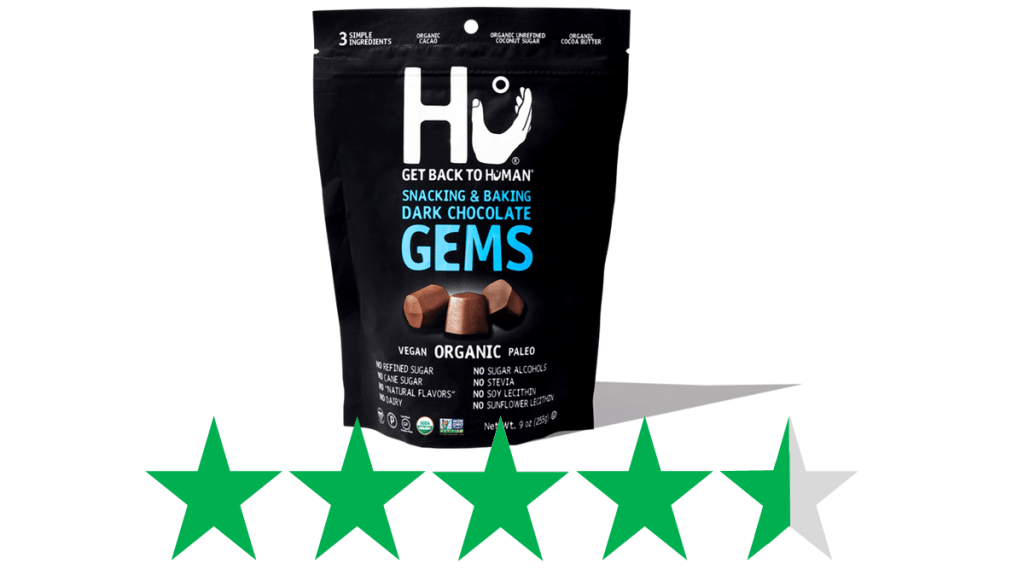
Summary scores (out of 5) for Hu Dark Chocolate Gems:
4 gold stars for quality and value.
4.5 Green Stars for social and environmental impact
If you have a different opinion, please share your rating as a comment below.
Join the movement (and win a prize!) by including a Green Stars rating whenever you write a product or company review and let me know if you do.


 Grocery Outlet Ethical Bargains
Leave a comment