
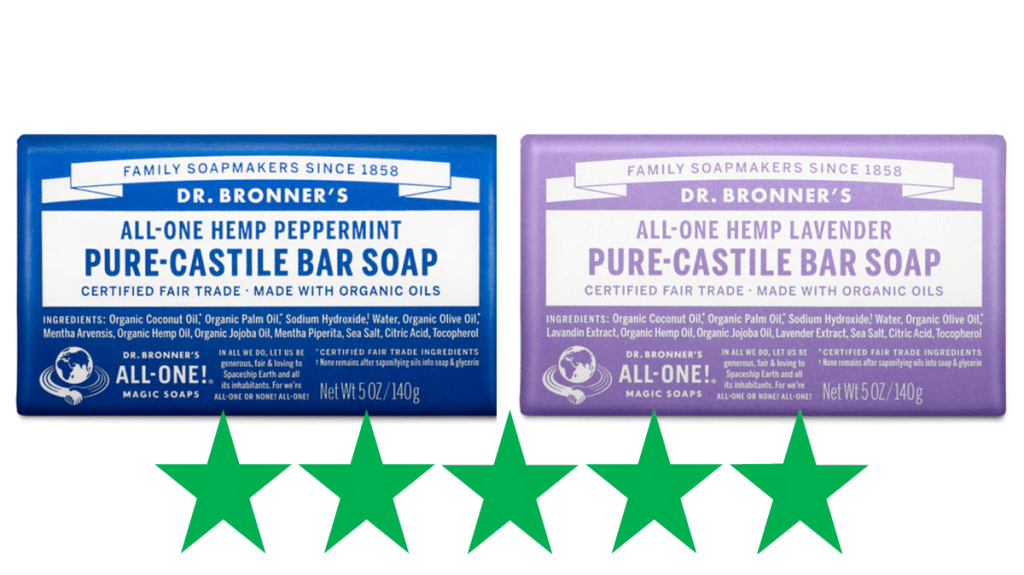
I picked up two bars of Dr. Bronner’s soap at the Grocery Outlet ($4.49 each) last week and I’m curious to find out how the company is doing these days. I wrote a Green Stars review of Dr. Bronner’s over seven years ago so I think it’s a useful exercise to do an update. After all, we hope that the companies that we support maintain their standards or, even better, improve over time. I’ve actually been thinking of Dr. Bronner’s a good bit recently as I remember the company’s program to source olive oil from both Palestine and Israel. I’m happy to see that the page is still there in the Suppliers section of the website, so let’s start with that topic.
Dr. Bronner’s and Peace in the Middle East
Here’s some information from the Dr. Bronner’s website on olive oil sourcing. Excuse the extensive use of quotes – this is not because I’m lazy (OK – it’s not just because I’m lazy) but because it’s useful to see the specific information provided. One reason why many consumers approve of Dr. Bronner’s is the company’s high level of transparency and depth of communication.
In honor of our Jewish ancestry and our commitment to promoting peaceful coexistence, our olive oil comes from the Holy Land, supplied by farmers in both Palestine and Israel.
In late 2006, we began sourcing 90% of our olive oil from Canaan, a company founded by Palestinians near the West Bank town of Jenin. Their objective was to improve the economic situation of olive farmers in the West Bank through fair trade with customers in the West, while promoting peaceful coexistence with Israel. Canaan works closely with the Palestine Fair Trade Association (PFTA) and now purchases oil from 1,700 smallholder members. Dr. Bronner’s helped Canaan plan for and fund the project’s organic and fair trade certification to the Fair for Life Programme.
Since 2009, the trading relationship with Dr. Bronner’s and other buyers has helped Canaan expand and become a symbol of hope for sustainable and fair economic development for olive farmers and their communities.
Since 2014, Canaan has significantly expanded the range of organic and regenerative organic practices used by its farmers. It cooperates with the Canaan Center for Research and Extension (CORE) in the development of non-toxic pest control techniques for almonds, the intercropping of olive trees with bushes, trees and legume field crops.
The balance of our olive oil (10%) comes from Israel. Sindyanna, a fair trade business run by Jewish and Arab women in Israel, supports Arab-Israeli farmers and workers.
Here are a couple of quotes from Dr. Bronner’s Jan 2024 blog post on the current situation:
Our hearts broke in the wake of the gruesome Oct. 7 attacks by Hamas where 1,200 people were murdered and 240 were taken hostage. While we support Israel’s right to defend itself against terrorism, we have also watched with increasing horror the indiscriminate bombing and loss of civilian life in Gaza. We believe it is a moral imperative that we join the growing chorus for an immediate and permanent ceasefire.
The U.S. must end military aid for this war and work for the release of all hostages and an end to the siege on Gaza. Further, we call on our government to condition all future aid to the state of Israel on the creation of a viable Palestinian state and removal of all settlements in the West Bank.
Review of Dr. Bronner’s soap bars: peppermint and lavender
For old time’s sake, I’m going to use my text from my old reviews of these soap bars, which really haven’t changed in the intervening time.
Peppermint: This soap will wake you up in the morning! I love the strong peppermint scent and tingle on my skin. Peppermint is recommended when you need to stay alert (studying, for example) and may possibly help with memory and cognitive function. Two things in no dispute are its antibacterial and antifungal activities.
Lavender: If the peppermint soap is too tingly for you, lavender is a good option. Lavender is best known for its calming effects – it’s even known to have anti-depressant properties and is useful against insomnia. It’s also very well known for helping to heal skin after cuts, minor burns, insect bites – and especially (from personal experience) cat scratches! It also has antibacterial and antifungal activities – a good thing to have in your soap.
At $4.50 per bar these soaps are not particularly cheap but consider that the primary ingredients are both organic and fair trade certified (see below). Also, the bars are big and dense and solid soap lasts a lot longer than liquid soap (see below). So it’s a fair price, I think.
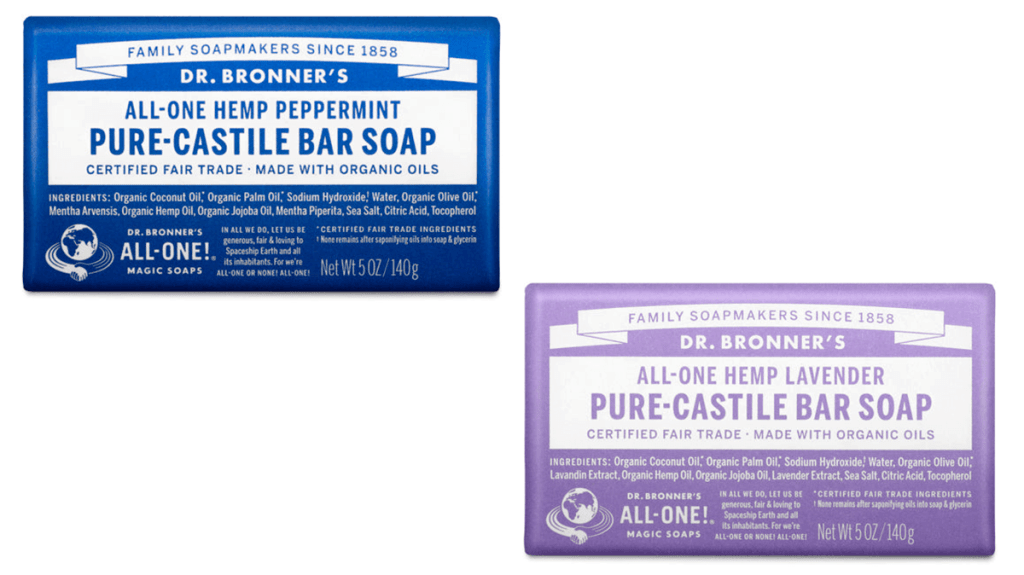
Dr. Bronner’s soap bars – ingredients
Peppermint Bar Soap Ingredients: Organic Coconut Oil*, Organic Palm Oil*, Sodium Hydroxide, Water, Organic Olive Oil*, Mentha Arvensis, Organic Hemp Seed Oil, Organic Jojoba Oil, Mentha Piperita, Sea Salt, Citric Acid, Tocopherol
Lavender Bar Soap Ingredients Organic Coconut Oil*, Organic Palm Oil*, Sodium Hydroxide, Water, Organic Olive Oil*, Lavandin Extract, Organic Hemp Seed Oil, Organic Jojoba Oil, Lavender Extract, Sea Salt, Citric Acid, Tocopherol
*Certified fair trade ingredients
Considering that soap is something that we apply to our skin every day, it’s worth investing in a product that contains high quality ingredients. I don’t think there is a lot of awareness that many soaps are made with petrochemical-based ingredients that may be hazardous (especially in liquid soaps). We’ve been duped, especially since Covid, into believing that liquid soaps with antimicrobial ingredients are more hygienic than solid soap bars (they are not). It has become a real challenge to find solid soap bars (or even liquid soaps) that aren’t made from either synthetic detergents or unethical palm oil. For more on that topic, see my post on the GSP following my struggles, last year, to find ethical soap in Europe.
Liquid versus solid soap
According to a 2009 study, compared to solid bar soaps, liquid soaps require:
- Five times more energy for raw material production
- Nearly twenty times more energy for packaging production
It also doesn’t last as long: on a per-wash basis consumers use more than six times the amount of liquid soap than bar soap. A bottle of liquid soap may only be enough for 100 hand washes, or less, depending on the amount we use (0.4 to 9 mL per wash). Obviously another major issue with liquid soap is the requirement for a plastic container, which usually comes with a pump dispenser (the latter is not recyclable and the former barely qualifies).
If you do need to buy liquid soap you can reduce that problem by refilling an old liquid soap container in the bulk section of your local store – Dr. Bronner’s is often stocked in bulk sections, especially in dedicated refill stores. Dr. Bronner’s also sells liquid soap refills in a (100% post-consumer) recycled plastic bottle or a (plastic and aluminium lined) cardboard carton.
Also note that Dr. Bronner’s soaps are more concentrated than other brands, so you only need a tiny amount – dilute before use! Here are guidelines for dilution from Dr. Bronner’s.
Have Dr. Bronner’s ethics changed since 2016?
Has the social and environmental impact of the company changed since I evaluated it 8 years ago? There was a lot of information available on the company back then, and even more now. But, as a quick overview, here’s the Green Stars portion of my review of Dr. Bronner’s from late 2016:
As far as the company goes, Dr. Bronner’s is fair to employees: good pay, full benefits, and a well-balanced workforce with a good percentage of women and minorities in staff and managerial positions. The CEO is paid only 5 times more than the average worker (In the average US company, the CEO earns 300 times more than the workers). They have a nice report on their website that even breaks down their expenditures – a large percentage of the price of the product is the cost of raw materials (not advertising or lobbying!) because they buy high-quality Fair Trade certified, organically grown ingredients. They also donate almost 5% of revenue to charities or projects and they list exactly how much they donate and to which organizations they donate. They also publish a total composition of their products (over 80% of raw materials are Fair Trade and organic) and packaging (100% recyclable, 64% is made from post-consumer recycled material). It looks like one area for improvement is waste sent to landfill (currently 11% of their waste is landfilled). Great report – if only every company could be as transparent as Dr. Bronner!
To see how the company’s current performance compares to 2016, I started by looking at the Dr. Bronner’s 2023 report (and the 2022 report, which contains more data). Then I got into other information on the website, including many informative blog posts that keep customers abreast of the company’s efforts to improve. See, for example, this 2023 blog post addressing plastic use and a 2024 update on company efforts to become circular, which introduces a refill carton.
Or take a look at this post on a specific kind of agroforestry – dynamic agroforestry (DAF) – that Dr. Bronner’s sister company Serendipalm has been trialing in Ghana. This DAF is a specific system in which timber and fruit trees are planted in between palm and cocoa to provide a healthy habitat. Following years of research on ethical consumption, climate change, etc., I believe that the adoption of agroforestry should be one of our top priorities, particularly when combined with equitable trade to alleviate poverty and enrich communities. This aligns with two of Dr. Bronner’s main principles – sustainable agriculture and fair trade. Dr. Bronner’s partnered with Ecosia to expand on this in 2022.

Genuine effort goes into improving the company’s impact and communicating the rationale – Dr. Bronner’s set a high bar on transparency – an example for others to follow. And it’s not just talk – the company’s operations align well with the mission to produce a product with a positive social and environmental impact. They also and make us feel part of this mission by transparent reporting and blogging.
In fact, I’m just realizing that there’s no way to cover everything in this post so I’m going to try to summarize some of the key points in the next section.

Ethical ratings for Dr. Bronner’s soap bars
Here’s a summary of how I feel about the social and environmental impact of Dr. Bronner’s soap bars, which I’m rating 5 out of 5 Green Stars:
- All Dr. Bronner’s soaps are vegan and certified cruelty-free.
- Traditional soaps, made from plant-oils. Contains no synthetic detergents made from petrochemicals.
- The major ingredients are organic and also certified fair trade.
- Dr. Bronner’s has been a leader in adopting regenerative organic agriculture and agroforestry.
- The sourcing relationships that Dr. Bronner’s has established for complex ingredients such as palm oil serve as some of the best examples of how people and the environment should be treated.
Palm oil sourced from Ghana has funded numerous community development projects, including deep water wells, toilet facilities, a market hall, a maternity ward and living quarters for nurses at local hospitals.
- The company is trialing diverse agroforestry strategy that could help restore biodiversity in Ghana.
- Dr. Bronner’s facilities use 100% renewable electricity. Total GHG emissions for Scope 1 and 2 are very low.
- Packaging is post-consumer recycled (and recyclable paper) printed with water-based inks.
- Dr. Bronner’s has been a leader in waste reduction being an early adopter of bulk stores, recycled plastic, and carton refills. 76% of all packaging (paper and plastic) is post-consumer recycled (PCR).
PCR plastic takes less energy to produce than virgin material and more importantly avoids putting new plastic out into the world. Making PCR plastic products also builds market demand for recycled plastic, which helps make plastic collection and recycling more economically viable around the world.
- The starting wage for new hires at entry level is almost $25/hr.
- Certified B-corporation with a score of 207 (very high), ranked Best for the World in both Community and Environment categories.
- Over the last twenty years, Dr. Bronner’s contributed nearly $100 million to activism and charities in areas such as animal advocacy, migrant justice and Sea Shepherd, which patrols krill fishing in the Antarctic waters.
If you’d like to write a Green Stars review, you can win a subscription to Ethical Consumer by entering the contest over on the GSP blog!
 Grocery Outlet Ethical Bargains
Leave a comment