
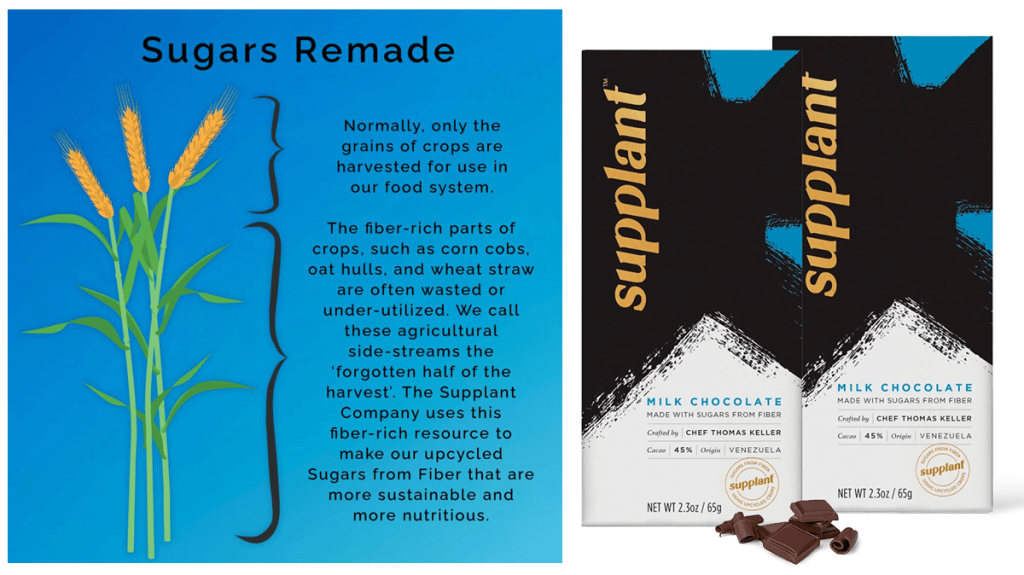
Supplant chocolate, made by Chef Thomas Keller (not literally) is available at the Grocery Outlet right now for $1.99. You may well have heard of Chef Thomas Keller but what is The Supplant Company? The company is behind the ingredient that makes this chocolate unique: upcycled sugars. Actually the ingredient is listed as, “sugars from fiber (oligosaccharides, cellulose).”
I happened to do my PhD on cellulose degradation, so I was compelled to buy some chocolate and investigate this ingredient. To think of a digest of cellulose as a food product is exciting – but for that to be commercially viable is even more so. Producing sugars from cellulose means producing food from the most abundant and underutilized carbon source on the planet. Here’s how Supplant describes its mission:
The Supplant Company is on a mission to fix three of the biggest problems faced by our food system: poor nutrition, climate impact, and food insecurity.
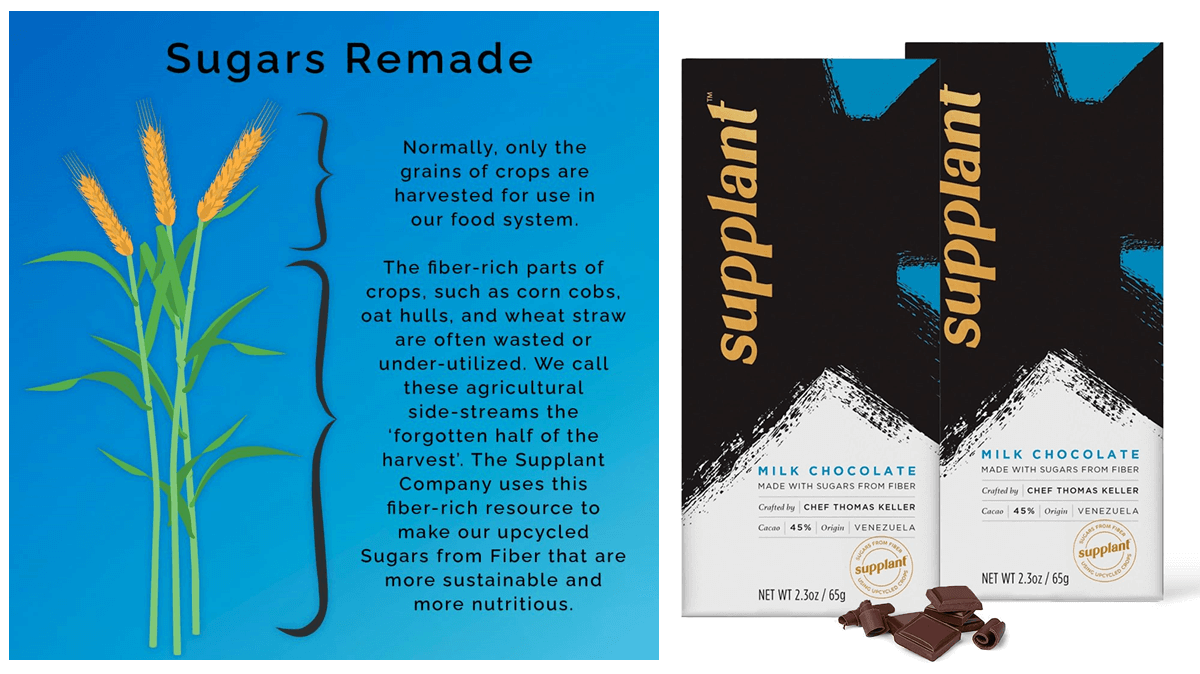
They plan to do this by converting agricultural side-streams into edible food. Agricultural byproducts such as wheat straw consist mainly of cellulose – a polysaccharide that we humans can’t digest. Supplant uses enzymes from fungi to convert this cellulose into shorter sugars that we are able to digest. Because the product is not a pure sugar (sucrose or glucose) but rather a mixture of sugars, oligosaccharides, and longer fibers, we metabolize them differently.
Benefits to humans include prebiotic fiber content and a lower glycemic response (15% that of glucose). Here’s the CEO, Dr. Tom Simmons (University of Cambridge biochemist) talking about the Supplant product and collaboration with Chef Thomas Keller:
The sugars (besides coconut sugar) that went into the Thomas Keller chocolate were made from corn cobs (i.e., after the kernels are removed), making good use of what’s essentially a waste product. The process can be applied to almost any agricultural side-product that consists of mainly cellulose (e.g., oat hulls, wheat straw, corn stover, etc.) which effectively increases the food yield for these crops. A lot will depend on the economics of the conversion process, which will probably become more favorable over time. Here’s an official company video:
Supplant Milk Chocolate – ingredients and nutrition facts
Ingredients: Cocoa butter, whole milk powder, chocolate liquor, sugars from fiber (oligosaccharides, cellulose), coconut sugar, sunflower lecithin.

According to Supplant, their “sugars from fiber” ingredient has a Glycemic Index of 15:
The glycemic response (or blood glucose response) is 15, which means that when you compare equal weights of sugars from fiber to glucose, sugars from fiber gives a 15% response of glucose.
Other than the lower glycemic response, the nutritional profile of the chocolate is quite typical of chocolate – see for example Tony’s Chocolonely, Beyond Good, and Endangered Species chocolate, all reviewed here previously.
Ethical ratings for Supplant chocolate
I’ve decided not to do a Green Stars rating for this product because I wanted to focus on Supplant’s technology rather than the chocolate bar. But I want to talk a little bit about the whole process of showcasing an idea (or ingredient) through a product launch. A major motivation for people to buy Supplant products will be the environmental benefits of upcycling agricultural side products such as corn cobs and wheat straw. So, it would be nice to see the Supplant “sugar from fibers” ingredient showcased in a product that we can wholeheartedly get behind in terms of social and environmental impact. I think that a page on the Supplant website explaining the broad social and environmental impact of the chocolate bar would have been really useful. Without going into too much detail, two aspects that should be addressed (covered in GSP posts on these topics) are:
- Social Impact: Cacao farmers living in poverty because commodity markets don’t support a living.
- Environmental Impact: Cacao is a significant cause of deforestation.
I’m not saying that the Supplant chocolate fails us on these issues – it just doesn’t do a good job at communicating on them. In fact, Thomas Keller is well known to do pretty well on social and environmental fronts. But he’s also not the best at communicating on them. The chocolate that Thomas Keller makes with Armando Manni under the K+M brand looks good in terms of social and environmental impact but I’ve never seen a description of company’s direct trade sourcing policy for cacao, other than a few comments in interviews.

A few years ago, I took a look at Loop – and idea by Tom Szaky, founder of Terracycle, to sell products in reusable packaging. The problem, as I saw it, was that Loop had partnered with brands from corporations (P&G, Unilever, and Nestlé) whose customer base is unlikely to have much overlap with consumers most eager to avoid packaging waste. I think that Supplant did a better job at choosing a suitable partner for its first product launch, but does need to improve on communication.
Is Supplant’s platform for upcycled sugars a sustainable idea?
It probably won’t be too long before we see a life cycle assessment (LCA) for the Supplant’s main product: sugars made from cellulose fibers. The energy costs for the Supplant process (breaking down plant fibers such as corn cobs or wheat straw, plus the upstream production of the necessary enzymes) will have to be pitted against the energy cost of growing sugar beet or sugarcane. If Supplant can use renewable energy for its in-house processing, this will certainly help. The land footprint is probably more clear-cut (no pun intended) – the use of byproducts from agriculture or food processing avoids the need for new land to produce sugars. It almost certainly also reduces the water footprint, plus the need for agrochemicals such as pesticide, herbicide and fertilizer.
Much of my own career as a scientist has focused on conversion of cellulose and other plant fibers into useful products such as aviation fuel. In this field (no pun intended) it’s clear that we should move beyond the use of edible crops (corn kernels, palm oil) to produce fuel, and start using plant fibers instead. However, producing fuels from cellulose is more complex and currently more expensive than starting from sugar. So you would imagine that conversion of cellulose to sugar for use as a food ingredient is not economically feasible either. However, The Supplant Company is converting cellulose into a product that offers nutritional benefits over sugar and is therefore more valuable than it.
Previously (on the GSP blog) I profiled Quorn Foods, a UK-based company that makes fungal protein as a meat replacement. I was excited to see that Quorn has investigated the possibility of using cellulose as a substrate for growing their fungus (i.e., starting with wheat straw rather than wheat grain). This could be a perfect opportunity for these companies to collaborate: Supplant X Quorn. Together, they could radically change the way we make our food.
 Grocery Outlet Ethical Bargains
Leave a comment