
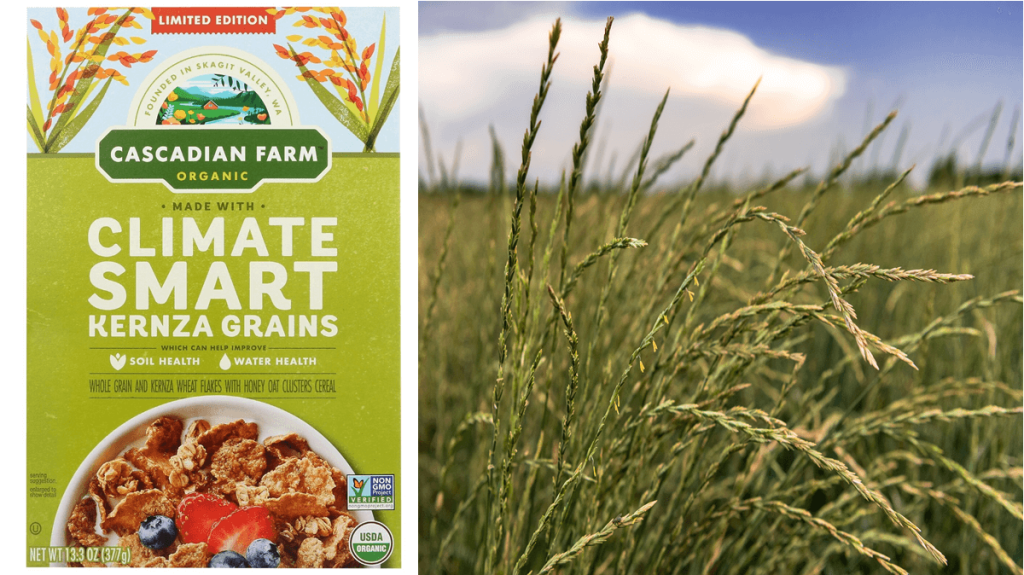
Cascadian Farm organic cereals turn up fairly often in the Grocery Outlet and I usually find them to be pretty good. Even though I’ve already reviewed Cascadian Farm cereals, I wanted to write another post about this cereal as I’m curious about Kernza, a special grain featured in the cereal, and wanted an excuse to research it.
Before I get to a description of Kernza, here are my thoughts on the cereal. It’s a limited edition product – probably limited by the amount of Kernza that’s currently grown. I really liked this cereal and would buy it again. It reminded me of a healthier (and much less sweet) version of a honey-oat cereal that I ate back a kid (something like Honey Bunches of Oats). It has decent nutritional profile (see below) with a pretty good amount of fiber & protein and not too much fat or sugar. Thanks to this, it provided a pretty filling breakfast that kept me going while avoiding a sugar spike and crash. Like all Cascadian Farms, the ingredients are certified organic. It costs $1.99 for a 13 oz. box at the Grocery Outlet, so it’s affordable to try right now.
What is Kernza?
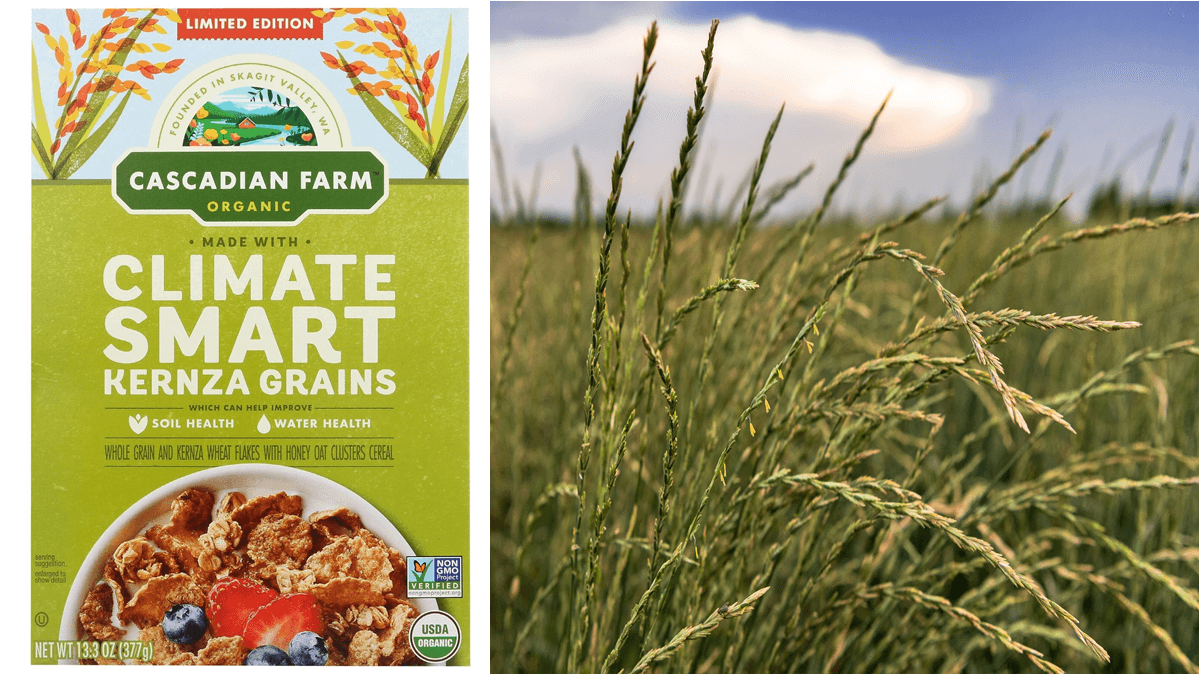
Kernza is basically a perennial grain – unlike wheat and other grains that need to be planted each year, Kernza’s roots survive in the soil over winter and produce a crop each year for a few years. The grain, an intermediate wheatgrass (Thinopyrum intermedium) was developed and trademarked by The Land Institute. Founded in 1976, The Land Institute is a non-profit that’s self-described as “a science-based research organization working to develop an alternative to current destructive agricultural practices.”
Kernza® grain plants are deeply rooted. The roots can extend 10 feet or more beneath the soil surface, delivering atmospheric carbon to the soil and efficiently taking up nutrients and water.
Kernza is still an experimental crop, only planted on a few thousand acres globally and it’s not going to be taking over your supermarket shelves until crop yields improve. For now you can find Kernza in niche products such as this cereal and a couple of products (beer and pasta) from Patagonia. You can also buy Kernza as a whole grain or flour from Perennial Pantry (almost $10 for 14 oz.) if you’d like to try baking with it. Here’s what Patagonia has to say about the grain:
A revolutionary new grain called Kernza® is igniting a movement to feed the world while restoring damaged soils and protecting groundwater from nitrogen pollution.
Kernza is a perennial, remaining in place year after year. This allows it to develop a complex web of roots that nourish the microbiome of the topsoil. Meanwhile, those penetrating roots allow the plant to find underground water and nutrients that remain inaccessible to annuals.
Patagonia also mentions some nutritional advantages of Kernza over its annual cousin, wheat:
Compared to annual wheat, a better source of fiber, plant-based protein, and essential amino acids. Kernza also contains higher levels of the carotenoids lutein and zeaxanthin.
Is Kernza more sustainable than wheat?
First off, wheat is a pretty good crop when it comes to nutritional value and environmental impact. So the bar is fairly high here, compared to foods that have the most negative impacts on the planet, such as red meat. Long story short, Kernza is a work in progress – right now, the cons outweigh the pros when comparing the environmental impact of Kernza relative to wheat.
The main reason for this is that the yield per acre for Kernza is much lower than that of conventional wheat. Yields of around one quarter those of conventional winter wheat can be achieved in year 1 and while one study reported a slight increase in yield for year 2 a critical look at several published studies reports that yields tend to decline from year 2 onwards (see table, below). To me, this drop in yield over time could be the biggest issue with Kernza – if the yields drop after year one then is there any benefit to it being a perennial crop?

Since we’d like to feed the planet without further deforestation it’s important to grow crops with fairly good yields. Since four times the amount of land is needed to grow Kernza instead of wheat, it’s no secret that the yield of Kernza needs to improve and this is a major research focus of The Land Institute.
However, if Kernza yields can be sufficiently improved (doubled, at a minimum) then there’s a good likelihood that the crop offers some advantages over annuals such as wheat or rice. The benefits could include reducing water pollution and herbicide use, increasing biodiversity, preventing soil erosion and storing soil carbon.
Here’s another interesting aspect of Kernza – flour made from the grain is almost 20% protein (close to the protein content of meat). Compare that to conventional wheat flour, which is around 12% protein, and you can begin to see the benefits of Kernza.* Many studies on the environmental impact of food (such as Poore and Nemecek’s seminal paper) evaluate the footprints (land, water, energy, etc.) in terms of the nutritional content of the food. So if the further development of Kernza led to a variety with even 60% the yield of wheat then we’re close to parity on a protein level. In other words, if we think of the yield in terms of protein rather than grain, the two crops become almost equivalent with these yields (Kernza at 60% the yield of wheat) particularly if Kernza’s yield can be maintained for two or three years.
*Even the 12% protein content in regular wheat is decent – we underestimate wheat, dismissing bread as just a carb.
Perennial crops are generally a good thing (think of a walnut tree that can produce nuts for years) and the breeding of new perennial crops is one goal of the sustainable agriculture community. One strain of perennial rice has apparently matched the yields to annual rice over eight consecutive harvests and farmers in China have begun to adopt it. Perhaps perennial versions of other crops, such as wheat, will follow.
Cascadian Farm Climate Smart Kernza cereal – ingredients and nutrition facts
Ingredients: Whole Grain Wheat*, Kernza® Perennial Grains*, Cane Sugar*, Rice*, Whole Grain Oats*, Sunflower Oil*, Honey*, Molasses*, Crisp Rice*, Sea Salt, Rice Flour*, Natural Flavor*. Vitamin E (mixed tocopherols) added to Preserve Freshness. *Organic
All organic ingredients, but note that it’s not strictly vegan as it contains honey.

Described as “whole grain wheat and Kernza® flakes with honey oat clusters,” I did find this cereal satisfying to eat. It’s only slightly sweet – just enough to balance the whole grains – with 9 g sugar versus 5 g fiber and 5 g protein per serving. It would have been useful to list carotenoid content, if this really is a selling point for Kernza (as Patagonia had claimed).
So how does this cereal rate overall in terms of social and environmental impact? What do we know about Cascadian Farm?
Cascadian Farm, owned by General Mills
Cascadian Farm was founded in 1972 in the Cascade Mountains of Washington and is “a pioneering supporter of farmers who use practices that regenerate the land and their communities.” General Mills acquired Cascadian Farm and, in 2022, donated the home farm to the Rodale Institute, which is famous for research on the feasibility and improvement of organic farming. Now that it’s owned by General Mills there’s always a risk that Cascadian Farm’s values will be degraded. The more optimistic way of viewing this relationship is that, by acquiring Cascadian Farm, General Mills has improved its impact.
The Cornucopia Institute summarized the situation as follows:
100% of [Cascadian Farm’s] cereal and granola products are certified organic its corporate owner [General Mills] is one of nation’s largest agribusinesses involved in GMO/ chemical agriculture.
I’ve discussed this topic previously in posts on Sweet Earth and Lightlife and in a post on the Green Stars Project: Should you support vegan brands owned by less ethical corporations? I support Cascadian Farm, even though it’s owned by General Mills, as long as there’s a net benefit.
General Mills gets a C grade on Australia’s Shop Ethical! Site, which I think is fair – I would probably rate the company around 2 or 2.5 (out of 5) Green Stars today. Cascadian Farms products deserve a higher rating, however.
Ethical rating for Cascadian Farm Climate Smart cereal
I’m scoring Cascadian Farm’s Climate Smart Kernza cereal 4.5/5 Green Stars for social and environmental impact, for these reasons:
- All products are made with organic ingredients.
- The packaging is a FSC-certified (and of course, recyclable) cardboard box and inner bag.
- It’s more nutritionally dense than most cereals, many of which are not worth the packaging footprint.
- Kernza is an interesting experiment – not more sustainable than annual wheat, but it may be, someday. All paths to sustainability have to start somewhere, and providing a small market for this novel cereal while we wait for an improvement in yields is a good strategy.
- Cascadian Farm has been a leader in organic agriculture for 50 years in the US.
- Charitable donations and collaborative projects such as “The Farmland” are secondary to the products themselves, but a nice addition, representing around 2% of Cascadian Farm’s revenue for 2021-2.
- The parent company, General Mills, gets a poor ethical rating but has made some improvements lately.
- Donating Cascadian Farm’s home farm to the Rodale Institute was a nice move.
Summary scores (out of 5) for Cascadian Farm cereals and granola:

- 4.5 gold stars for quality and value
- 4.5 green stars for social and environmental impact
If you have a different opinion, please share your rating! Until next time, stay safe : )

 Grocery Outlet Ethical Bargains
Leave a comment