
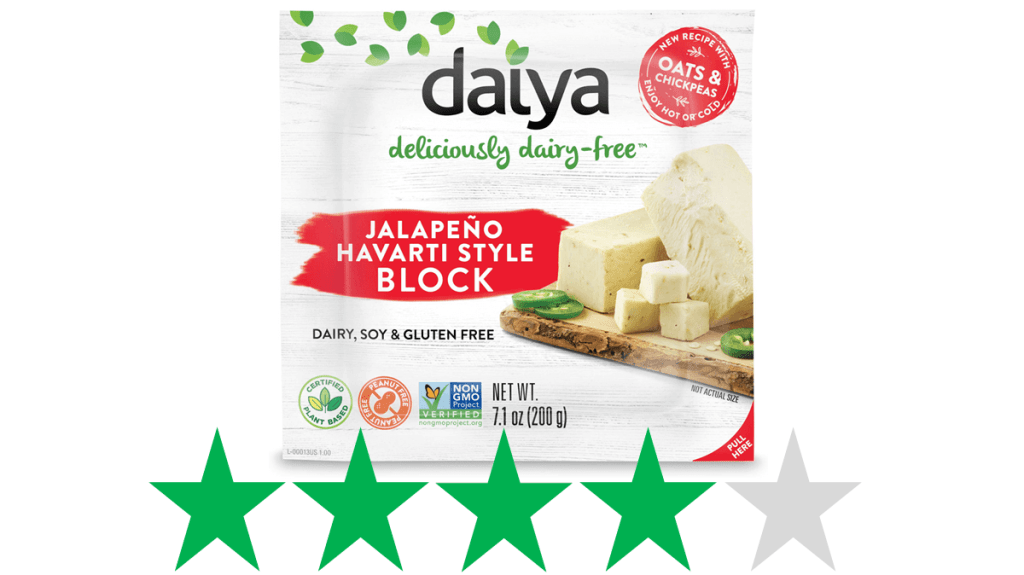
Daiya Havarti-style vegan cheese with jalapeño is available for $2 at the Grocery Outlet and I’d recommend trying it. You may be tired of trying plant-based cheeses but hang in there – we do seem to be reaching a turning point. Many vegan cheeses that you’ll find in a supermarket are made from coconut oil and potato starch and often not a lot else. Some of these cheeses are good enough for some purposes, usually melted and combined with other things. Not many of them are so delightful that you’d want to eat them on their own, especially not cold. But every now and then I find a product that shows me that things are improving!
In a previous post, I featured Nurishh vegan Camembert, which I actually bought in Ireland (every now and then I’ll feature items of interest even when not bought at the Grocery Outlet). This was my first time in a while finding a vegan cheese in a supermarket that made me want to write a blog post about it. You can find soft ripened plant-based cheeses that resemble brie and Camembert in specialty stores but they are harder to come by in supermarkets. In this post, I’m taking a look at a Havarti-style cheese from Daiya as I think it’s also worth mentioning.
Daiya jalapeño Havarti – review
Daiya actually used to make a Havarti-style cheese, but it was quite different, consisting of “Tapioca Flour, Palm Fruit Oil, Expeller Pressed Non-GMO Canola Oil and/or Safflower Oil…” However, it was quite good according to this review, which captured the issues of almost all vegan cheese 10 years ago:
When it was announced that they were coming out with sliceable wedge versions of their classic flavors I wasn’t all that excited. There was no situation I could think of that would require me to use vegan cheese slices rather than shreds. Things like cheese and crackers and grilled cheese are snack and meal ideas of the far distant past. – The Good Karma Kitchen
The trials and tribulations of a cheese lover who has adopted a vegan diet! (Or is somewhere on the vegetarian-vegan spectrum, as is my case.)
Anyway, I think there are a few main reasons why vegan cheese is becoming better, and even the Daiya Havarti from a decade ago hit one of them.
How plant-based cheese is going to get better:
- Ingredients beyond starch and oil that help create a better texture.
- Ingredients that add flavor! Heat, acidity, sweetness, umami, etc.
- Fermentation (e.g., by lactic acid bacteria) and/or ripening (e.g., by a surface mold).
I think the Havarti reviewed above on The Good Karma Kitchen had one of these elements: heat from the jalapeños. Perhaps it also got the texture right – the review mentions it being creamy and delicious even served cold and on its own.
The current Daiya Havarti that I just tried also did well on both texture and flavor. It doesn’t undergo any ripening process as far as I know, while Havarti from dairy milk usually undergoes interior ripening for around three months. Daiya, like many vegan cheese makers, has recently started experimenting with fermentation/ripening methods and a new range of products should be available in the near future.
The texture of this cheese is definitely different to most starch + coconut oil cheeses that I’ve tried – it’s much creamier. That’s due to the additional ingredients including oat milk (the main ingredient) and a little chickpea protein and flour. Like the older Daiya Havarti, it seems, the amount of jalapeño is just enough to make the cheese interesting without being dominated by heat.
I had it for breakfast this morning, on toast and was surprised at how good the cheese was without needing to be melted or any additional toppings. I actually removed the banana from another piece of toast to have more Havarti on top! (I did eat the banana afterwards!) It was even better combined with ripe tomato and some seasoning. But even on its own it passed an essential test that most plant-based cheeses fail, unfortunately: I wanted more of it : )
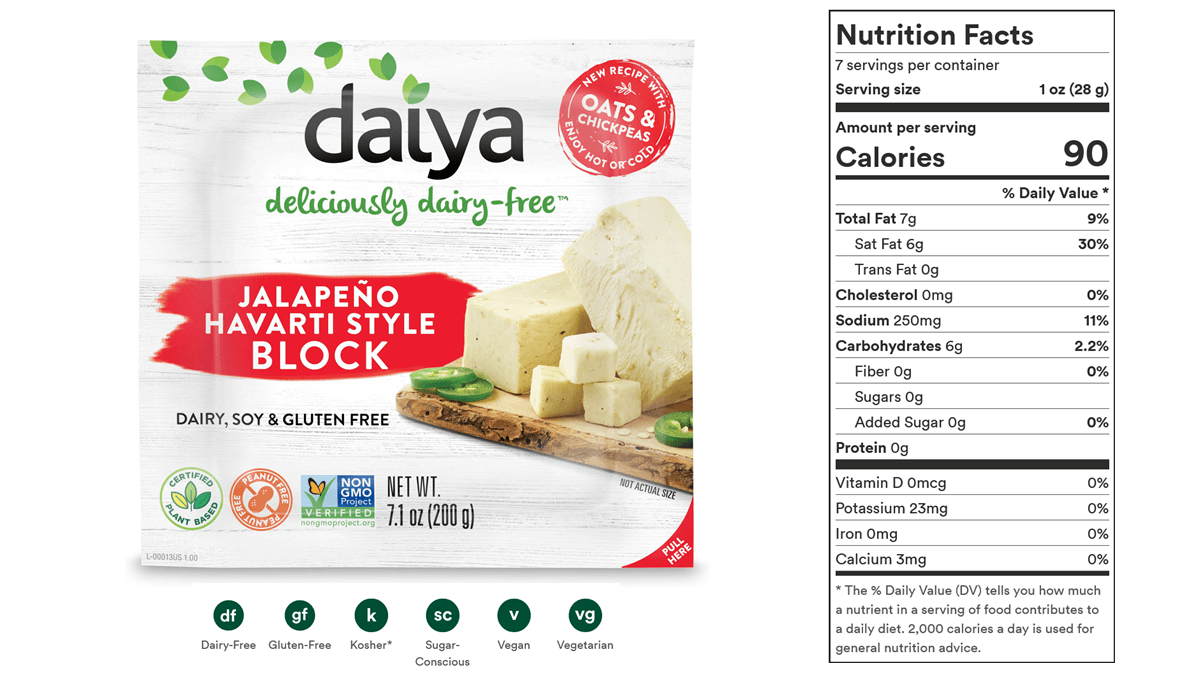
Daiya Jalapeño Havarti– Ingredients and Nutrition Facts
By the way, Havarti is capitalized as it’s named after a region in Denmark where a famous cheesemaker once worked.
Ingredients: Oat Base (Filtered Water, Oat Flour), Coconut Oil, Modified Potato Starch, Green Jalapeno Peppers, Natural Flavors, Salt, Chickpea Protein, Chickpea Flour, Garlic, Lactic Acid, Fruit and/or Vegetable Juice Color
Daiya – social and environmental impact
I’ve never looked into Daiya before so let’s see… The first thing that I came across is news of Daiya’s ownership change in 2017.
Daiya ownership by Otsuka Pharmaceutical
Otsuka Pharmaceutical Co., Ltd. (Otsuka), a wholly owned subsidiary of Otsuka Holdings Co., Ltd. and a global holistic healthcare company dedicated to bettering the health of people worldwide, today announced that it has entered into a definitive agreement to acquire 100 percent of Daiya Foods Inc. (Daiya), a privately held Vancouver, Canada-based company specializing in the manufacture of plant-based foods. The acquisition, reported at 405 million Canadian dollars, is expected to help increase Daiya’s presence throughout North America and beyond, while creating a global plant-based platform. – Daiya Foods blog.
Before we cancel Daiya for being owned by a Pharma company, take a look at this GSP post on whether you should always support vegan brands, even when owned by corporation you don’t love. Also take a look at this thoughtful post from the Vegan Strategist that examines this quandary with specific reference to Daiya/Otsuka.
Consider also that it’s not easy making a success out of a plant-based food company. Sales of plant-based food have dropped in the last couple of years and even the best-known companies like Beyond Meat are struggling. Tactics used by the meat and dairy industry are ruthless and sometimes brutal – including direct harassment of plant-based food companies.
Bottom line: we are walking a tightrope right now with climate change. Turning our backs on plant-based food companies for taking reasonable measures to survive is not the solution.
Has Daiya changed since the sale to Otsuka Pharmaceutical?
Funnily enough, there has been a positive change in Daiya’s Havarti product since the change in ownership. The Havarti they made a decade ago used mainly palm oil as a source of fat, while now it’s coconut oil. This is an improvement – there are exceptions, of course, but coconut oil is generally more sustainable than palm oil.
Daiya maintained its status as an independent subsidiary after acquisition by Otsuka. There seem to be positive things going on: avoidance of food waste by donations to food banks and applications in progress for B-Corp certification and LEED (Leadership in Energy and Environmental Design) certification for their Vancouver production facility and HQ.
Daiya don’t actually have a lot of information on topics like ingredient sourcing – I had to go to the WebArchive to check their website as it’s actually down for a makeover at the moment. But I appreciate the items above, and also the efforts to reduce packaging waste.
Ethical rating for Daiya jalapeño Havarti
I’m scoring Daiya jalapeño Havarti 4/5 Green Stars for social and environmental impact, for these reasons:
- All Daiya products are vegan. Adopting a plant-based diet is one of the top things (the top thing for many people) that we can do to mitigate climate change, deforestation, and food security.
- The main ingredients are oats, coconut oil and potato starch. Generally speaking, oats and potatoes are good from a sustainability perspective and coconut oil is better than the palm oil Daiya used to use.
- Packaging for the Havarti was plastic film, but pretty minimal. Obviously not zero-waste but it’s compatible with a low-waste lifestyle.
- Daiya has applied for B-Corp certification. The company has also applied for LEED certification for the main Vancouver facility.
- Daiya collaborates with Food Mesh, which links food banks to companies that sometimes have excess food to donate. Daiya has donated over $600k worth of food, avoiding over 200 tonnes of CO2 emissions.
- Daiya could definitely do more to communicate on company operations and impact. Hopefully the new website will include some of that!

Summary scores (out of 5) for Daiya jalapeño Havarti:
- 4.5 gold stars for quality and value (relative to the average vegan cheese)
- 4 green stars for social and environmental impact
If you have a different opinion, please share your rating! Until next time, stay safe : )
 Grocery Outlet Ethical Bargains
Leave a comment