
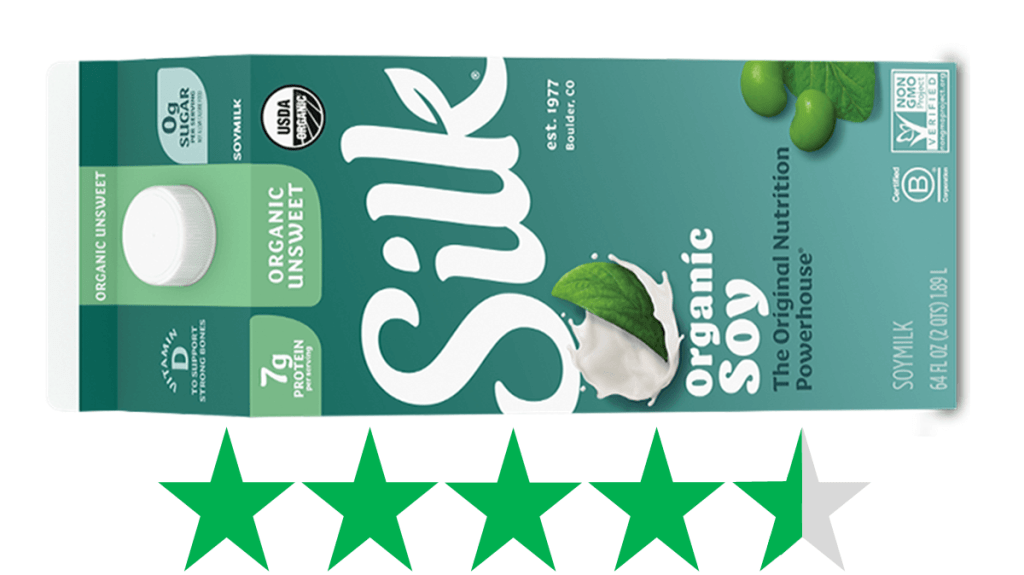
Silk Organic Soymilk (Unsweetened) is available on discount at the Grocery Outlet – it’s only $1.50 for a half-gallon carton, compared to around $4 to $5 in other stores. I picked it up to try it out for the first time, but I was feeling a little skeptical, to be honest. I was skeptical for two reasons: one, when I tried soy milk (years ago) I didn’t like it very much and two, I didn’t think Silk had a particularly good reputation for either taste or social & environmental impact. However, I wanted to give soy milk another try and was hopeful that this organic soy milk, with few additives, would be a better option than whatever I had tried before. Also, I was curious to research Silk to figure out how it rates for social and environmental impact.
As far as taste goes, I actually did like this organic soy milk, so consider me converted! I’ve been trying lots of plant-based milks lately, in the name of research, and I would buy this one again – in fact I did buy it again! It works well in cereal and although it’s not completely neutral in coffee, it didn’t interfere too much with the flavor and blended in well. Probably the biggest selling points for me were the nutritional value – it’s basically made from just organic soybeans and water, with some added vitamins. My policy on milk is that if you’re going to unleash another carton (or bottle) on the world then it better at least be nutritionally dense.
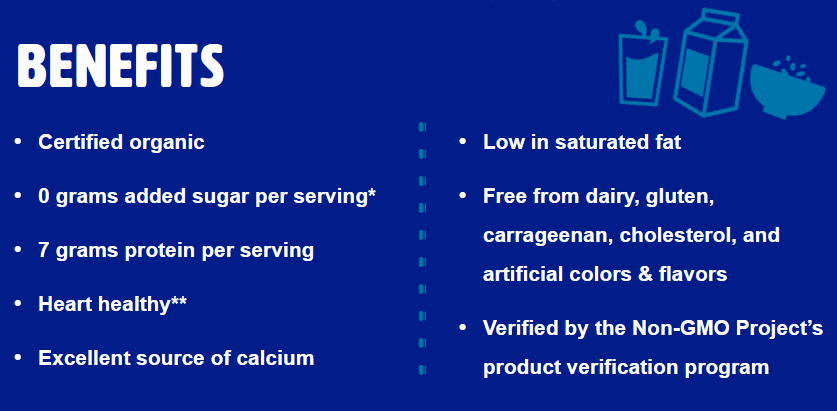
Silk Organic Soy Milk – Ingredients and Nutrition Facts
Ingredients: Organic Soymilk (Filtered Water, Organic Soybeans), Contains 2% or Less of: Vitamin and Mineral Blend (Calcium Carbonate, Vitamin A Palmitate, Vitamin D2, Riboflavin [B2], Vitamin B12), Sea Salt, Gellan Gum, Ascorbic Acid (Vitamin C To Protect Freshness), Natural Flavor.
Silk’s organic soy milk is almost as simple as it gets, in terms of ingredients – it’s mostly organic soybeans and water. The added vitamins and minerals are not a bad idea, I think, as people who transition to plant-based diets may not always remember to take a B12 supplement. The soy milk is fortified with vitamins A, B2, B12 and D2, providing 100% of the RDA for B12, per serving and a smaller percentage of other vitamins and minerals. The 7 g of protein per serving and 4.5 g of fat (0.5 g saturated fat) are provided by the organic soybeans. The only unknown, really, is the “natural flavor,” which I guess is a trade secret.

Silk – soy bean souring
On its FAQ page, Silk provides a pretty comprehensive answer to the question: Where does Silk get its soybeans?
Our soybeans are all grown in the United States and Canada. All our soymilk is verified by the Non-GMO Project’s Product Verification Program. We employ robust testing protocols to ensure that our beans meet the highest standards of quality, consistency and safety.
Our organic soymilks are made with soybeans that are certified organic by independent agencies accredited by the U.S. Department of Agriculture (USDA), in compliance with the organic standards set by the National Organic Program (NOP).
This covers the big two questions, for me, on products made from soybeans.
Where are the soybeans grown? I’ve covered the relationship between soybeans and deforestation in posts on tofu and Amazon deforestation on Ethical Bargains’ sister-site, The Green Stars Project (GSP). Long story short, soybeans for human consumption are no longer a significant driver of Amazon deforestation but it is still a good idea to know where your soybeans were grown.*
How are the soybeans grown? Several posts on the GSP have looked at evidence that a class of insecticide known as neonics is a major contributor to stress on bee populations. I believe that neonics are among the most environmentally destructive agrochemicals in widespread use. In the US, most soy, corn and sunflower is grown from seed that’s coated with neonics – they have become a default add-on for seeds from the agrochemical/seed giants. The most clear-cut way to avoid the use of neonics in the US is to buy organic soy. It’s not a concern for soy grown in Europe, as neonics are banned in the EU.
So these are two reasons for North American consumers to support organic soy that’s grown in the US or Canada. Hopefully a time will come where neonics are banned in the US.
*Improvements were due in large part to the Soya Moratorium, but are subject to political situations in Brazil and other countries. Protections against deforestation in the Amazon took a hit during the reign of Bolsonaro. Bear in mind that meat consumption (cattle grazing and soybeans grown for animal feed) is a much bigger driver of deforestation.
Silk ownership – Danone
Silk is currently owned by French multinational food corp., Danone Group. Like many multinationals, Danone is a mix of good and bad. Some of Danone’s negatives are similar to those of Nestlé – selling bottled water and pushing infant formula in developing countries. More generally, large diversified corporations tend to source ingredients via commodity markets that provide little assurance on social or environmental impact. For these reasons, I rarely buy items from multinational corporations unless the product is a move in the right direction.
Silk was launched by WhiteWave Foods in the mid-90’s and then sold to dairy company, Dean Foods in 2002. I’ve written about Dean Foods after its bankruptcy in 2019 and this is one of the reasons I didn’t particularly like the Silk brand at that point:
The company entered the plant-based milk market with their Silk brand soy milk, but came under fire for lack of transparency/integrity on their switches from organic to conventional soy beans and from local farmers to Chinese suppliers who could undercut them on price.
What’s interesting here is that Dean Foods spun off its plant-based and organic brands (Silk and Horizon Organic) in 2013 and then went bankrupt six years later. The original WhiteWave Foods management, including founder Steve Demos, left after the Dean Foods acquisition, with Demos claiming that sustainability was no longer valued. It sounds like a cautionary tale: A company acquires some relatively ethical brands but then compromises their values, probably resulting in a decline in revenue for those brands. The company eventually abandons the brands and goes back to its core business (intensive dairy farming) and then, a few later, goes bankrupt.
Silk (WhiteWave Foods) meanwhile, was independent again from 2013 until it was acquired by Danone in 2017. Is Silk a better brand again? Well, as discussed above, Silk’s soybeans are sourced from North America, so the issue with sourcing from China seems to have subsided.
Danone North America is a certified B-corporation and the B Corp score has improved from 85 when I evaluated So Delicious vegan ice cream in 2021 to a current score of 96. On the other hand, Ethical Consumer states that “Groupe Danone is far from ethical when it comes to human or animal rights.”
Personally I’m more comfortable with Silk under Danone ownership compared to under Dean Foods, but Danone certainly has issues. A few products such as this Silk Organic Soy Milk on its own merits, I think it looks quite good.
Ethical rating for Silk Organic Soy Milk
I’m scoring Silk Organic Soy Milk 4.5/5 Green Stars for social and environmental impact, for these reasons:
- All Silk products are vegan. Adopting a plant-based diet is the top thing you can do to mitigate deforestation & climate change.
- Milk made from soybeans has significantly lower carbon, land, and water footprints compared to milk sourced from a cow.
- As soybeans are sourced from North America, there is no risk of tropical deforestation.
- The soybeans are also certified organic, thus avoiding the use of neonics that threaten bees and other insects.
- 100% of the electricity used to manufacture Silk products comes directly from renewable sources, or via renewable credits.
- Producing Silk vegan dairy products requires 65% less water, on average, than conventional dairy.
- Silk is a charter sponsor of Change the Course, and has funded the restoration of groundwater and aquatic habitats in Colorado and California for 15 years.
- Danone North America, Silk’s parent company is a certified B Corporation, with a score of 98.
- The cardboard in the refrigerated carton packaging is technically recyclable but a specialized facility to separate it from the plastic lining. If it ends up in landfill (which in many cases it will) it’s at least composed mainly of cardboard, a renewable material.
- Danone North America, Silk’s parent company is a certified B Corporation, with an improving score.
- However, Danone does have many issues as a result of the major sources of income being bottled water, dairy, and palm oil products (infant formula). Organic soy milk is one of their better products so you could say you’re supporting a step in the right direction by buying it.
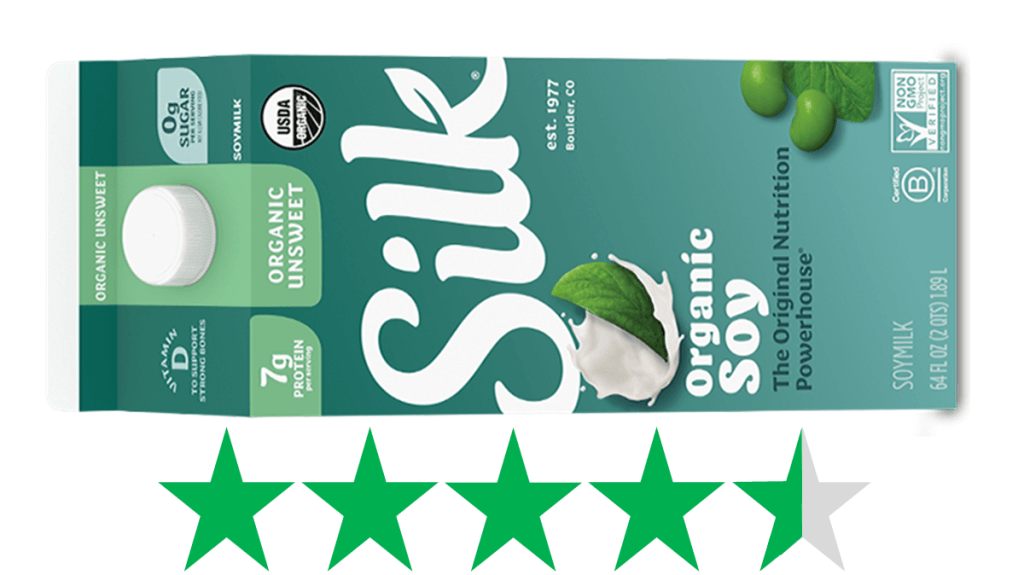
Summary scores (out of 5) for Silk Organic Soy Milk:
- 4.5 gold stars for quality and value
- 4.5 green stars for social and environmental impact
If you have a different opinion, please share your rating! Until next time, stay safe : )
 Grocery Outlet Ethical Bargains
Leave a comment