
I’m happy to report that the vegan breaded shrimp from Sophie’s Kitchen are really good – surprisingly good. I’ve found vegan alternatives to fish to be fairly hit and miss – a lot of misses, to be honest. Perhaps I’m just not a huge fan of products made from fish (e.g., crab cakes) – or their plant-based alternatives. However, fried breaded shrimp (scampi) used to be one of my favorite foods back when I ate fish. Sophie’s Kitchen vegan version brought me back to my childhood – it’s actually a very good replica of shrimp.
I cook them in a little oil (not much) until brown and then place them on paper napkin to adsorb any excess oil. The only thing I add to them is salt (fancy salt – fleur de sel – but still just salt) and I found them to be so good that I ate them all quite fast. I served them to three non-vegetarian friends who all liked them and thought they were similar to the real shrimp in texture and taste – and they are harsh critics 😉
I highly recommend trying them out – you can buy them at the Grocery Outlet at the moment for only $1.50 per box. The key ingredient is a konjac, a gelatinous substance that has been used in Asia for centuries.
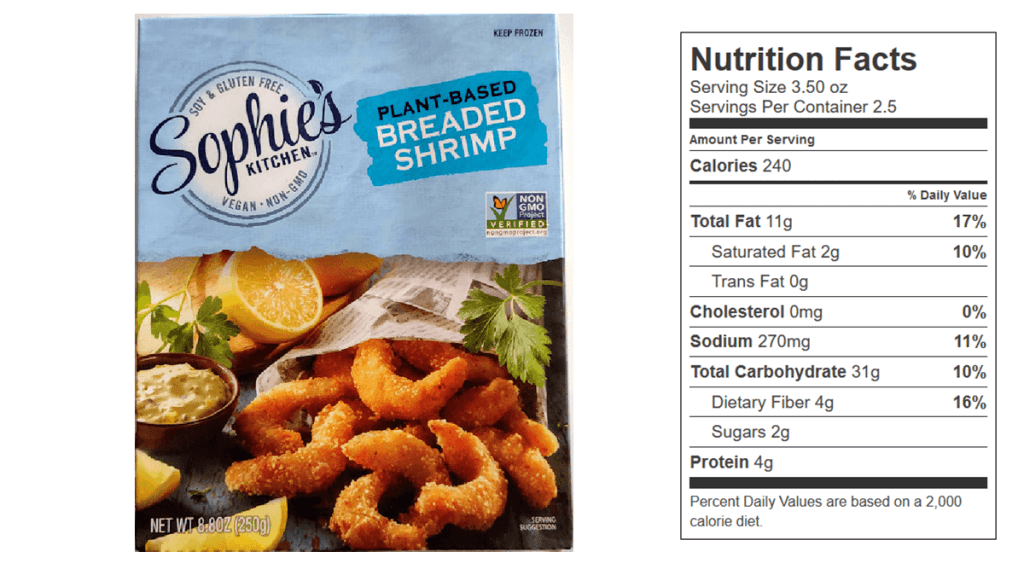
Sophie’s Kitchen vegan breaded shrimp– Ingredients and Nutrition Facts
Ingredients: Water, Rice Flakes (from Brown Rice), Canola Oil, Potato Starch, Konjac Powder, Pea Starch, Fenugreek, Organic Agave Nectar, Sea Salt, Alginate(from Seaweed), Paprika, White Pepper, Turmeric, Calcium Hydroxide.
The ingredients are interesting – it might be easy to miss the key ingredient that gives the vegan shrimp its shrimp-like texture: konjac.
Our products are made with konjac root (also known as konjaku and elephant yam), pronounced kon-jack. This ancient superfood is a staple across Southeast Asia and very popular in traditional Japanese cuisine. It is low in calories and high in fiber.
Yes – lots of fiber (4 g per serving), an equal amount of protein, and not too heavy on saturated fat or salt.
What is konjac?
Konjac, or konnyaku refers to the plant Amorphophallus konjac, which contains an edible underground stem (corm). Konjac is used in Asian countries as a vegan substitute for gelatin in desserts and jellies, and to make “noodles” and vegan seafood. Because of its gelatinous texture and slightly fishy flavor, it has become a popular ingredient for plant-based seafood, particularly vegan shrimp.

Sophie’s Kitchen was one of the first companies to sell vegan seafood made from Konjac in the US, if not the first. I remember trying Sophie’s vegan calamari more than a decade ago and really liking them. There are now several brands of vegan shrimp available – one of them, BeLeaf, won the best vegan seafood award at the 2022 World Plant-Based Awards. I highly recommend trying out vegan shrimp such as Sophie’s because it avoids the social and environmental issues linked to regular shrimp.
Social and environmental issues with shrimp
Shrimp, the most popular seafood in the US, is also the most lucrative marine product in the world, valued at around $50 billion. Here are a few quotes from a CalAcademy post on sustainable seafood:
About half of shrimp production is caught by boats that drag nets across the bottom and the remainder is farmed in bays and along shorelines, largely in the tropics. Shrimp trawling has a century-old tradition and is decreasing, whereas shrimp farming is undergoing an explosive gold rush expansion, and both practices contribute to widespread environmental damage.
Shrimp Farming:
The problem with shrimp rearing is a combination of the devastation of mangroves, the nursery grounds for many fishes and invertebrates, the antibiotic-laden food, the use of pesticides, excessive freshwater usage, and the consumption of vast quantities of fish stocks to feed these carnivorous crustaceans. The lifespan of a shrimp pond rarely exceeds 5 – 10 years. When yields decline, ponds are often abandoned and due to the latent chemical and mineral modifications, are useless for other crops. By the last century’s end, more than half of the world’s mangrove forest had been destroyed, and half of that was due to shrimp farming, a practice equivalent to the clearcutting of coastal forests. At this time such destruction is accelerating.
Shrimp fishing by trawling:
The downside of shrimp trawling is less apparent than that of shrimp farming but equally depressing. Imagine, a fleet of 13,000 boats dragging nets that scrape the bottom of the Gulf of Mexico, a practice that is 100 years old. Catches of shrimp as well as mackerel, snapper, croaker, and a host of other creatures have steadily declined as a result of the wasteful bycatch clearcutting—more appropriately called “bykill.” Worldwide, shrimp fisheries discard 9.5 million metric tons of dead and dying non-shrimp creatures (including many endangered marine turtles) at a ratio often as great as ten pounds of bycatch to one of shrimp.
For more on shrimp sustainability, check out the Monterey Bay Aquarium’s SeafoodWatch guide to shrimp.
In 2014, the Guardian exposed human rights issues in the shrimp / prawn industry off the coast of Thailand: Revealed: Asian slave labour producing prawns for supermarkets in US, UK.
A six-month investigation has established that large numbers of men bought and sold like animals and held against their will on fishing boats off Thailand are integral to the production of prawns (commonly called shrimp in the US) sold in leading supermarkets around the world, including the top four global retailers: Walmart, Carrefour, Costco and Tesco.
A follow-up article, published in 2018, revealed that not enough progress had been made:
Thailand’s billion-dollar seafood export industry remains infested with human rights abuses despite government pledges to stamp out slavery in its fishing industry, according to research by Human Rights Watch.
Besides avoiding some of these potential issues vegan shrimp, probably more than any other plant-based seafood, is not a sacrifice in experience.
Ethical rating for Sophie’s Kitchen vegan breaded shrimp
I’m scoring Sophie’s Kitchen vegan breaded shrimp 4/5 Green Stars for social and environmental impact, for these reasons:
- A vegan product. Adopting a plant-based diet is the top thing you can do to mitigate deforestation, climate change, animal cruelty, and the negative impact that the meat industry has on society.
- Shrimp in particular can have large significant social and environmental downsides such as human rights issues, the destruction of mangrove habitats and a high by-kill impact of bottom trawling. Choosing vegan shrimp avoids all of these issues.
- Not organic but GMO-certified – this does tend to avoid the heavy application of herbicides that goes hand-in-hand with plants engineered for herbicide resistance.
- Packaging is a cardboard box and inner plastic bag.
- Sophie’s Kitchen website seems to be defunct and information on the company is hard to find.

Summary scores (out of 5) for Sophie’s Kitchen vegan breaded shrimp:
- 4.5 gold stars for quality and value
- 4 green stars for social and environmental impact
If you have a different opinion, please share your rating! Until next time, stay safe : )
 Grocery Outlet Ethical Bargains
Leave a comment